
From Kibbutz to the global stage
From Kiryat Gat to Cairo via Washington
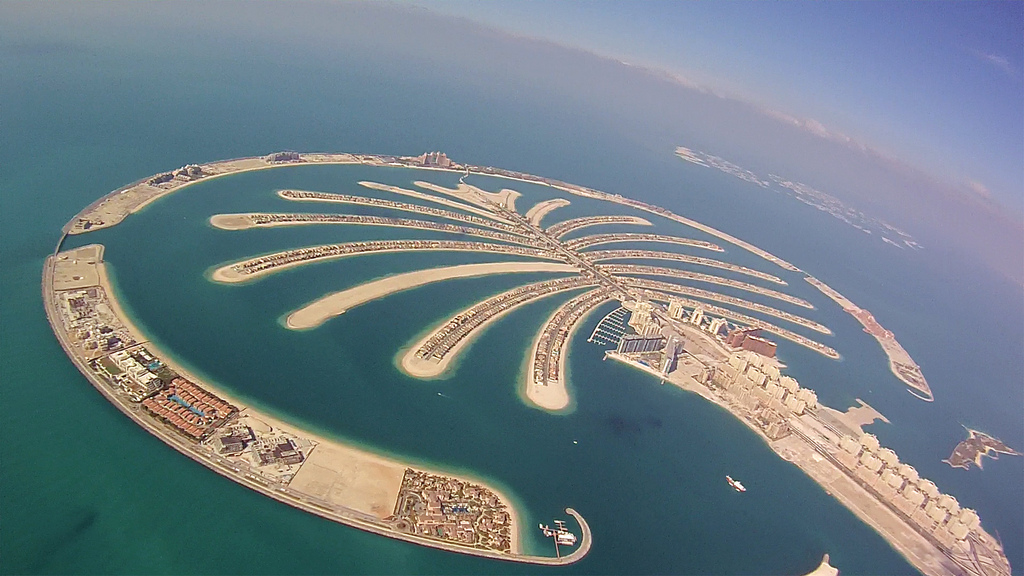
Aerial view of Palm Jumeirah, Dubai. Source: Wikimedia Commons, CC BY-SA 4.0.
From Kiryat Gat to Cairo via Washington
Is Gaza’s Reconstruction About to Begin?
Over recent weeks, a sequence of diplomatic steps has unfolded that suggests the transition from negotiations to reconstruction in Gaza may have already begun. Many of these developments were anticipated in earlier analyses published here, often days or even weeks before they materialized:
- September 12: First description of the emerging US concept for a ceasefire and phased reconstruction after the Doha strike.
• September 20: The introduction of a man-made island solutionoff Gaza’s coast, repurposing debris for desalination and green-energy infrastructure, which sparked significant attention (over 17,000 views).
• October 1: An argument that American strategic interests would drive a regional peace initiative.
• October 13: A forecast that Minister Tzachi Hanegbi’s position had become politically untenable due to the Qatar portfolio. Days later, he was removed.
• October 18: A clear shift identified from US declarative policy to operational planning.
• October 22: Analysis of the growing gap between Israel’s diplomatic rhetoric and practical policy on the ground.
Today, following US Secretary of State Marco Rubio’s visit, and President Trump’s notably strategic meeting with Qatar’s emir aboard Air Force One, Washington’s intent appears unmistakable: the center of gravity is moving from diplomacy to reconstruction.
The Hostages: A Critical Humanitarian Trigger
Multiple diplomatic sources acknowledge that if the coming days bring the return of the bodies of Israeli hostages held in Gaza, it will serve as a defining humanitarian signal. Such a gesture would not only offer sacred closure to bereaved families. It would unlock the next phase of the international stabilization and reconstruction mission.
This linkage between the return of the fallen and accelerated reconstruction has been emphasized repeatedly in these pages. Quietly, it is now guiding decisions at the highest levels among Washington, Cairo, and Doha.
If this step materializes imminently, it will mark the moment the reconstruction process moves into a significantly faster gear. If delayed, the process still continues, though at a slower operational tempo.
Egypt Steps Forward
At the Sharm el-Sheikh summit, President el-Sisi announced that Cairo will host an International Gaza Reconstruction Conference in early November, dedicated to physical rebuilding and long-term environmental recovery. The framework presented to the Arab League emphasizes:
- A phased and sequenced rebuilding model
• Environmental sustainability
• Full coordination with the United States and Europe.
The Two Core Plans Already Driving Policy.
Media reports in Ynet and Globes closely track two existing masterplans:
- Egypt’s “Gaza 2030”:
Cairo leads the civilian reconstruction corridor from Rafah northward, including housing, water, power, and logistics. - The U.S. Framework(rooted in RAND studies and the “Great Trust for Gaza” concept):
International oversight, secure funding mechanisms, and “pilot zones” enabling accelerated rebuilding in Hamas-free areas.
Together, they strongly resemble “Trump Plan 2.0”, incorporating Saudi, Emirati, and European participation.
The Scale of the Task: Toward 100 Billion Dollars.
Published estimates of 50 billion USD cover only above-ground reconstruction. Updated UN figures (October 2025) raise the number to 70 billion USD, excluding underground remediation.
The underground network of tunnels may add 20–30 billion USD, pushing the realistic total to 100 billion USD over a 10–20 year horizon.
The Largest Debris Challenge in Modern Urban History
- 60–70 million tonsof rubble
• No available land inside Gaza large enough to absorb it
• Egypt rejects dumping in Sinai
Technical inevitability leads to a maritime solution: debris would be repurposed as engineered infill.
This revives the concept of:
- A man-made island, and
• A westward coastal expansion
Both previously evaluated in Israel during 2017–2018 feasibility studies.
A Combined Solution: A New Coast and a New Island
The emerging approach integrates:
- A widened coastline near Gaza City for civilian and industrial infrastructure
• A strategic international island hub near Rafah including:
– A seaport
– A regional airport
– Desalination and power facilities
– A free-trade zone
This model enables debris removal, new land creation, and regional economic cooperation under U.S.–Egyptian leadership with European regulatory involvement.
The Critical Step: Operational Command Already Established
Security and diplomatic sources confirm that the Kiryat Gat coordination facility, built by the United States, is now functioning as a Joint Reconstruction Command Center, comprising:
- Senior Egyptian intelligence (led by Gen. Abbas Kamel)
• U.S. military officers
• COGAT representatives
• European liaison officers
An American general has been appointed to command the site, alongside a senior U.S. civilian administrator. Joint geospatial mapping and subterranean engineering data are already being processed.
Additionally, U.S. drones have begun monitoring the ceasefire from above Gaza.
Cairo Conference: Early November
Scheduled between November 3–5:
- Egypt introduces the full “Gaza 2030” vision
• The U.S. announces symbolic and financial commitments
• The UN provides political mandate
Delegations are expected from Germany, France, the United Kingdom, Gulf partners, and others. Senior U.S. envoys such as Brett McGurk or Steve Witkoff may attend.
Strategic Implications
Washington and Cairo appear to be assuming a joint mandate:
Egypt manages, the U.S. supervises, and a global fund pays.
Israel transitions from a battlefield actor to an indirect reconstruction partner through liaison channels and the Kiryat Gat operations center.
Where the Artificial Island Fits In
The environmental and logistical constraints leave little alternative to a maritime expansion strategy. Based on discussions with international engineering teams, including the UAE’s MBRSC, the concept is already on the table.
The difference this time: it is tied not only to vision, but to necessity.
Conclusion: The Audacity of Peace
Some Israelis support the effort, others fear the risks, and many remain skeptical. Yet history teaches that those who dare are those who prevail, in war and in peace.
One day, perhaps, future generations will walk the new shoreline, swim at Gaza’s rebuilt beaches, or visit a thriving artificial island off Rafah.
Whether that vision becomes reality depends not only on Washington and Cairo, but on us Israelis: our confidence, our courage, and our willingness to seize a historic opening.
Image: Dubai’s Palm Jumeirah, representing the type of concept proposed off the Gaza coast.
Related Topics