From Light to Peace: The Journey Hidden in My Son’s Name
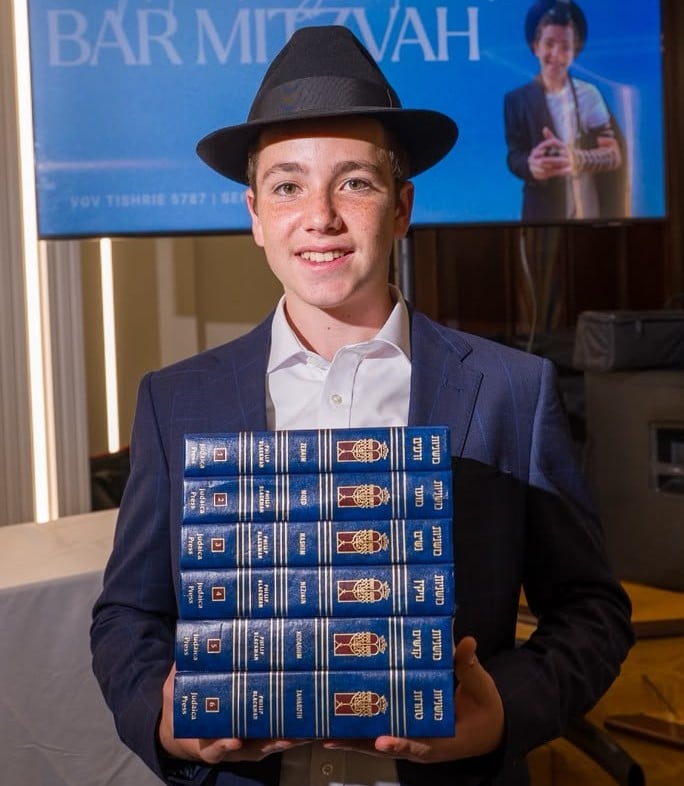
Yesterday, my son Meir Shalom turned 13. We celebrated his Bar Mitzvah with his classmates, our many relatives, and a few friends. Tomorrow morning, the celebration continues for the entire community at Chabad, where Meir will lead the services and read from the Torah, followed by a delicious two-course Kiddush.
Everyone is invited to join us and share in the joy of this special milestone!
But for me, the highlight of yesterday’s celebration was not the music or the food. It was watching my son complete a journey he began four years ago.
Meir finished studying the entire Mishnah.
The Mishnah is the foundation of the Oral Torah and the basis of nearly every discussion of Jewish law that has followed in the 1,800 years since it was written. It contains 63 tractates, 525 chapters, and almost 4,200 individual Mishnahs covering everything from prayer and holidays to marriage, business, agriculture, and the Temple.
Watching my thirteen-year-old son complete this daunting mission brought tremendous nachas and joy to my wife and me. There is no greater happiness than seeing your child succeed at something so big.
Yet, as I thought about the heartfelt emotions I wanted to share this week, I wanted to do more than just publicly express the pride and gratitude I feel for my son. I wanted to offer him a blessing that could also become a blessing for every one of us.
My son’s name is Meir Shalom.
Meir means “to shine.” Shalom means “peace.”
When we gave him that name thirteen years ago, we had no idea that it would one day describe his entire journey through the Mishnah.
The very first Mishnah begins by discussing the appropriate time to recite the evening Shema. The final ruling is that you can recite the nighttime Shema until the first light of the sun begins to shine upon the horizon.
If you think about it, it is fascinating that the first Mishnah begins at night. It begins in darkness. Yet it is in defining the night that we move towards the morning light that begins to appear on the horizon.
Then, after 63 volumes and thousands of individual teachings, the Mishnah reaches its final words. It teaches that G-d found no vessel capable of containing His blessing other than peace. It concludes with the verse, “G-d will give strength to His people; G-d will bless His people with peace.”
This final word is our son’s second name, Shalom, which means peace.
The Mishnah begins with the glow of light in the darkness, and it ends with the blessing of peace.
Meir Shalom.
But this is more than a beautiful connection between a boy’s name and the books he studied. It is the story of the Torah itself.
The Torah begins with G-d’s first declaration: “Let there be light.” Let the universe I just created, first and foremost be a place of illumination and Divine light.
Yet the Torah does not end with light.
The final verse of the Torah speaks of Moses’ greatness, describing the mighty acts he performed “before the eyes of all Israel.” Rashi explains that this phrase refers to Moses breaking the first tablets after the sin of the Golden Calf.
We begin with light, but we end with broken tablets.
Yet, breaking the tablets is not the end of the story.
It is the beginning of the process of reconciling G-d and the Jewish people. It was only after Moses broke the tablets of a covenant we had already violated that he could plead for our forgiveness, carve a second set of tablets, and create the opportunity for Teshuvah, repentance and return.
The Torah begins with light, but it ends with something even more powerful: the peace and love between G-d and us, created through forgiveness and reconciliation.
This journey from the beginning of the Torah to its conclusion, and from the beginning of the Mishnah to its ending, also describe the Ten Days of Repentance in which we now find ourselves.
Last week, on Rosh Hashanah, we celebrated the birthday of humanity. We were placed in this world for a purpose. We are here to bring light into places that seem dark, and to reveal the presence of G-d through the way we live and behave.
But the story of life rarely remains as idyllic and romantic as it was in the beginning, when Adam and Eve were placed in the Garden of Eden. The story begins with beautiful hopes and idealistic plans. Then life happens. We become distracted. We make mistakes.
Things break.
Even sacred things can break.
Even the tablets made by G-d Himself could break.
But the breaking of the tablets was not the end of the story. Moses broke them to protect the Jewish people. He broke them so that we could receive a second chance. He then returned to Mount Sinai and pleaded for our forgiveness.
Moses’s greatest and most enduring act was bringing peace between us and G-d once again. It was when Moses came down the mountain on Yom Kippur carrying the second tablets that he reached the greatest pinnacle of his career.
The great symbol of Yom Kippur is not failure. It is the second set of tablets. It is the possibility that brokenness can be followed by forgiveness and that conflict can be followed by peace.
This is the journey from the Torah’s opening words in Genesis, with the creation of light, to its final verse, where Moses’ breaking of the tablets opened the path toward reconciliation.
This is the journey from the first Mishnah, moving from the darkness of night toward dawn, and leading us to the final Mishnah with its blessing of peace.
This is the human journey from our birthday on Rosh Hashanah to our second chance to make things right on Yom Kippur.
This is the journey from Meir to Shalom.
We all began the new year with light. We stood on Rosh Hashanah and thought about the people we wanted to become. We made dreams and resolutions for a better year ahead.
Yom Kippur asks us to turn that light into peace. To fix what somehow did not go according to plan. To make the phone call we have avoided, and to offer the apology we have been postponing.
Because light that doesn’t help us see another person in pain has not yet fulfilled its purpose.
Peace does not mean that we must always agree. It means caring enough to repair what can be repaired. It means making room for another person, for forgiveness, and for G-d.
So, my dear Meir, my blessing to you is that the tremendous amount of Torah you have learned should help you become worthy of both of your names.
May you be a true Meir. May you illuminate your own life and the lives of others with your wisdom, intelligence, sensitivity, and love for learning. May you use your knowledge to provide greater clarity, warmth, and closeness to G-d to those you know.
And may you be Shalom.
May you bring people together. May you respect those who think differently from you and learn to live peacefully even with those you think are not as smart as you.
True Torah learning should never cause a person to feel above someone else. It should make us more peaceful and kind. More patient and more humble.
And may this blessing be for us all.
May we all increase our Torah learning, and through that learning increase the light we bring into our homes, our community, and the world.
But may the Torah we learn never remain only on the page. May it increase our willingness to repair what has broken, and to increase in Shalom between one another.
May we enter Yom Kippur ready to bring light into our personal darkness and peace into any fractured relationships we may have.
With heartfelt blessings that we all be sealed for a good and sweet year, full of light and peace.
Good Shabbos!
Rabbi Yankie & Chana Denburg