Thinking about 'Resilient Zionism'
From Miriam’s Well to Resilient Zionism: Financing Israel’s Next Stage
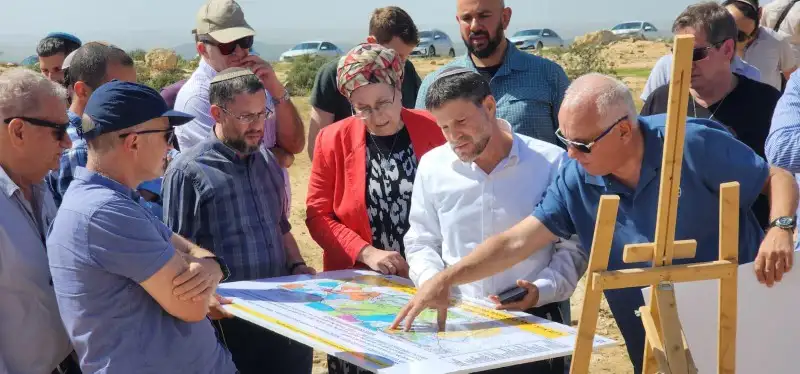
Israel's Finance Minister Bezalel Smotrich and Settlements Minister Orit Strock review development plans during a recent strategic tour of the Negev region. Source: Government Spokespersons
This week in Israel, we read Parshat Chukat, which records Miriam’s death in a single, almost understated verse: “Miriam died there and was buried there.” Immediately afterward, the Torah tells us that the people had no water. The Midrash saw in this juxtaposition something profound. Miriam’s presence had sustained the people in the wilderness. In her merit, the people had water. With her passing, the people suddenly confront the terrifying question of how a nation survives when the miraculous source that carried it until now is no longer there.
That question feels painfully relevant today.
Since October 7, Israel has lived through a period of extraordinary emergency mobilization. Israel’s civil society stepped forward with remarkable courage. Much like the wilderness generation, we have seen moments of almost miraculous resilience. But the narrative of Miriam’s passing and the ensuing dramatically tragic event of Moses smiting the rock in this week’s Torah reading remind us that a people cannot live forever on emergency miracles. At some point, water must become infrastructure. Courage must become institutions. Vision must become implementation. And national resilience must become something that can be financed, measured and sustained.
That is why the recent government decision to allocate NIS 180 million toward the establishment of pioneer neighborhoods in Mevo’ot Arad and along Route 25 in the Negev is significant. It is not only a budgetary announcement. It is a signal that the state understands that settlement, regional development and national resilience require practical systems: roads, water, housing, public services, economic anchors and the ability to move from planning to families on the ground.
But this decision also points to a broader opportunity: the emergence of outcome-based blended finance structures in Israel.
Israel’s post–October 7 reality has created vast financing needs and opportunities: rebuilding communities, strengthening the Negev and Galilee, restoring trust in vulnerable regions, supporting agriculture and food security, developing resilient infrastructure and creating local economic opportunity. Government budgets and philanthropy will remain essential, but they will not be enough. The scale of the challenge requires models that can mobilize and de-risk additional capital and ensure that money is tied to measurable results.
This is where blended finance becomes highly relevant.
Blended finance brings together public, philanthropic and private capital in a single structure. Government can define priorities and support enabling infrastructure. Philanthropy can provide catalytic or first-loss capital. Private investors can bring scale and discipline. Implementers can bring local knowledge and operational capacity. At its best, blended finance is not charity dressed up as investment. It is a mechanism for aligning risk, return and national purpose.
The Israeli Forum for Impact Economy’s recent work on blended finance is therefore timely. It gives local language and structure to a field that Israel urgently needs to develop. It recognizes that recovery, growth and resilience require more than donations or isolated government allocations. They require financing frameworks that connect capital to outcomes.
Consider the new communities in the Negev. A government allocation can help fund initial infrastructure and accelerate early settlement. That is crucial. But what happens next? How do we ensure that these communities become economically productive, socially cohesive and financially sustainable? How do we attract aligned capital into agriculture, renewable energy, tourism, education, local enterprise and resilient infrastructure?
An outcome-based blended finance model could help answer these questions.
Public capital could support enabling infrastructure and define the desired outcomes: such as families settled, jobs created, agricultural land brought into productive use, renewable energy installed, local businesses launched, water efficiency improved and community services established. Philanthropic capital could absorb early-stage risk and fund planning and technical assistance. Private capital could then finance revenue-generating assets. The question would no longer be only: Was the budget spent? It would become: Did the investment create the resilience it was meant to create?
That shift matters.
Outcome-based finance introduces discipline into idealism. It insists that values must be translated into implementation. It asks whether a new community is not only established, but thriving. Whether infrastructure is not only built, but enabling economic life. Whether agriculture is not only planted, but strengthening food security and stewardship of the land. Whether public money is not only allocated, but leveraged.
This is especially relevant in the Negev, where settlement, governance, infrastructure, employment, agriculture and security are deeply interconnected. Blended finance can help connect these pieces. It can turn a government allocation into a platform. It can turn philanthropy into catalytic capital. It can turn private investment into a partner in national resilience.
In Parshat Chukat, the people stand thirsty in the desert. The story is not only about water. It is about transition. The generation that left Egypt is giving way to the generation that will enter the Land. The question is no longer only how to be redeemed from slavery, but how to build a society capable of living in its own land.
That is our question too.
The State is actively allocating capital toward strategic regional development. The Israeli impact-economy field is beginning to articulate blended finance in a locally relevant way. Philanthropic actors are looking beyond emergency giving toward long-term rebuilding. Investors are increasingly focused on infrastructure, resilience and real-economy opportunities. The pieces are there. What is needed now is architecture.
Parshat Chukat reminds us that a people journeying toward its land must learn to transform faith into systems of sustenance. For Israel today, that means transforming courage into infrastructure, philanthropy into catalytic capital, public budgets into measurable outcomes, and resilience into a durable national economy.
Now is the time for outcome-based blended finance in Israel.
Related Topics
Related Posts