Greek Jewish roots. New York voice. Unfiltered perspective.
Mayor Mamdani, October 7 Was Not Your Day To Rewrite
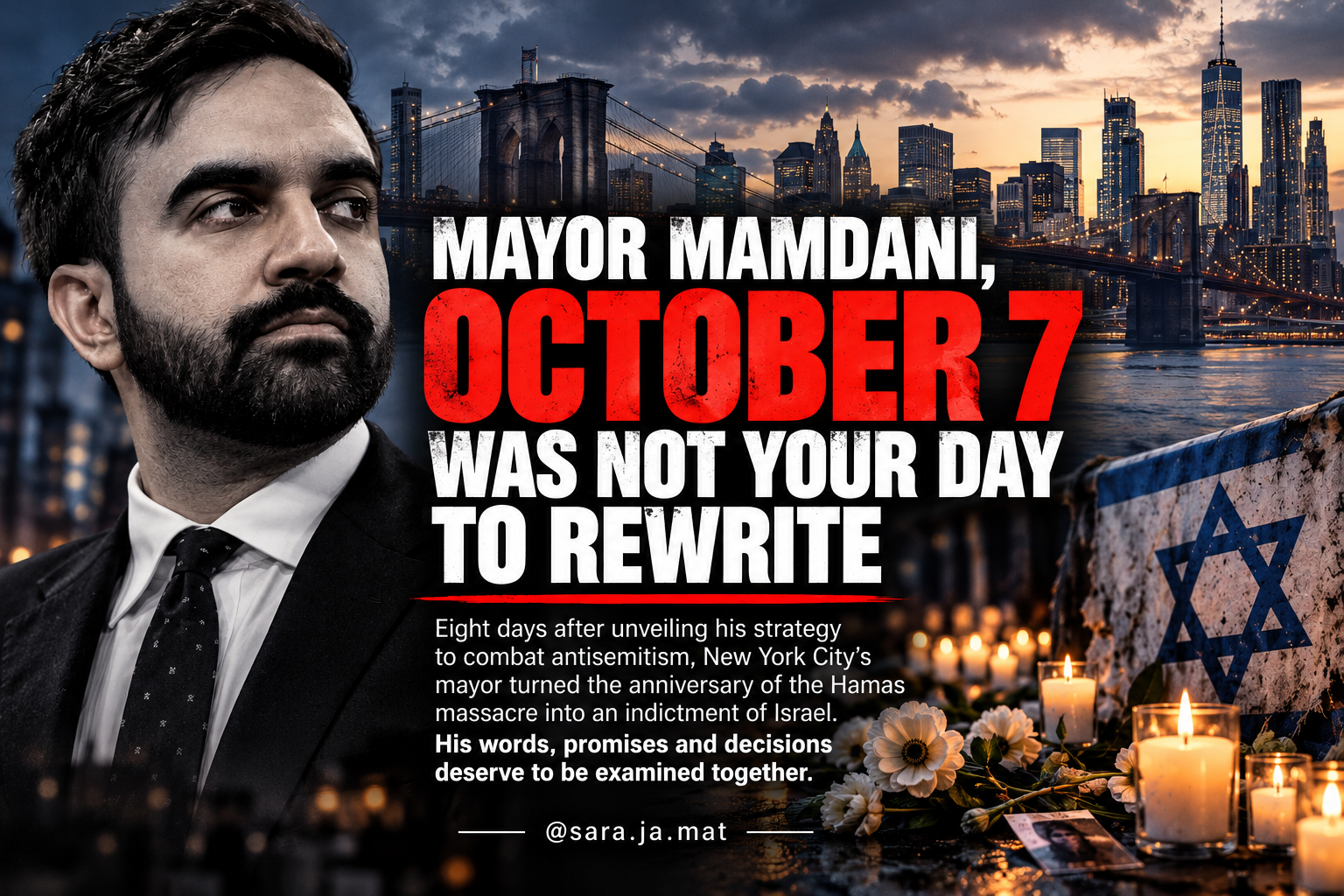
Eight days after unveiling his strategy to combat antisemitism, New York City’s mayor turned the anniversary of the Hamas massacre into an indictment of Israel. His words, promises and decisions deserve to be examined together.
I wasn’t planning to write a fifth article about Zohran Mamdani.
But apparently, the mayor has no intention of running out of material for me.
And yesterday, October 7, of all days, he gave me another reason to write.
On September 22, I published Moral Clarity: Put It All on the Board, the fourth installment of my investigation into New York City’s mayor.
Four articles. Months of research.
His associations. His executive orders. His decisions. His promises to Jewish New Yorkers.
I established one rule:
If I can prove it, put it on the board.
If I can’t, take it down.
I even defended Mamdani when a four-second video from the September 11 memorial circulated without sufficient context. I acknowledged the extraordinary NYPD security provided for the Israel Day Parade, despite his decision not to attend.
Because intellectual honesty means applying the same standard to everyone.
Including people whose politics I oppose.
Yesterday, Mayor Mamdani gave us something new.
His own words. Published by his own office. On the third anniversary of the deadliest attack against Jews since the Holocaust.
The entire statement is available on the City of New York’s website.
So let’s read it.
THE DAY WAS OCTOBER 7
Three years ago, Hamas-led terrorists invaded southern Israel.
They murdered families in their homes.
They attacked the Nova music festival.
They abducted 251 people.
Approximately 1,200 people were killed.
Parents. Children. Grandparents. Friends.
Young adults who went dancing and never came home.
These were not abstract casualties in a geopolitical dispute.
And for the Jewish people, October 7 became another date permanently carved into our collective memory.
A day to remember the murdered, honor the survivors and acknowledge families whose lives were permanently altered.
And that was the day New York City’s mayor chose to issue his statement.
THREE SENTENCES. THEN THE PIVOT.
Mamdani began by acknowledging the Hamas attacks.
He called them war crimes, recognized the deaths of more than 1,100 Israelis and the abduction of 251 people, and expressed grief.
Those acknowledgments belong on the board.
But then came the pivot.
“The suffering did not begin nor end that day.”
From there, his statement described Israel’s military campaign as an “ongoing genocide,” cited Palestinian casualty figures, condemned American financial support and invoked occupation and apartheid.
Suddenly, a statement commemorating October 7 had become a sweeping indictment of Israel.
Civilian suffering in Gaza is real. Civilian deaths deserve serious attention.
But none of those principles requires turning the anniversary of a massacre into an argument against the country where it occurred.
October 7 was not the day to make the murdered defend the policies of their government.
The mayor could have addressed Gaza on October 6.
He could address it today, October 8.
He has an entire year to discuss international affairs, despite holding an office without authority over American foreign policy.
But on October 7?
Was it impossible to allow the victims to remain the focus?
MAYOR MAMDANI, WHY COULDN’T YOU SAY THE WORD JEW?
Mayor Mamdani, I have a question that deserves a direct answer.
Why did your October 7 statement omit the words “Jew,” “Jewish” and “antisemitism”?
Not once did you explicitly identify the Jewish people as the targets of the deadliest antisemitic massacre since the Holocaust.
Hamas did not leave its ideology to our imagination.
Hamas’s 1988 founding covenant invoked killing Jews and Israel’s destruction. Its 2017 political document did not recognize Israel’s legitimacy. After October 7, senior Hamas official Ghazi Hamad spoke openly of repeating the attack a second, third and fourth time.
Hamas’s intentions did not have to be inferred.
Mayor Mamdani, knowing this history, why did you commemorate the massacre without explicitly identifying the Jewish people?
You have promised to protect Jewish New Yorkers.
You have announced millions in antisemitism prevention initiatives.
You have spoken about making Jewish residents feel safe and celebrated.
Yet on October 7, you omitted the very word Jewish.
Why?
Identifying the Jewish victims of Hamas is not an endorsement of any Israeli government.
It is historical accuracy.
NO, OCTOBER 7 IS NOT A GENERIC DAY OF SUFFERING
There is another argument I want to address.
The suggestion that commemorating October 7 requires equal attention to suffering on both sides of the subsequent war.
No.
Not because innocent Gazan civilians do not deserve compassion.
But because a commemoration has a specific historical subject.
On International Holocaust Remembrance Day, we remember Holocaust victims. We do not redirect that commemoration toward German civilian suffering during World War II.
German civilians suffered too. Their history deserves examination. But Holocaust remembrance has a specific historical subject.
So does October 7.
And let us not sanitize October 7.
Hamas and other attackers filmed and circulated footage of their own violence.
I watched some of it.
I wish I hadn’t.
Three years later, those images have not left me.
I remember footage of a man being attacked and beheaded. Images of bodies burned beyond recognition. Murdered children. Devastated families. Accounts of sexual violence against women and men.
I remember wondering how human beings could deliberately inflict such suffering.
The United Nations Independent International Commission of Inquiry documented killings, hostage-taking, and sexual and gender-based violence during the October 7 attacks.
A separate UN mission reported reasonable grounds to believe that rape and gang rape occurred at multiple locations.
I do not need to exaggerate October 7 to explain its horror. The documented atrocities are horrifying enough.
Hamas launched the attacks. Its fighters and other perpetrators committed atrocities that helped unleash a devastating war. Those responsible for these crimes must answer for their actions, and that responsibility must never disappear from the historical record.
But none of that changes the purpose of October 7 remembrance.
October 7 has its own victims. Its own survivors. Its own historical meaning.
And they deserve to remain at the center of that day.
EIGHT DAYS EARLIER, THE PROMISES
On September 29, 2026, Mayor Mamdani unveiled New York City’s first municipal Strategy to Combat Antisemitism.
The administration announced or highlighted:
$6.4 million in grants to combat hate and support survivors.
$1 million for security at synagogues and other houses of worship.
$2 million toward the Queens Holocaust memorial.
$2.5 million for the Center for New Jewish Culture in Brooklyn.
A broader $26 million investment in the Office for the Prevention of Hate Crimes.
But there is a distinction between announcing funding and demonstrating results.
Reporting indicated that the $2 million memorial allocation and $2.5 million cultural-center allocation had previously been announced under the prior administration.
What was genuinely new?
What was inherited?
What has actually been disbursed?
What measurable protection has resulted?
A press conference is not the same thing as an implemented program.
And even if every dollar were new, there remains a question no budget line can answer.
Can a mayor earn a community’s trust through security announcements while leaving that community questioning his judgment on the anniversary of its worst massacre in generations?
PROTECT YOU. CELEBRATE WITH YOU. MOURN ALONGSIDE YOU.
In Part IV, I returned to Mamdani’s inaugural commitments.
Protect you.
Celebrate with you.
Mourn alongside you.
Never hide from you.
I took those promises seriously.
I still do.
Which is why his words and actions surrounding October 7 matter.
On October 2, NY1 reported that Mamdani’s administration was threatening legal action against Columbia University unless it reopened College Walk to the public.
The pedestrian passage had been restricted following campus protests.
The city argued that a decades-old agreement required public access. Columbia maintained that it had the legal authority and responsibility to manage access and protect its community.
This was a dispute over property rights and public access.
But the safety question remains legitimate.
Mayor Mamdani, how do you reconcile the demand for immediate public access with Columbia’s stated security concerns? What protections would your administration put in place?
And then came October 7.
On the third anniversary of the Hamas massacre, protesters gathered outside City Hall, where participants chanted:
“Resistance is justified when people are occupied.”
Read those words again.
On October 7. Outside New York City Hall.
On the anniversary of an attack in which Hamas terrorists murdered, abducted and sexually assaulted civilians, protesters were chanting that resistance was justified.
Mayor Mamdani, what exactly did they mean by resistance?
Were they referring to peaceful demonstrations? Or were they defending the violence carried out on October 7?
That distinction is not optional. It is the entire question.
And it demands an unequivocal response from the mayor of New York City to clearly say that the murder, kidnapping and sexual assault of Jewish civilians can never be justified as resistance.
Say that no political grievance excuses those crimes.
Say that anyone using the anniversary of October 7 to celebrate or excuse the massacre is repudiating the very principles of civilian protection your administration claims to defend.
You do not have to suppress lawful protest to condemn a message.
And you do not have to agree with Israel’s government to reject the justification of atrocities against Jews.
The First Amendment protects political expression. It does not require the mayor to remain silent about rhetoric that can be understood as excusing violence against civilians.
I have not verified that Mamdani endorsed the chant, heard it personally or issued a response specifically addressing it.
But the question remains:
Mayor Mamdani, will you condemn the justification of the October 7 atrocities, explicitly and without qualification?
Because protecting Jewish New Yorkers cannot mean announcing security grants one week and leaving them guessing about your position on the glorification of violence the next.
Protection is not only a budget line. It is also the willingness to draw an unmistakable moral line.
Later that evening, Mamdani attended a Union Square remembrance vigil organized by Israelis for Peace.
He stood among people listening to testimonies and remembering lives lost.
That matters.
It belongs on the board.
But the vigil was disrupted by protesters who shouted over the proceedings. Some directed their anger at Mamdani himself, accusing him of betraying their cause.
The mayor’s presence deserves acknowledgement.
So does the experience of mourners whose remembrance was interrupted.
The mayor’s public commitments, legal decisions and responses to demonstrations should be evaluated together; not selectively.
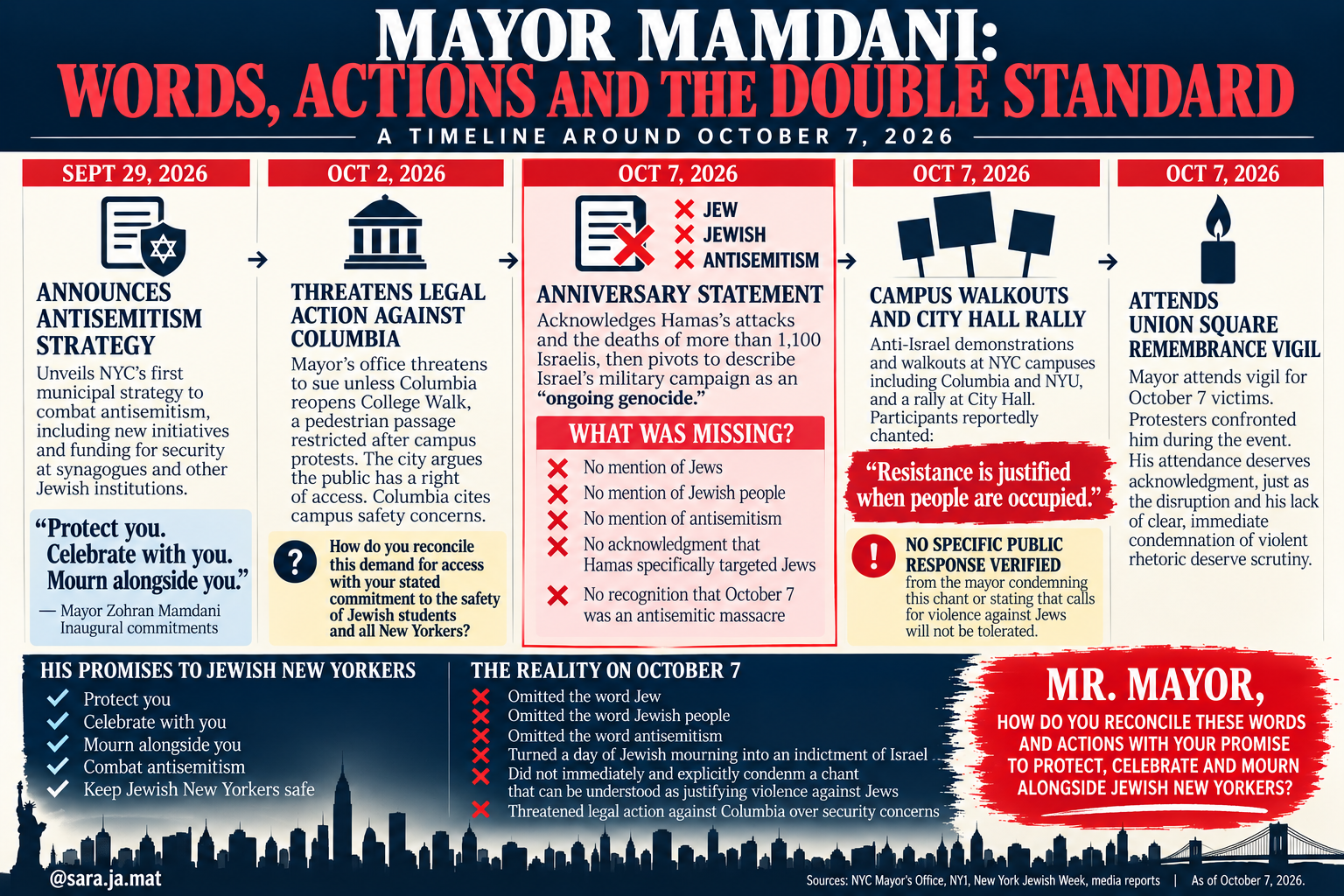 October 7, 2026: Mayor Mamdani’s public statements and actions, from his antisemitism strategy to the anniversary commemorations. Editorial graphic by @sara.ja.mat.
THE WORD GENOCIDE IS NOT A SUBSTITUTE FOR EVIDENCE
There is another issue. Of course there is.
Mamdani did not merely criticize Israel’s conduct.
He described its military campaign as an ongoing genocide.
That is an extraordinarily grave accusation.
Genocide has a specific legal meaning under the 1948 Genocide Convention. It requires prohibited acts committed with the intent to destroy, in whole or in part, a protected group.
The legal analysis cannot be reduced to casualty totals alone.
Israel disputes the genocide accusation and maintains that its military operations have targeted Hamas, not civilians.
And Israel’s extensive efforts to protect civilian lives are not merely assertions. They are documented: millions of leaflets, telephone calls, text messages, recorded warnings and evacuation instructions intended to move civilians away from military operations.
Retired US Army Major John Spencer, an urban-warfare expert who served two tours in Iraq, has studied these methods extensively. In his March 2024 Newsweek analysis, he concluded that Israel had implemented more precautions to prevent civilian harm than any other military in history, including measures exceeding those used by American forces in Iraq and Afghanistan. Spencer argued that the IDF had established a new standard for urban warfare, one other militaries should learn from.
Now consider how Hamas operates. Its extensive tunnel network beneath densely populated areas is well documented, and its fighters have operated in civilian clothing. This is not merely a battlefield disguise. It blurs the distinction between combatants and civilians, making it easier for Hamas to portray its dead fighters as civilian casualties and use those figures in its propaganda campaign against Israel, a tactic examined in the Henry Jackson Society’s 2025 report on Hamas’s human-shield strategy.
And where were Gaza’s civilian bomb shelters and warning systems? Israel invested in Iron Dome, protected spaces and public alerts. Hamas built an extensive underground military network. Why has the absence of comparable civilian protection in Gaza, and Hamas’s responsibility for its military infrastructure, received so little scrutiny?
Mayor Mamdani, three years have passed. Three years.
You have had ample time to examine Israel’s civilian-warning measures, the military use of civilian areas by Hamas, the tunnel network built beneath Gaza, and the absence of comparable civilian shelter infrastructure.
Have you examined that evidence? Have you acknowledged it publicly? Have you ever demanded that Hamas answer for the protection it failed to provide Gaza’s civilians?
Because if you have examined these facts, why are they conspicuously absent from your October 7 statement? And if you have not, on what basis do you speak with such certainty about genocide?
Three years is ample time to ask questions, examine evidence and confront facts that challenge your conclusions. Ignorance is no longer a convincing excuse.
Mayor Mamdani, you cannot demand moral accountability from Israel while treating Hamas’s conduct as an afterthought—or, more accurately, not a thought at all. And you cannot claim moral clarity while leaving inconvenient evidence out of the picture.
You have had three years to examine the record. The question now is not whether the evidence exists. It is whether you are willing to confront it.
The International Court of Justice case brought by South Africa has involved provisional measures, but those measures are not a final judgment establishing genocide.
So here is my second direct question.
Mayor Mamdani, how does your office distinguish a legal allegation of genocide from a final judicial finding when issuing official statements?
What legal standard did your office apply?
Which findings did it rely upon?
Why did your statement present the conclusion without explaining its contested judicial status?
You are entitled to your interpretation of the evidence.
But when you speak through the Office of the Mayor, the public is entitled to know the legal and evidentiary basis for your assertions.
Political conviction does not relieve a public official of the obligation to distinguish investigative findings, allegations and judicial rulings.
And a grave accusation does not become more legally established simply because a politician delivers it with greater certainty.
I HAVE BEEN THERE
In 2024, I traveled to Israel while the war continued and hostages remained in Gaza. I met survivors, soldiers and grieving families. At Sheba Medical Center, I met people whose lives had been transformed by October 7 and the war.
I listened. I asked questions.
And I watched a grieving country continue living. People worked. Children played. Families gathered.
Some of those people became part of my life. They were not talking points. They were human beings.
And yesterday, on the third anniversary, I published October 7 Didn’t Give Me a Voice. It Taught Me What My Voice Was For.
I wrote about the people I met, how those encounters changed my life and what it means to refuse to surrender one’s identity to fear.
And I wrote as the daughter of a Greek Holocaust survivor who died just twenty-five days ago.
My father understood what happens when Jewish lives become abstractions in somebody else’s political argument.
I cannot ask him what he thinks of yesterday’s statement.
But I know the standard he taught me.
Know your history. Examine the evidence. And never allow political convenience to replace moral responsibility.
THE MAYOR OF ALL NEW YORKERS
Mamdani is entitled to his political convictions.
He is entitled to criticize Israel.
He is entitled to advocate for Gazans.
And Jewish New Yorkers are entitled to challenge his judgment without being accused of demanding ideological conformity.
The office of mayor requires representing a city whose residents carry different histories, traumas, loyalties and fears.
New York is home to one of the world’s largest Jewish communities.
Its mayor has an obligation to protect that community from antisemitism, whether its members are religious or secular, Zionist or anti-Zionist, supportive or critical of Israeli government policy.
His obligation to protect Palestinian New Yorkers is equally real.
These responsibilities are not mutually exclusive.
But leadership also requires judgment about context, language and timing.
There are days for political arguments and policy announcements. And there are days when public office demands simply recognizing grief.
October 7 was one of those days.
THE WOLF WAS NEVER HIDING
Three years have passed since October 7, 2023.
Three years since families were slaughtered in their homes. Since young people were hunted at a music festival. Since children were taken hostage.
And three years later, Zohran Mamdani’s statement has left me questioning whether he understands what that day means to the Jewish people.
But we have learned something.
We can examine what he says through the words he chooses, the positions he defends and the decisions he makes.
In September, I began this investigation with a question:
What If the Wolf Never Hid?
Then came Now the Wolf Has the Keys.
Then Now Watch What He Does With Them.
And finally, Moral Clarity: Put It All on the Board.
Today, I return to that first question.
Perhaps the mistake was assuming there was ever a disguise to uncover.
The wolf, as I have described him throughout this series, is no longer even bothering with sheep’s clothing.
That is my conclusion after examining the public record. Readers can examine the same evidence and reach their own.
He promised to protect Jewish New Yorkers.
He promised to mourn alongside them.
And on the anniversary of their darkest day in generations, he chose to make his official statement about Israel’s alleged crimes.
The promises are on the board.
The funding announcements are on the board.
The Columbia dispute is on the board.
The demonstrations and the mayor’s documented responses are on the board.
And now his October 7 statement is on the board.
No rumor. No speculation. No missing context.
Just his words.
His choices.
His record.
The wolf was never hiding.
We were simply waiting to see whether the mayor would prove us wrong.
Related Topics
Related Posts