From Kibbutz to the global stage
From Muscat to Washington: How a US-Iran Deal Could Emerge Beyond the Noise
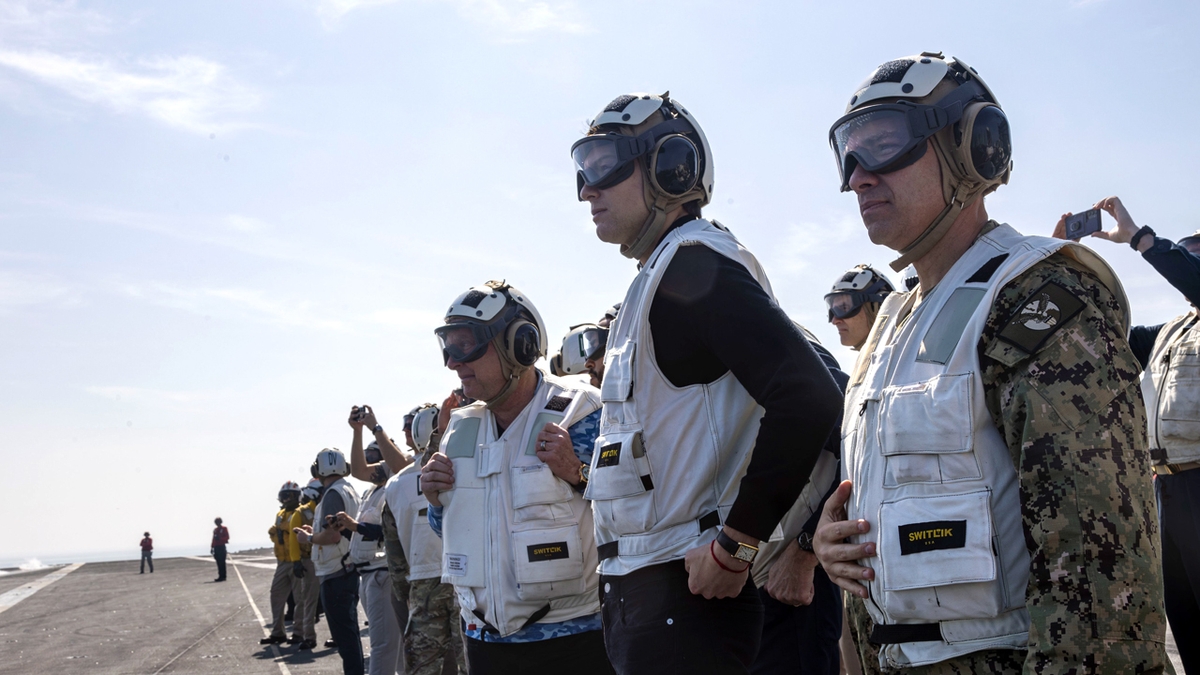
Image: Steve Witkoff and Jared Kushner flew on Saturday to the USS Lincoln in the Arabian Sea. Source: CENTCOM / X)
Since last Wednesday, the crisis between Iran and the United States has felt like watching a multi-screen film: in each arena, a different version of the same drama is projected, tailored primarily to domestic audiences and the political considerations of the actors involved.
In Iran, the talks were moved from Istanbul to Muscat in the Sultanate of Oman, accompanied by a change of mediators and formally framed as indirect negotiations. In practice, however, a public meeting and handshakes still took place between representatives of the American and Iranian delegations — symbolic gestures, but not insignificant ones.
The day after the first round of talks, Iran’s foreign minister appeared at an Al Jazeera conference in Doha, alongside senior officials from Qatar and Turkey. The discourse there focused sharply on Israel and the fighting in Gaza, while largely ignoring — at least in the public arena — the violent events that had preceded the talks inside Iran itself. Regarding the negotiations with Washington, the minister emphasized that a “good framework” had been established, while reiterating that “zero enrichment” was not on the table, nor was Iran’s ballistic missile program.
-In the United States, President Donald Trump presented a different picture. He described the talks as positive, stressed that the United States “has time,” and noted that parts of U.S. naval and air forces were still moving into the region — a dual message of diplomatic openness paired with implicit pressure. At the same time, Washington tightened sanctions on entities trading with Iran, with an indirect focus on China, and announced the renewal of strategic talks with Russia on ballistic missile issues — another indication of a certain warming in relations between the two major powers.
-In Israel, by contrast, the dominant tendency was to search for signs of a breakdown. The change in the venue of the talks was interpreted as a failure; the departure of the American delegation from its hotel in Muscat on Friday was portrayed as a rupture, despite the talks being defined as indirect; and Prime Minister Benjamin Netanyahu’s decision to advance his visit to Washington was seen by some commentators and segments of the public as a diversion ahead of a possible military strike. The official explanation, however, was more straightforward: an effort to ensure that Israel’s interests would be addressed within the framework of the negotiations.
Yet if one filters out the noise and the political messaging largely intended for domestic consumption, clearer contours of the substantive issues at stake begin to emerge.
From Israel’s perspective, any sustainable U.S.–Iran agreement would need to address not a single issue, but four interlinked ones:
-Limits on uranium enrichment.
-The fate of uranium already enriched.
-Iran’s ballistic missile program
-Iranian proxy activity and terrorism through militias in Yemen, Iraq, Syria, and Lebanon.
On enrichment, a compromise may be taking shape. While Tehran insists that “zero enrichment” is non-negotiable, an agreed ceiling — potentially around 20 percent — could serve as the technical basis for a temporary or phased agreement.
As for uranium already enriched to higher levels, one possible solution would involve its removal from Iran, for example, to Russia, under strict international supervision. Such a step would reduce the immediate risk of a nuclear breakout without requiring Iran to abandon its core position.
The ballistic missile issue is far more complex. In the absence of a modern air force and advanced air defense systems, Iran’s missile arsenal serves as its primary strategic deterrent. Any attempt to significantly curtail this capability on a one-sided basis is likely to encounter demands for regional balancing — potentially including claims regarding Israel’s air superiority.
This is why a different framework may be required: not direct dismantlement of capabilities, but a regional non-aggression arrangement backed by guarantees from major powers. In such a model, China and Russia would assume responsibility for restraining Iran, while the United States would provide assurances that Israel refrains from military action as long as the agreement is upheld.
A similar approach would apply to Iran’s proxy networks, where progress would likewise depend on enforceable monitoring and enforcement mechanisms supported by the major powers.
Ultimately, the durability of any agreement will depend not only on Iranian compliance but also on the ability of the major powers to demonstrate discipline, consistency, and credibility in enforcing it. In this context, it becomes clearer why coordination between Washington and Jerusalem has become so central at this stage of the talks.
Related Topics
Related Posts