
November 16: Three Carriers. Is Trump’s Final Ultimatum to Iran Approaching?
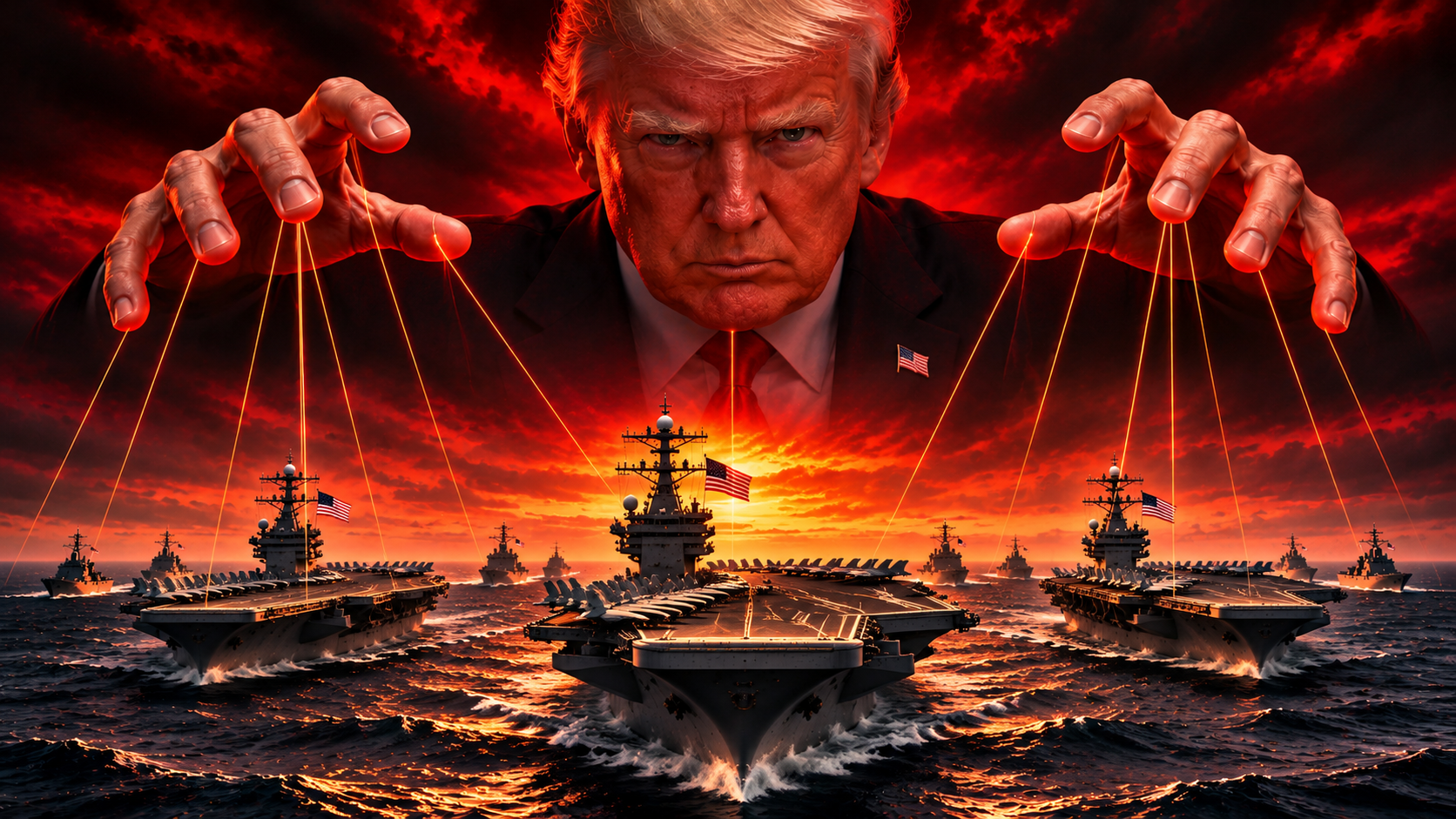
On November 9, The Maritime Executive reported that the USS Theodore Roosevelt, having left Singapore, could reach the northern Arabian Sea by November 16. The date is an estimate based on a possible 30-knot transit, not an official arrival. If the ship arrives before the USS George Washington departs, it could briefly join the USS George H. W. Bush, placing three American carrier strike groups within striking distance of Iran. The Roosevelt is expected to relieve the Washington, so a temporary overlap is plausible. But is simple rotation the whole plan, or is Trump preparing to concentrate all three before his next move?
In April, the United States also deployed three carriers—the Gerald R. Ford, Abraham Lincoln, and George H. W. Bush—during a fragile ceasefire. Their presence reinforced the blockade and pressure for a deal. The Ford later left. By then, Trump’s pattern was already clear: repeated threats of devastating strikes, deadlines issued and then extended when talks offered another opening. Even after the blockade began, the cycle continued. Iran had neither surrendered its highly enriched uranium nor yielded on the Strait of Hormuz.
The question grew harder to avoid: how many more ultimatums could Trump issue before Tehran began treating them as threats he would not carry out?
Seven months later, the picture is different. Iran has absorbed months of blockade without accepting the nuclear settlement Washington wants. The United States retains overwhelming military superiority but has not secured a verifiable resolution of the nuclear dispute. The Strait remains unstable, and energy-market disruption has raised costs far beyond the region.
On November 3, those costs contributed to a devastating midterm defeat for Trump and the Republicans. Democrats will control both chambers from January 3. Trump himself acknowledged that the war contributed to the losses.
Iran’s economy is under severe strain. The United States faces the added burden of electoral defeat and an approaching hostile Congress. On January 3, the new Congress takes office. Trump will keep his authority as commander in chief, but investigations, budget pressure, and political scrutiny could make further escalation harder to sustain.
On November 9, President Masoud Pezeshkian said Supreme Leader Mojtaba Khamenei had ordered officials to end the state of “neither war nor peace.” Pezeshkian expressed willingness to negotiate while insisting Iran would not surrender. Mojtaba Khamenei has not appeared publicly since taking power, and the account of his instructions has not been independently verified.
Trump may believe the blockade is steadily pushing Tehran toward the point where resistance becomes intolerable. Both governments face pressure to break the stalemate, yet an agreement may prove harder to reach than the decision that the current situation cannot continue. November is not April. After prolonged economic pressure, unsuccessful talks, and an electoral defeat that changed the balance in Washington, a new concentration of three carriers deserves attention.
No ultimatum has been announced, and there is no confirmation that the Roosevelt’s arrival is meant to precede one. Trump has said that further strikes against Iran are unnecessary for now, while Secretary of State Marco Rubio maintains that the blockade and sanctions are achieving their objectives without renewed large-scale combat operations. But waiting carries political risks. A Reuters/Ipsos poll published on November 10 found that 71 percent of Americans, including majorities of both parties, want Congress to pass legislation ending the war.
After January 3, Trump could find himself confronting opposition on three fronts: a Democratic-controlled House, a Democratic-controlled Senate, and an American public increasingly unwilling to support the continuation of the war.
But those statements could also serve a strategic purpose while American military assets continue moving into position. The United States has relocated military aircraft from bases in Britain following reported threats linked to Iran, including refueling tankers moved from RAF Mildenhall in November and bombers withdrawn from RAF Fairford in October. Although the precise nature of the threats remains uncertain, the precautions suggest that Washington is taking the possibility of Iranian retaliation seriously.
Trump may genuinely prefer to avoid another offensive. He may also want Tehran to believe that diplomacy remains his priority while preserving the option of overwhelming force. The words suggest restraint. But the pieces on the military chessboard are still moving.
The core demand could be straightforward: Iran surrenders its stockpile of highly enriched uranium under an internationally verified arrangement, then grants the International Atomic Energy Agency the access needed to establish the status of its program and investigate unresolved safeguards issues.
Washington’s concerns over Iran’s ballistic missiles and regional activities remain legitimate, but the enriched uranium is the decisive issue. Without its verified surrender and comprehensive international inspections, Trump could claim military achievements or diplomatic progress. He could not credibly claim to have resolved the nuclear threat that has defined the confrontation.
Such a deal would let Trump tell Americans that the blockade and diplomatic pressure had compelled Iran to relinquish its most sensitive nuclear material. Tehran could avoid another devastating offensive and open the way to a peace agreement, the lifting of the blockade, and desperately needed economic relief. Surrendering the uranium would be a major strategic concession, but it could ultimately become a matter of survival.
History, however, offers little evidence that a military or naval blockade alone can force a determined nation to capitulate. Economic devastation does not necessarily translate into political surrender. Trump may be discovering just how difficult it is to compel Tehran to relinquish its uranium through economic pressure alone.
If Tehran refuses, however, Trump may have to decide whether to carry out the military threat behind a final ultimatum.
Iranian leaders may calculate that surviving until January strengthens their hand. Trump has shown little willingness to accept outcomes he regards as humiliating defeats. Having insisted Iran must never possess a nuclear weapon, he would face high political and personal costs if the confrontation ended with an unresolved stockpile of highly enriched uranium. A temporary three-carrier concentration could demonstrate that Washington still has the capacity to intensify operations on a large scale.
Each side may see the other’s determination as a bluff. Carriers can project extraordinary power and expand the president’s options, but they cannot guarantee that an adversary will surrender. Concentrating three groups could be a final attempt to persuade Tehran that rejection would expose it to a more destructive campaign than it might face with only two. Trump may hope that the threat alone will accomplish what months of economic pressure have failed to achieve, without firing another shot.
Regardless of Trump’s midterm defeat and his repeated unfulfilled ultimatums, the naval blockade has already inflicted severe damage on Iran’s economy. A devastating American military campaign could make a return to prewar economic conditions extraordinarily difficult, potentially setting the country back for years.
Trump sees an Iranian economy under mounting pressure. Tehran sees an American president approaching a hostile Congress. Neither knows which pressure will prove decisive. The Roosevelt may arrive later than November 16, the overlap may be brief, and the deployment may prove routine. But if Trump is considering one last attempt to force a nuclear settlement before January 3, the possible concentration of three carriers could offer the moment to make his intentions unmistakable.
Iran would then face the choice between surrendering its most sensitive nuclear material and risking further destruction. Trump would face the consequences of his own ultimatum if Tehran refused. The world, already paying an economic price, would confront the prospect of renewed fighting around a critical energy corridor.
But Tehran may not wait for Trump to make the next move.
Iranian leaders could interpret the concentration of three carriers as a sign that another American offensive is imminent and decide to strike first, risking precisely the devastating response they seek to prevent.
Or Trump may decide that Iran has received enough warnings and unleash a military campaign on a scale not yet seen in this war, without another ultimatum. Or none of these scenarios may unfold. The carriers could simply rotate, negotiations could continue, and the confrontation could drag on, with Iran’s economy sinking deeper into desperation and Trump proving willing to endure whatever political consequences await him after January 3.
Trump may be running out of political time. Iran may be running out of economic time. Neither appears willing to surrender.
Three aircraft carriers could help Trump deliver a final ultimatum. They could also help him carry it out. But even the most powerful navy cannot guarantee the answer he wants from Tehran.
Trump has threatened devastating consequences before. He has issued deadlines, extended them, and repeatedly given diplomacy another chance.
If three American aircraft carriers are now meant to reinforce one final ultimatum, Tehran may have a question of its own:
What makes this one different?