
From Stilettos to Flip-Flops: Becoming Israeli
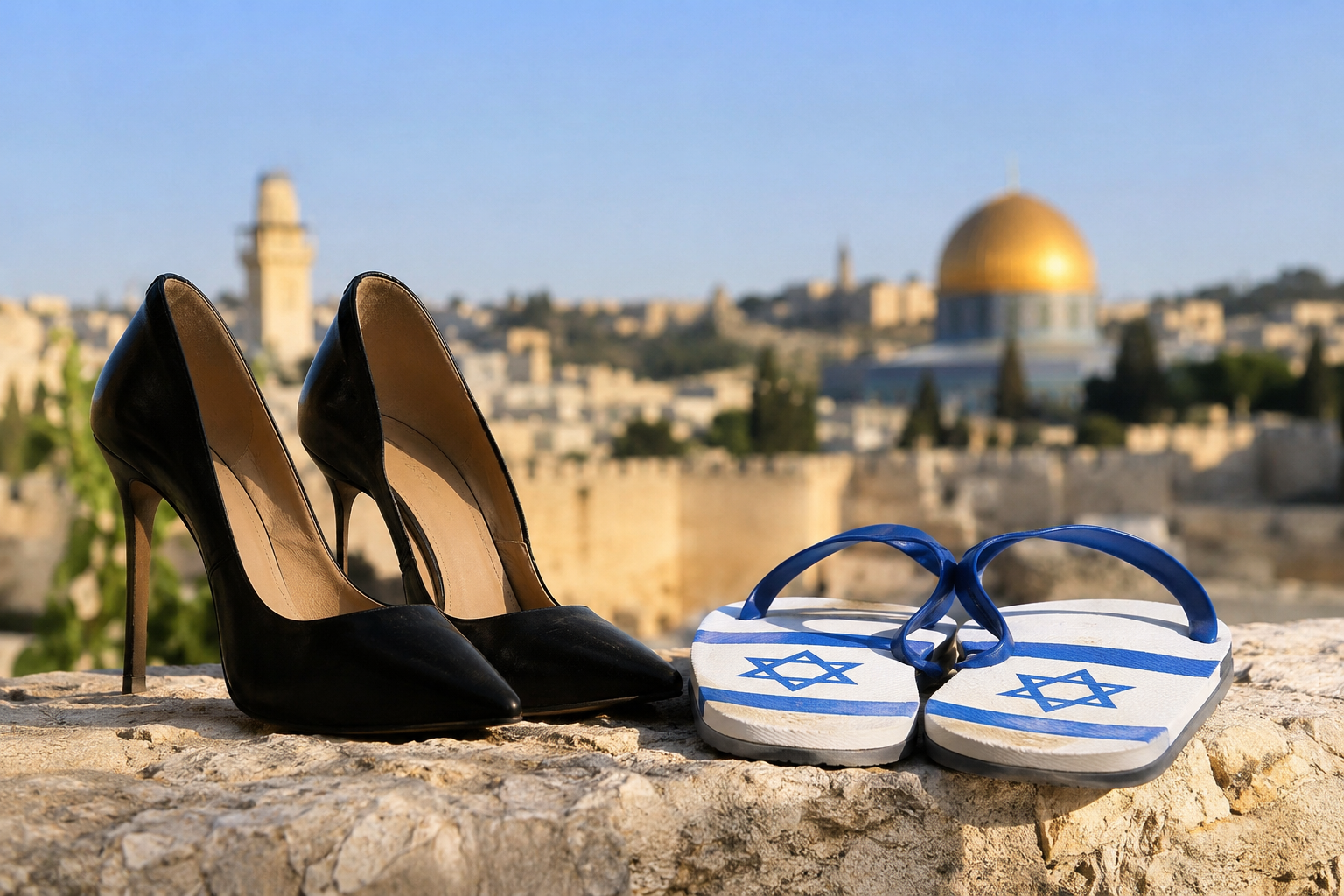
Six months after making aliyah, How I discovered that becoming Israeli has less to do with changing my wardrobe than with finding a place where I can finally be entirely myself.
I used to have very strong opinions about flip-flops.
Why would Israelis wear them everywhere? To restaurants, to meetings, sometimes even to places where I would never have considered showing up without proper shoes? Why did they speak so loudly? Why did they seem so unconcerned with appearances, with elegance, with the little social codes that had shaped my life?
Six months ago, I would never have imagined that I would one day become one of them.
I was born and raised in France, a product of what we proudly call the French republican meritocracy. My family came from North Africa and fought to give me the best possible education, convinced that education was the key to opportunity and emancipation.
I was fortunate to move between business, political and public life. I was elected to represent Paris’s 16th arrondissement, became involved in the leadership of the UMP, France’s major centre-right party, and worked closely with President Nicolas Sarkozy as his Special Envoy for the Middle East Peace Process.
I had a career, a place, a network, and a language in which I could express every nuance of my thoughts. I was somebody.
And then, six months ago, I decided to make aliyah.
I arrived in Israel on one of the first flights after the war, after the flight I had originally booked was cancelled. Sometimes you have to wonder what makes someone sufficiently crazy—or perhaps sufficiently determined—to leave everything behind.
Why voluntarily become a beginner again? Why move to a country where you cannot properly express yourself, where ordering a coffee becomes an intellectual exercise, where you suddenly speak like a child, and where nobody knows who you are?
I could have moved to Rome for its lifestyle, or Miami for its sunshine and quality of life. Instead, I chose Israel: a country that, at this moment in history, is often treated as an international pariah. A country where giving your nationality can trigger an immediate conversation about the war, and where every weekend someone seems convinced that another war is about to begin.
Perhaps I had anticipated some of what was coming. Looking at the growing unease among French Jews, I had come to believe that it was better to leave while you still had the freedom to choose, rather than wait until circumstances made the choice for you.
But I did not come simply to escape Antisemitism. I came because I wanted to belong somewhere.
And six months later, I know I made the right decision.
The First Thing That Changed Was My Wardrobe
I gradually abandoned my stilettos and tailored suits for something considerably more casual. I discovered that flip-flops were not necessarily a sign of a lack of sophistication. They were, perhaps, a sign that people had other things on their minds and a sign of freedom.
I still haven’t quite adjusted to the volume of conversations in Israeli restaurants, or on planes. I sometimes wonder why an entire restaurant needs to participate in one conversation. But I have stopped judging.
What I discovered here is something I had not fully experienced elsewhere: the extraordinary freedom of not having to hide or explain one part of your identity.
When you live abroad, you sometimes become accustomed to compartmentalising yourself. You adapt, you explain, you anticipate questions. You learn which part of your identity to bring forward and which part to leave in the background.
In Israel, you can be entirely yourself. You don’t have to translate your Jewish identity, justify your attachment to Israel or explain why certain things matter to you. It is simply part of the common language.
That freedom is enormously liberating. It gives you energy. Perhaps it is also one of the less visible ingredients of Israeli creativity and innovation: the ability to bring your entire self, your entire experience and your entire mind to whatever you are doing.
A Country Where You Can Disagree With Everyone, But Never Feel Alone
I discovered that Israel is a country where you can disagree with everyone, but rarely feel alone.
Israelis argue. They interrupt. They challenge. They disagree passionately, sometimes endlessly. But underneath all this noise there is something deeply reassuring: the feeling of belonging to a family. You can fight with your family, disagree with your family, be exasperated by your family. But when something happens, they are there.
I discovered this in very ordinary circumstances. When I injured my foot, suddenly everyone had an opinion: what I should do, what I should avoid, how I should sit, which doctor I should see. People I barely knew were concerned. Sometimes it can be overwhelming; sometimes you would rather be left alone. But it also makes you feel cared for. There is something very Israeli about this mixture of directness, curiosity, interference and genuine solidarity.
And then there is everyday life. I used to be struck by how much of the outside world seemed obsessed with Israel—with its conflicts, its politics, its international image. Yet here, I discovered another Israel.
Restaurants and cafés are full. People meet friends, take their children to school, plan holidays, celebrate birthdays despite the profound wounds and trauma of the wars.
Life goes on with an intensity that is sometimes almost bewildering.
Of course, life is extraordinarily expensive, especially food, in a country blessed with so much produce. And no, I haven’t entirely made peace with the prices. But there is an extraordinary ability to live, to enjoy, to celebrate the everyday, even when the world around you is uncertain.
The sun, the sea and the light certainly help. But it is more than that. I feel nourished by this land, connected to it in a physical, almost visceral way that is difficult to explain rationally. This land fits me. And the people give it its energy.
There is also something wonderfully simple about being able to say Shabbat Shalom to almost everyone, to share a common reference, a calendar, a rhythm. These small things create a sense of continuity and belonging that I had perhaps underestimated.
Those Who Make Aliyah Have Something to Bring
I also believe that people who make aliyah have something to contribute.
Israel is a country built by successive waves of immigration. Every new arrival brings a different education, professional experience and way of looking at the world.
Those who arrive from abroad know how the country is perceived, how its institutions are understood, how its universities and businesses are viewed internationally. They can sometimes see what Israelis, understandably preoccupied with their own reality, cannot see as easily. At a time when Israeli universities and institutions face growing international challenges, this external perspective matters.
We can remind Israel that being strong does not mean being closed, and that knowing who you are does not mean you no longer need to listen to others.
Israelis are Good at Talking. Are we still good at Listening?
There is something I have been thinking about lately. We are a people who are not traditionally a proselytising people. We have never built our identity around convincing the world to become like us. Perhaps this is one reason why we sometimes struggle with public diplomacy and international communication. We tend to speak to ourselves, convinced that if we know we are right, there is little need to explain ourselves to the rest of the world.
But the world does not necessarily understand what we understand, nor does it share our references, our history or our fears.
And perhaps we should remember something fundamental about our own tradition.
The most famous declaration in Judaism begins with two words: Shema Israel. Hear, O Israel.
The first injunction is not to speak. It is to listen.
Listening does not mean agreeing. It does not mean compromising on who we are or abandoning our convictions. It means making the effort to understand how others see us, what they hear when we speak, and why our message sometimes fails to reach them.
Perhaps this is precisely what Israel needs today: not to speak less about itself, but to listen more to the world, to adapt its language without compromising its values, and to understand that explaining who we are is also a responsibility.
We are the people of Shema Israel. Perhaps we should remember that listening is also part of our identity. And that listening is sometimes the best way to be heard.
Six months ago, I arrived in a country where I thought I would have to rebuild everything: my professional identity, my social life, my language, my daily habits.
I am still learning Hebrew. I still make mistakes when ordering coffee. I still sometimes struggle with the volume of conversations.
And yes, I now wear flip-flops and understand that you can dream bigger when your feet hurt less …
But I have discovered something much more important than a new dress code. I have discovered the extraordinary relief of feeling at home.
I came to Israel thinking I would have to reinvent myself. Instead, I found a place where I could finally be entirely myself.
And perhaps that is what becoming Israeli really means.