Historian, Librarian, Educator, and Artist
From Talk to Walk: The Continuum of Israeli Art at Engel Gallery
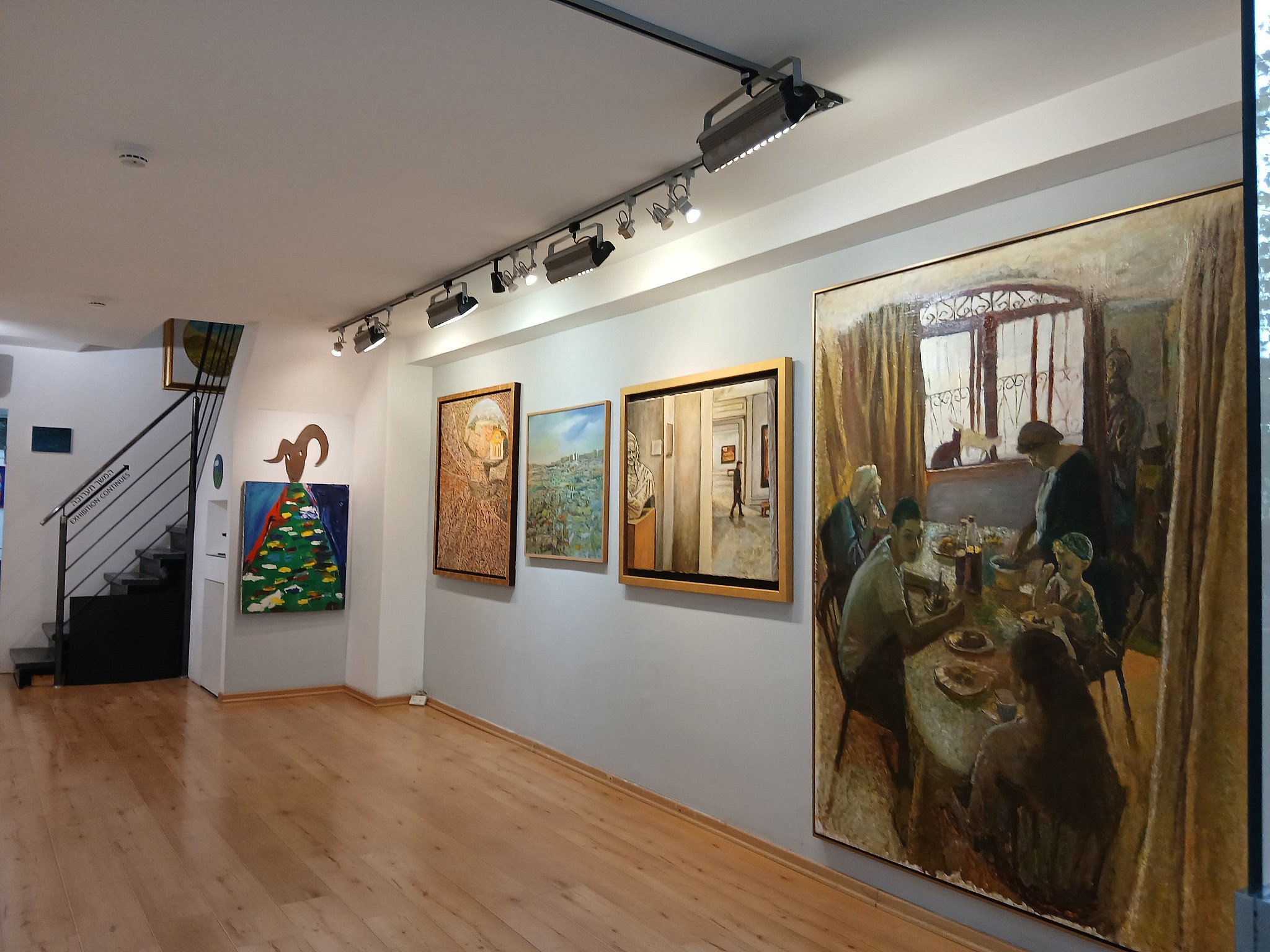
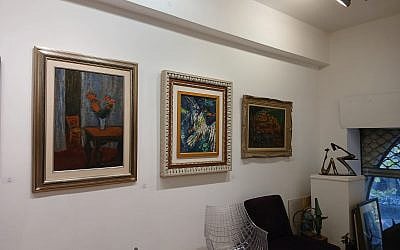
Paintings from the Engel Gallery's summer exhibition. Photo: Bonnie K. Goodman
Part 2 of a two-part essay: Read Part 1 here:
Why Israel’s art world is afraid of honest criticism
The Walk through Jerusalem
The artist talk had ended, but the air in the gallery still felt crowded—with words, with certainty, with self-regard. I stepped outside into Jerusalem’s night, hungry for quiet, for the kind of truth that can’t be performed. The city, luminous and imperfect, unfolded before me like a canvas still drying. I walked through the bustling streets of Hol Hamoed Sukkot, from the light-strewn lanes of the Shuk toward Jaffa Road, then down to Shlomzion HaMalka, where nearly every gallery door was open.
My first stop was Binyamin Gallery, a small yet vibrant space managed by Oded Binyamin. The gallery was intimate, canvases stacked against the walls like a living archive. Robert Rosenberg’s large-scale works dominated the room—complex, layered, and profoundly human. Here conversation flowed freely. No one was performing; art felt once again like dialogue, not defense. Further along, I passed the David Rakia Gallery, where his daughter continues to preserve her father’s mystical legacy. Rakia’s paintings shimmered with transcendence — colors breathing with light and memory, abstractions whispering of Jerusalem’s soul. Then, across the street, the glow of Engel Gallery caught my eye.
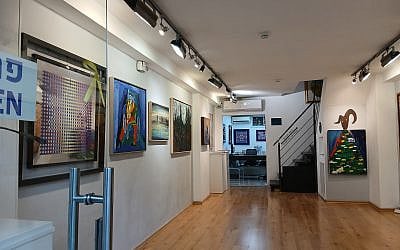
The Engel Legacy
Founded in 1955 by Yitzhak Engel, the Engel Gallery is one of Jerusalem’s oldest and most enduring art institutions. From the start, its mission was to promote and exhibit Israeli art both in Israel and abroad. The gallery published prints and books, collaborated with museums and art fairs, and helped define the early narrative of Israeli modernism. Many of Israel’s leading painters and sculptors took their first professional steps here — Rafi Lavi, Arie Aroch, Aviva Uri, Uri Lifshitz, Yehezkel Streichman, Joseph Zaritsky, Ovadia Alkara, Ofer Lellouche, and Jan Rauchwerger — artists whose first exhibitions at Engel launched lifelong careers.
Equally foundational were the artists who remained part of the gallery’s story for decades: Moshe Castel, Mordechai Ardon, and Anna Ticho. Their works became the cornerstones of the Engel collection, forming one of Israel’s largest and most historically significant holdings. In the 1970s, Engel Gallery expanded internationally, opening branches on Madison Avenue in New York and in downtown Toronto, where for nearly two decades it introduced Israeli art to North American audiences. By the 1980s, the second generation — Shmuel (Malachi) Engel — joined the management, establishing a Tel Aviv branch that deepened the gallery’s reach and renewed its contemporary dialogue.
Today, Engel Gallery is guided by three generations of the Engel family: Shmuel Engel (Malachi), his son Gavriel, and grandsons Matar Engel and Ofir Hirshfeld. The Jerusalem flagship at 13 Shlomzion HaMalka Street remains a cultural landmark, while the Tel Aviv space at 100 Ben Yehuda Street presents temporary exhibitions of contemporary Israeli artists. The gallery’s collection spans three generations of Israeli art as well as European masters such as Chagall, Miró, Renoir, and Gauguin, alongside Reuven Rubin, Marcel Janco, Chana Orloff, Yaacov Agam, Moshe Castel, and Leonid Balaklav. Across seven decades, Engel Gallery has preserved the continuum of Israeli art — a living conversation between the Bezalel pioneers and today’s visionaries.
The Summer Group Exhibition
The Summer Group Exhibition (July 24 — September 2025) featured an impressive lineup: Yaacov Agam, Richard Bilan, Leonid Balaklav, Jack Jano, Nobuya Yamaguchi, Meidad Moshe Landoy, Malachi, Oded Feingersh, Menashe Kadishman, Shaul Shatz, Yaakov Foldman, Jan Rauchwerger, Arie Berkowitz, Jonathan Ofek, and Lev Stern. The exhibition offered a panoramic view of Israel’s artistic spectrum—from geometric abstraction to expressive realism, from spiritual meditation to irony.
At the exhibition’s heart hung Leonid Balaklav’s The Artist’s Family, a monumental oil on canvas (200×150 cm). The painting radiated quiet power. Having just come from the loud certainties of an artist panel, I was struck by its humility. Balaklav paints with sculptural restraint; his palette is tender but disciplined. Figures emerge from light, not pigment — a portrait of domestic stillness that becomes a meditation on love, mortality, and belonging.
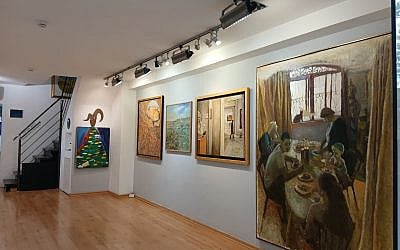
Nearby hung Meidad Moshe Landoy’s At the Israel Museum, his response to his teacher’s legacy. The composition is architectural yet personal: the artist paints himself gazing at the museum itself, inserting his own presence into the space of the canon. By placing himself outside the building that defines Israeli art, he questions who is seen and who remains beyond the frame. Together the two works—mentor and student—illustrated the essence of continuity. Israeli art, the exhibition seemed to say, is not repetition but reflection.
Elsewhere, Yaacov Agam’s Star of Love shimmered with optical harmony, geometry transformed into mysticism. Richard Bilan’s Clown offered its counterpoint — a portrait of chaos and color, laughter as vulnerability. Menashe Kadishman’s Ram in the Landscape (iron and oil) grounded the show in mythic modernism, the eternal symbol of sacrifice recast in contemporary form. Oded Feingersh’s Jerusalem pulsed with golden light; Malachi’s For Out of Zion Shall Go Forth the Torah fused digital and sacred; Jan Rauchwerger’s Galit in the Studio offered a study in quiet devotion. Jonathan Ofek’s Herd, small and tender, seemed to echo Kadishman’s rams in miniature—a generational echo rendered in brushstroke. The cumulative effect was coherence through contrast—a mosaic of Israeli identity, each tile distinct yet inseparable.
The Next Day: A Conversation with Matar Engel
I returned to Engel Gallery the next afternoon. The night before, I had discovered it by chance—drawn by its quiet gravity amid Jerusalem’s noise and celebration. Now I was deliberately coming back to understand the place that had stayed with me long after I left. Matar Engel, the gallery’s director and third generation of the Engel family, greeted me with a warmth that felt more like a welcome than a transaction. Upstairs, surrounded by oils and sculptures by early Bezalel-trained artists and mid-century painters, he spoke with quiet conviction about something few mention anymore—that too many Israelis, even art students, have lost touch with their own visual heritage. “Bezalel doesn’t even teach it,” he said softly, pausing before a sheep’s-head sculpture by Menashe Kadishman, whom he called “our closest thing to a national artist.”
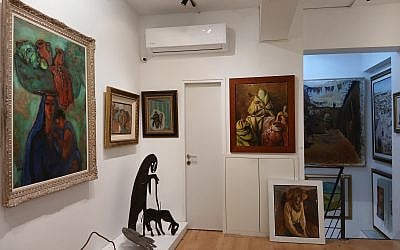
Around us hung a carefully layered dialogue of eras: the current exhibition’s abstractions, landscapes, and portraits blending effortlessly with the gallery’s permanent collection. In the next room, the luminous brushwork of Nahum Gutman and Reuven Rubin glowed like fragments of the nation’s early dream, while along the stairwell, Lipa Nathanson, Mane Katz, Leonid Balaklav, and Meidad Moshe Landoy towered in expressive grandeur—each one a chapter in the story of Israeli art. The space felt less like a commercial gallery than a museum in miniature, a living archive of continuity. As we spoke, I realized this was not merely a discussion about paintings but about cultural inheritance.
The Stairway of Memory
Ascending the stairwell felt like an artistic journey. Each wall engaged in a conversation between past and present. On one side, Mane Katz’s Rabbis with Torahs towered with expressive fervor—the folds of tallitot swirling like pillars of fire. Across from it glowed Lipa Nathanson’s Jerusalem, an ochre-toned hymn to the Old City, its alleyways breathing warmth. Halfway up hung Meidad Moshe Landoy’s At the Israel Museum, now recontextualized between the canonical and the contemporary. To see it there—beneath Mane Katz’s spiritual intensity and above the modernist restraint of Arie Aroch—was to grasp the continuum Matar had described. The stairwell itself became a metaphor: each step a passage through the nation’s visual consciousness.
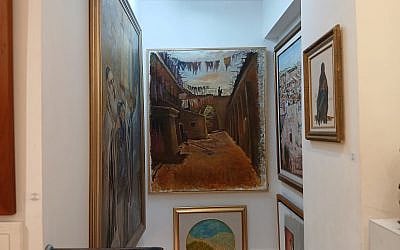
The Upper Floor: A Living Museum
At the top floor, the atmosphere shifted. The space was intimate yet monumental — white walls, warm floors, and paintings that breathed across generations. Reuven Rubin’s mother and child glowed in radiant blue and terracotta, their basket of fruit a symbol of sustenance and faith. Menashe Kadishman’s iron rams grazed nearby — modern altarpieces forged in steel. Nahum Gutman’s sun-drenched landscape of early Tel Aviv captured the innocence of beginnings, while Arie Aroch’s textual abstraction murmured the modernist turn toward idea and symbol. A haunting Samuel Bak painting introduced moral gravity — fractured allegory, memory rendered as survival. Around them, Lipa Nathanson’s Jerusalem, Mane Katz’s Rabbis with Torahs, and Meidad Landoy’s At the Israel Museum formed a triad of devotion, place, and reflection.
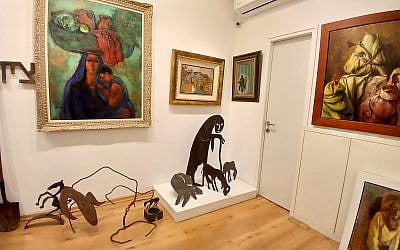
There were sculptures too: Kadishman’s simplified rams in iron, their forms distilled to archetype, and abstract metal works echoing the geometry of Yaacov Agam downstairs. The room felt less curated than composed—art arranged not by chronology but by conversation. One wall held a still life, another a cityscape, and another a portrait. They coexisted without hierarchy. Engel’s genius lay in this coexistence—the refusal to isolate the modern from the classical or the sacred from the secular.
The Continuum of Art and Memory
Every inch of Engel Gallery taught through juxtaposition. The lower floor hummed with contemporary color and experimentation; the stairway narrated the climb toward inheritance; the upper level enshrined the lineage itself. In the main hall, the eye traveled naturally from Agam’s kinetic geometry to Bilan’s theatrical figuration, from Balaklav’s meditative family to Landoy’s introspection. Each doorway opened onto another conversation. The gallery’s design—clean, light-filled, yet warm—allowed paintings to breathe. Even the furniture felt intentional: transparent chairs, metal sculptures, and archival catalogues stacked casually on a side table. It was both home and museum, echoing the rhythm of Jerusalem itself—intimate yet eternal.
Art history, Matar Engel explained, survives only through distance—the capacity to see the past not as a relic but as a dialogue. Matar reflected that Israeli art history risks disappearing when it’s no longer reinterpreted by each new generation — when it sits in storage, unseen. His anecdote recalled a principle from Jewish study: that argument is sacred because it keeps the text alive. So too with art. To question a painting is to honor it. Standing before Balaklav’s The Artist’s Family, I understood that idea viscerally. The figures — quiet, illuminated, bound by invisible threads — seemed to listen. The act of seeing became participation in their silence. Critique, I realized, is not opposition but devotion. To look deeply is to keep the work breathing.
Jerusalem’s art scene, like its religious life, has its hierarchies and gatekeepers. Yet art, like faith, thrives on humility. The galleries I visited that night — Binyamin, Rakia, and Engel — reminded me that integrity still resides in small rooms filled with large ideas. Money and influence may build institutions, but only openness builds legacy. Engel Gallery’s endurance — seventy years of showing Israeli art in its full continuity — is an act of quiet resistance against cultural amnesia.
Two Jerusalems
Those two encounters — the gallery talk and the walk through Jerusalem that led me to Engel Gallery and the conversation with Matar Engel the next day — became a parable of two Jerusalems: one guarded, one generous. The first fears critique; the second welcomes it. As both an artist and a critic, I stand with the second — for the belief that seeing and questioning are acts of faith. Art belongs not only to those who stand before it but to all who dare to imagine it. Engel Gallery, with its layered rooms and luminous walls, reminds us that to see is also to remember — and that in remembering, we become part of the art’s own unfolding story.
Exhibition Reference
Engel Gallery: https://www.engel-art.co.il/
Summer Group Exhibition, Engel Gallery, Jerusalem. July 24 — September 5, 2025. Featuring Yaacov Agam, Richard Bilan, Leonid Balaklav, Jack Jano, Nobuya Yamaguchi, Meidad Moshe Landoy, Malachi, Oded Feingersh, Menashe Kadishman, Shaul Shatz, Yaakov Foldman, Jan Rauchwerger, Arie Berkowitz, Jonathan Ofek, and Lev Stern.
Related Topics