CFO | Empower Society for Good I Author
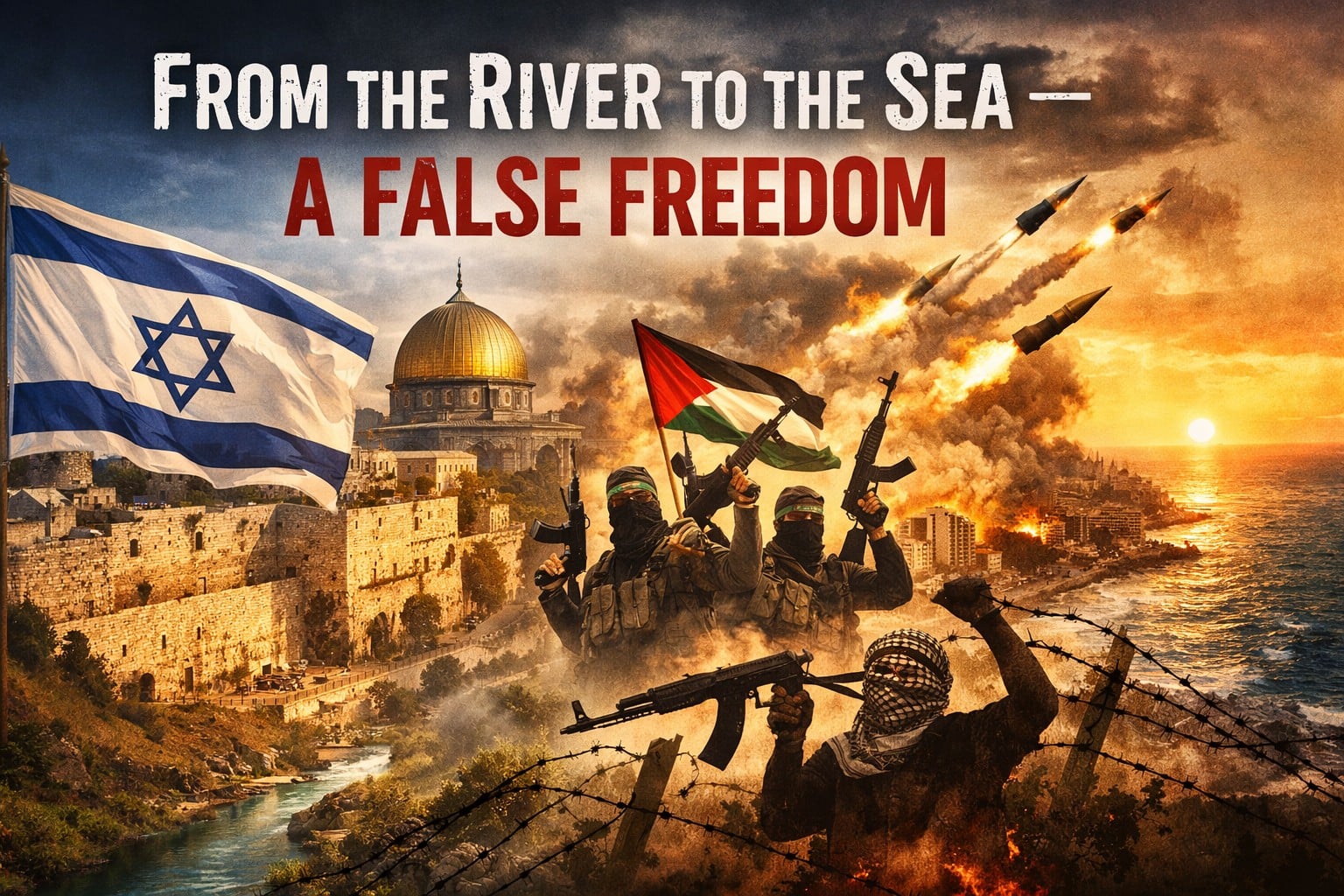
From the River to the Sea — A False Freedom
This reflection is part three of a three-part series. Hardened Hearts: Power, Ideology, and the Long Road to Freedom. In this reflection, we turn to the deeper meaning of Passover itself and what the Exodus story ultimately teaches about the difficult but hopeful journey toward freedom and the building of a good society.
Over the centuries, the story of the Exodus did not remain only a Jewish memory. It became one of the most powerful freedom narratives in human civilization. From struggles against tyranny in Europe to the civil rights movement in America and the fight against apartheid in South Africa, the language of liberation often drew inspiration from Moses confronting Pharaoh.
Passover introduced a revolutionary idea into human history: that no ruler or regime is absolute, and that human dignity cannot be permanently suppressed.
But the Exodus story also teaches something that is often forgotten.
Freedom alone does not automatically create a just society.
When the Israelites left Egypt, they did not immediately arrive at a perfect nation. They spent decades in the wilderness learning responsibility, law, and moral discipline. Freedom required the building of institutions, shared values, and a moral framework capable of sustaining society.
Freedom often involves war — this is a pattern throughout history. It is ugly and uncomfortable. The Israelite conquest of Canaan, as detailed in the Book of Joshua, is uncomfortable. And you will be hard-pressed to find any country whose history does not involve migration, conquest, or colonisation.
Israel today is still fighting its war of independence. Somehow, the world has over 150 countries with Christian majorities and around 50 Muslim-majority countries, yet has a problem with one Jewish state. The chorus is led by the UN, which, instead of focusing on peace and the UN SDGs, maintains permanent resolutions against Israel. Even our neighbour Lebanon has not yet recognised Israel as a state, and with others we have, at best, a fragile or false peace.
It is a sad fact that the major mission of the Iranian regime is the elimination of the sole Jewish state — directly and through its proxies: Hamas, Hezbollah, the Houthis, and others.
For goodness’ sake — how many thousands of missiles do they have, and for what purpose? We sadly know the answer.
I write this knowing that another missile alert could come at any moment. Why is the world not condemning the war crime of targeting civilians — targeting me, targeting ordinary people?
Peace can only be maintained through strong action.
I would like to see a clear warning by Israel: that if missiles continue to target civilian areas, Israel will respond by targeting Iranian oil infrastructure. Let us see what happens then.
It is time for the world — and for Iran — to take responsibility for its actions. Time to stop sending missiles at civilians.
Rabbi Kook saw war as a tragic necessity at times — a stage in history where evil must be confronted — but one that must ultimately lead humanity toward a higher moral and spiritual unity.
Rabbi Jonathan Sacks often emphasized that freedom without responsibility cannot sustain a good society. Liberation is only the beginning; what follows is the harder work of building a society rooted in dignity, accountability, and mutual respect.
This brings us to one of the most common slogans heard today across campuses and protests around the world:
“Free Palestine, from the river to the sea.”
At first glance, the language of freedom sounds compelling. But slogans must be examined carefully. We must ask: what kind of freedom is actually being envisioned?
The phrase “from the river to the sea” describes the elimination of Israel as a Jewish state between the Jordan River and the Mediterranean Sea. It does not envision coexistence. It does not acknowledge Jewish history or national rights. It imagines a future in which one nation disappears.
Calling this “freedom” is therefore deeply misleading.
True freedom cannot be built on the erasure of another people.
The lessons of Passover teach exactly the opposite. Liberation is not about replacing one domination with another. It is about building a society grounded in dignity and moral responsibility.
Rabbi Jonathan Sacks captured this challenge when he wrote that the test of a civilization is whether it can create “a society in which the dignity of difference is honoured, and those who are not like us are still treated with justice and respect.”
History offers a powerful modern example of this principle.
In the struggle against apartheid in South Africa, Nelson Mandela did not call for the destruction of the white population or the elimination of the state. Instead, he envisioned a society built on reconciliation and coexistence.
Mandela himself recognised both Palestinian aspirations and the legitimacy of Israel, stating:
“We recognize the legitimacy of Palestinian nationalism just as we recognize the legitimacy of Zionism as a Jewish nationalism. We insist on the right of the State of Israel to exist within secure borders.”
The South African freedom struggle also included remarkable Jewish participation. Many Jewish activists — inspired by the moral vision of justice deeply rooted in Jewish tradition and the Passover story — played major roles in the fight against apartheid.
Figures such as Joe Slovo, Ruth First, Albie Sachs, Denis Goldberg, Helen Suzman, and Arthur Goldreich were central to the movement that challenged apartheid. Many of them saw the Exodus narrative as a universal call to oppose oppression.
They were inspired by the phrase repeated in the Torah over 40 times in various forms:
“Do not wrong a stranger or oppress him, for you were strangers in the land of Egypt.”
This is indeed one of the most fundamental teachings of the Torah — that memory must lead to responsibility, and that freedom must create a society of justice and compassion.
In many ways, their struggle became a modern echo of the Passover story — a movement seeking freedom not through the destruction of another people, but through the creation of a new and inclusive society.
That is the deeper meaning of liberation.
The alternative to slogans of elimination is not oppression.
The alternative is a good society.
We have already seen glimpses of this possibility in recent years. The Abraham Accords demonstrated that former adversaries in the Middle East can choose cooperation over conflict. Nations that once defined themselves through hostility toward Israel have begun building partnerships in technology, trade, and development.
These agreements suggest that the future of the region does not have to be defined by endless confrontation.
Jerusalem itself embodies this challenge.
The prophet Isaiah envisioned Jerusalem as a place that would become “a house of prayer for all nations.” For thousands of years, the city has been sacred to Jews, Christians, and Muslims alike.
Yet the world often fails to see that Jerusalem and Israel today already reflect elements of that vision — a place where all religions have access to their holy sites, where diversity exists in practice, and where freedom of worship is protected in a region where this is far from guaranteed.
Rabbi Jonathan Sacks defined a good society as one in which “the dignity of difference is honoured,” where people of different faiths and identities live together with justice, respect, and shared responsibility. A good society does not erase differences — it makes space for them, protects them, and builds a moral framework in which they can coexist.
Yet Jerusalem has also repeatedly been used as a tool of political incitement.
False narratives about threats to Al-Aqsa Mosque have been spread time and again to inflame tensions and mobilize violence. The struggle over Jerusalem often becomes less about religious devotion and more about political power.
When religion is weaponized in this way, it hardens hearts and deepens division.
Passover invites us to imagine a different path.
The Exodus story reminds us that societies built on domination and denial eventually collapse. But it also reminds us that freedom must lead to something higher: responsibility, justice, and the recognition of others’ dignity.
The real question facing our world today is not whether people seek freedom.
It is whether that freedom will be used to destroy — or to build.
If the lessons of Passover are taken seriously, the goal cannot be the elimination of one nation by another.
The goal must be the creation of a good society — and a region — where freedom leads to coexistence, responsibility, and peace.
That is the deeper message of Passover. Freedom is not the end of the journey — it is the beginning. The real work is what comes after: building a society that honours dignity, accepts responsibility, and makes space for others.
That remains the unfinished work of our generation.
Related Topics
Related Posts