
From the River to the Sea Is Not a Metaphor
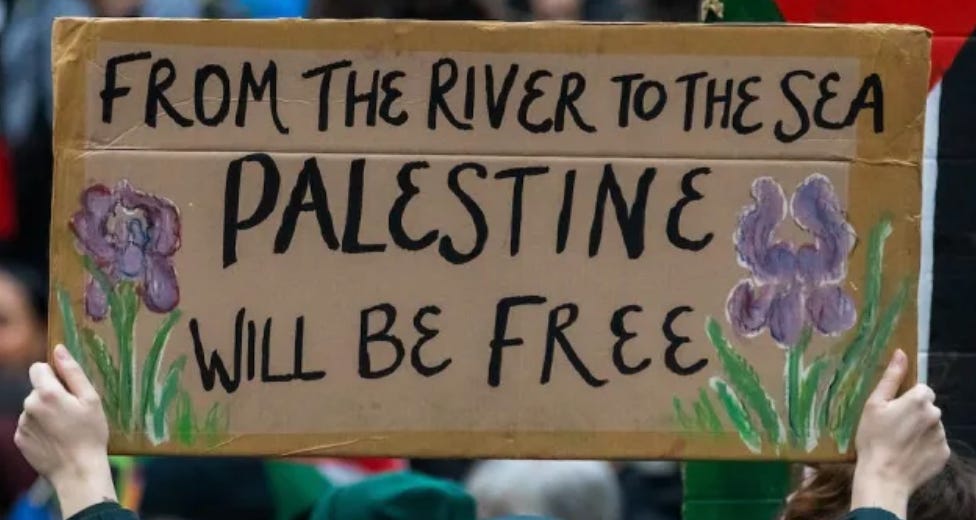
When Jews say “from the river to the sea” feels antisemitic, they are not necessarily misinterpreting it. While many anti-Zionist activists frame the slogan as a metaphor—for equity, reparation, return—its meaning is frequently not metaphorical at all. It is concrete. It names a specific political outcome. The chant draws its power from the language of decolonization, and that term has political and ideological history.
In academic settings, we can debate endlessly which interpretation is more legitimate, more faithful, more “correct.” But I have stood inside the chant. I have said the words aloud. I know what I meant when I said them. I know what my friends meant. I know what my professors meant. This article is an attempt to tell the truth about that knowledge.
1. Phase One: Physical Withdrawal for the Creation of an Independent State
Historically and literally, “decolonization” refers to the material process by which territories under formal colonial rule achieved political independence and self-governance. It names a legal and geopolitical transition involving the withdrawal of imperial authority, the transfer of sovereignty, the dismantling of colonial administrations, and the creation of new nation-states (e.g., India, Pakistan, Algeria, Ghana).
While early precedents appear in the late eighteenth and early nineteenth centuries—most notably the American Revolution, the Haitian Revolution, and the Spanish American wars of independence—the most consequential and widely recognized global wave of decolonization occurred in the post–World War II period (roughly 1945–1960s). War exhaustion, economic strain, and organized nationalist movements across Asia, Africa, and the Caribbean hastened imperial withdrawal and the creation of new, indigenously governed nation-states.
2. Phase Two: Decolonization as Coexistence & “Race Relations”
A second usage of decolonization emerged afterwards, not as a question of territorial sovereignty, but as a social and intellectual problem within Western democracies themselves. As formal empires receded, states like Britain allowed migrants from former colonies to settle there. Confronting new questions about race, migration, and belonging amid changing populations at home, “decolonization” became a question of how to co-exist in racially, ethnically and linguistically diverse Western societies.
Scholarship on “race relations” from that time disproportionately focuses on attitudes toward new migrants from territories still under, or recently released from, colonial rule. Academics and policymakers alike dealt with questions about integration and coexistence. For the purposes of the present argument, this constitutes phase two decolonization.
3. Phase Three: Decolonization as an Ideological Project
A third meaning of decolonization takes shape later, with Ethnic Studies, postcolonial critique, and decolonial theory. In this register, decolonization no longer argues about treaties, borders, or the withdrawal of imperial administrators. Instead, it offers a critique of power, legitimacy, and history in the first place.
This form shifts the terrain toward the stories that make land ‘claimable.’ In other words, political authority becomes bound up in narrative authority: who names, who remembers, who counts as human, who inherits the moral weight of history. Decolonization in this phase dreams about undoing the epistemic foundations of the colonial world—stripping the colonizer of innocence, coherence, or legitimacy.
Aimé Césaire’s Discourse on Colonialism opens with the following indictment:
A civilization that proves incapable of solving the problems it creates is a decadent civilization.
A civilization that chooses to close its eyes to its most crucial problems is a stricken civilization.
A civilization that uses its principles for trickery and deceit is a dying civilization.
Césaire treats colonialism as a violent force that has corroded language, distorted morality, and converted people into things (“thingification”). The demand that follows is a reckoning.
Relatedly, the world colonialism built, Frantz Fanon argues, must be overturned—not merely repaired. Liberation restores what domination stripped away, but only through the dismantling of the structures that sustained colonial rule.
Later theorists, like Edward Said, continue the logic of knowledge production, i.e. where power organizes meaning. In this view, decolonization necessitates the reclamation of authority over memory, history, and interpretation—to decide whose stories matter and whose lives anchor the moral order of the present.
Later, in their influential essay Decolonization Is Not a Metaphor, Eve Tuck and K. Wayne Yang insist that decolonization is not a metaphorical synonym for justice, equity, or social improvement. Rather, “decolonization” names a specific political demand: the repatriation of Indigenous land and the dismantling of settler colonial sovereignty. Turning decolonization into a flexible moral idiom, they argue, enables what they call “settler moves to innocence”—gestures that preserve moral clarity while evading the material consequences of the demand being made. The “metaphor,” in this sense, only protects those who invoke it from reckoning with what decolonization really requires. Here, the term does not just describe a critique or symbolic set of values—it clarifies a material demand whose consequences, they argue, cannot be deferred or symbolized.
In this phase, sovereignty becomes unsolvable by mere coexistence or legal reform. Colonialism is understood as a violent, ongoing process that resulted in historical, moral, material and irredeemable debt.
Where Decolonization Frameworks Collide with Jewish History | Decolonization and the Question of Jewish Political Legitimacy
The application of “decolonization” to Jews, Israel, and Zionism reveals a distinctive semantic shift.
Contemporary campus discourses frequently invoke ideas about “decolonization” that reflect components of the third register on the surface (e.g. a critique of power, legitimacy, and historical narrative) while meaning the political demands of Phase One (i.e., dismantling of the state).
While many activists imply that “from the river to the sea” is about ideological reform and redistributive justice, with anti-Zionism decolonization usually reverts to its original political meaning: a demand for the dismantling of an existing sovereign state and the transfer of territorial and governing authority to another resident group (i.e. Palestinians). This usage aligns with the first historical phase of decolonization—which names a legal and geopolitical process involving the withdrawal of imperial rule and the creation or replacement of states—even when the anti-Zionists using it defend it as “free speech” or “reparative justice.”
A more pragmatic stance would operate closer to the second register: emphasizing civic equality, shared governance, minority rights, and the construction of political arrangements in which multiple peoples can coexist as equal and secure citizens. This approach would treat the Israeli–Palestinian conflict as a problem of governance, rights, and political structure rather than as a question of whether a Jewish state may exist at all.
Calls to “decolonize Palestine,” so frequently accompanied on campuses by “globalize the Intifada,” “from the river to the sea, Palestine will be free” and “nobody is free until everybody is free,” hurt many Jews because they often feel a lot more like Tuck and Yang.
No, I cannot right now prove to you that people who say these slogans always mean “end the State of Israel.” What I can tell you, based off my own experiences living in, organizing with, and believing deeply in the anti-Zionist ideology is that, in practice, we were advocating for the dissolution of Israel. As a settler colonial and apartheid state, I believed (along with my comrades) it had no legitimate right to exist.
Rather than thinking about proposals for institutional reform, binational governance, or shared sovereignty, we wanted Palestinians everywhere to be granted the right of return with the ultimate accomplishment being one Palestinian state under sovereign Palestinian rule in which Jews would be “equal subjects.” [No, we did not care to think about the history of antisemitism, the realities of Jews Indigenous to the Middle East, or how unlikely collective freedom is for Jews in that region.]
I do not intend to speak here for all anti-Zionists, and especially not all anti-Zionist Jews. The issue I am trying to raise, instead, is that when decolonization is framed as a moral critique but functions as a demand for state elimination, Jewish concerns about existential threat are dismissed. But they are not always invalid.
Please stop telling Jews they’re hallucinating when they react to words that have real histories. Jewish discomfort with “from the river to the sea” is not delusional—and it deserves to be taken seriously. Regardless of politics, ideology or commitment, the discomfort is not imaginary, nor is the interpretation. It is time we acknowledge that.
My objection is not to imagining a different political future. It is to a vision of “decolonization” and “collective liberation” that refuses to grapple with what that idea of a future would concretely mean for Jewish safety. When calls for a single Palestinian state proceed without articulating how Jews—who lack historical safety in the region—would be protected as a minority, Jewish fear is not paranoia. It is a rational response to being written out of the moral imagination.
Many Zionist Jews feel silenced when they speak on this because, unlike other contexts where decolonization refers to material inclusion or plurality, its application to Zionism frequently entails the negation of Jewish political self-determination altogether.
This semantic opacity helps explain why Jewish claims of harm are routinely misrecognized in progressive culture. Many Jews, especially Zionists, respond to decolonization rhetoric as a call for political erasure, even while antizionist opponents insist that their “free speech” is simply a moral or justice framework. The result is that the same term—“decolonization”—operates simultaneously as a theory of justice and as a policy demand for the dissolution of the State of Israel, with Jews uniquely positioned on the receiving end of its most literal and consequential meaning. The same word is doing radically different work depending on the target.
In practice, this means that institutions often interpret these chants as abstract expressions of decolonial critique, understood as symbolic, rhetorical, or theoretical opposition to state power. When framed this way, such speech is treated as protected political expression rather than as a direct threat.
When read literally and historically, however, “resistance by any means necessary” and “from the river to the sea” are not merely metaphorical. As we saw on and after October 7, they are consistently invoked to legitimate violence against Jews as justified acts of liberation. These phrases are not abstract, but Phase One calls for the dismantling of the Jewish state without articulated concern for the safety, rights, or lives of the Jewish population living therein.
DEI bureaucracies, Title VI and other policy infrastructure meant to protect minority groups so often misrecognize this slippage because they read decolonization as a moral or analytic critique rather than as a programmatic demand for national elimination. As a result, the structures meant to ensure anti-discrimination hear Jewish students, faculty and community members say they feel existentially threatened, but then reclassify that threatening rhetoric as abstract political discourse.
This pattern is not an anomaly or misunderstanding; it is the predictable result of a culture that cannot hear Jews when they say, “I’m in pain.”
You can follow the author’s latest work at her site, “Rabbi’s Daughter Rebellion.”