
Thinking about 'Resilient Zionism'
From Tourists to Inhabitants: The Negev’s New-Old Wine Story
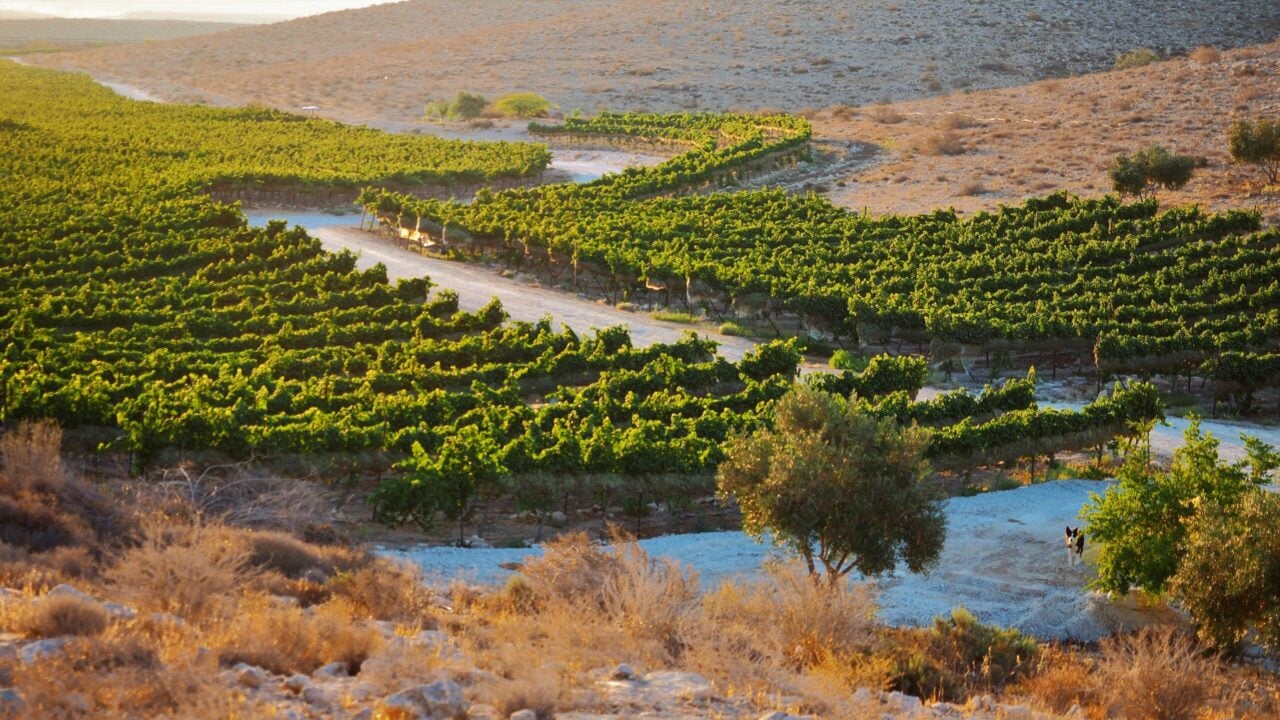
Vineyward in the Negev (Merage Foundation Israel)
Last month something quietly remarkable happened: the Negev was officially recognized as a protected Geographical Indication — effectively an appellation — for wine.
It is the kind of development that passes unnoticed amid war, politics, grief and the endless stream of urgent headlines. But sometimes quieter news carries a different kind of significance. Not because it changes reality overnight, but because it points to something taking root over time.
The recognition was formally approved through Israel’s Justice Ministry, under the international framework for protecting appellations of origin and geographical indications. The initiative was led by the Merage Foundation Israel, following years of work to document the distinct qualities of Negev wines and the region’s unique desert terroir. Once approved, the Negev joined the language of internationally recognized wine regions — not as an imitation of somewhere else, but as a place with a wine identity of its own.
This is no small thing.
A geographical indication is, in one sense, a technical designation. It recognizes that a product is connected to a particular region and shaped by its conditions. In the case of wine, that means soil, climate, altitude, temperature shifts, landscape and accumulated expertise. But beyond the technical language, it makes a simple claim: place matters.
Wine is never only about grapes. It is about where they grow. Champagne is not simply sparkling wine. Bordeaux is not simply red wine. These names carry geography, history, culture, and identity. The recognition of the Negev as a wine region suggests that Israel’s desert, too, has its own unique and desired wine identity.
This development especially resonates with this week’s Torah portion of Shelach (communities outside of Israel will read this portion next week).
We are all familiar with the story of the sin of the spies related Parshat Shelach. Moshe sends men to explore the Land of Israel. We usually call them “spies,” but the Torah’s language is more subtle. The descriptive language used in the Torah to describe the episode is ויתורו (vayaturu) — from the root לתור (latur), meaning to tour, explore, or scout, as opposed to the verb of וירגלו (vayeraglu) meaning to spy. As such, they were not necessarily spies in the narrow military sense. They were, in a sense, tourists.
That distinction is perhaps nuanced, but indeed powerful.
A spy comes to uncover weakness. A tourist comes to observe, experience, and report back. But neither necessarily comes as an inhabitant. A tourist can admire a place, taste its fruit, describe its beauty, and return home with impressions. But the tourist remains outside the story of the place. He or she does not necessarily ask what it would mean to live there, take responsibility for it and build a future with it.
The men sent by Moshe certainly saw the land. They saw its strength, its fruit, its fortified cities and its complexity. The Torah tells us that they “went up into the Negev and came to Hebron.” The famous grapes they carried back came from Nachal Eshkol, traditionally associated with the Hebron-area valleys of the southern Judean hills. Their journey took them through the broader southern landscape that connects the Negev with the Southern Hebron Hills. For those who have visited the area, the biblical imagery feels acutely tangible — the desert edge and its expansiveness, the ascent toward Hebron, vineyards, orchards, fear, promise and the question of whether one comes to the land as a visitor or as someone prepared to inhabit it.
That is why the Negev’s new wine appellation feels worth pausing over, especially this week.
The Negev is still too often spoken about in abstract terms. We talk about its potential, its strategic importance, its challenges and its future. All of that is true. But an appellation is different. It is not a slogan. It is a sign that something tangible is already happening: farmers, winemakers, researchers, entrepreneurs and communities are gradually turning place into product and product into identity.
This connects directly to the work we are beginning at Yachad.
Yachad is a new community in formation in the Negev, located west of Arad, in the broader southern corridor through which the men sent by Moshe may well have travelled on their way from the Negev toward Hebron. The grapes they harvested from Nachal Eshkol — may have been only some 20–30 kilometers away from the site we will hopefully settle within the next 18 months. Yachad is being built around the idea that people, place, values, and economic life need to grow together. As part of our emerging agribusiness plan, we are exploring and scoping the establishment of a vineyard integrated into other areas of regenerative agriculture, eco-tourism, local enterprise and regional economic development.
The inclusion of grapes and wine into our business plan is not incidental. A vineyard is a long-term proposition. It requires patience, professional discipline, water sensitivity, soil and climate understanding and a willingness to think in seasons and years. In that sense, it is a natural fit for a community that is itself still being planted.
There is something quietly powerful about that parallel. A new community does not become rooted all at once. Neither does a vineyard. Both require infrastructure, trust, adaptation, and time. Both depend on the relationship between vision and daily work. Both are vulnerable in their early stages. And both, if tended properly, can become part of a wider regional story.
The Negev appellation gives that story a broader context. It shows that desert agriculture can produce more than crops. It can produce identity, tourism, employment, exports, environmental learning and a stronger connection between people and place. It suggests that the Negev’s constraints — aridity, distance, heat, scarcity — can also become part of its distinctiveness. This does not mean romanticizing the desert. The Negev is difficult. Water is limited. Infrastructure is complex. Agriculture requires capital, technology, and expertise. Community-building also brings its own challenges. But precisely because of that, development in the Negev needs to be careful, integrated, and grounded.
The Torah’s story in Parshat Shelach turns on perception. The same land is seen by different people in very different ways. Some see danger. Some see promise. Some observe from a distance. Others are prepared to enter and build. There is a difference between touring the land and inhabiting it. Between admiring its potential and taking responsibility for it. Between speaking about the Negev and actually building there.
As Parshat Shelach approaches, the grapes of Eshkol offer a familiar biblical image. This year, the wines of the Negev add a contemporary one.
Together, they invite a quieter reflection: perhaps the future of the land is built not only through dramatic moments, but through the slow work of becoming inhabitants — planting, tending, learning, adapting and allowing roots to deepen over time.
Related Topics
Related Posts