Crisis Communicator, Droll Dragon
What We Carry, What We Leave Behind
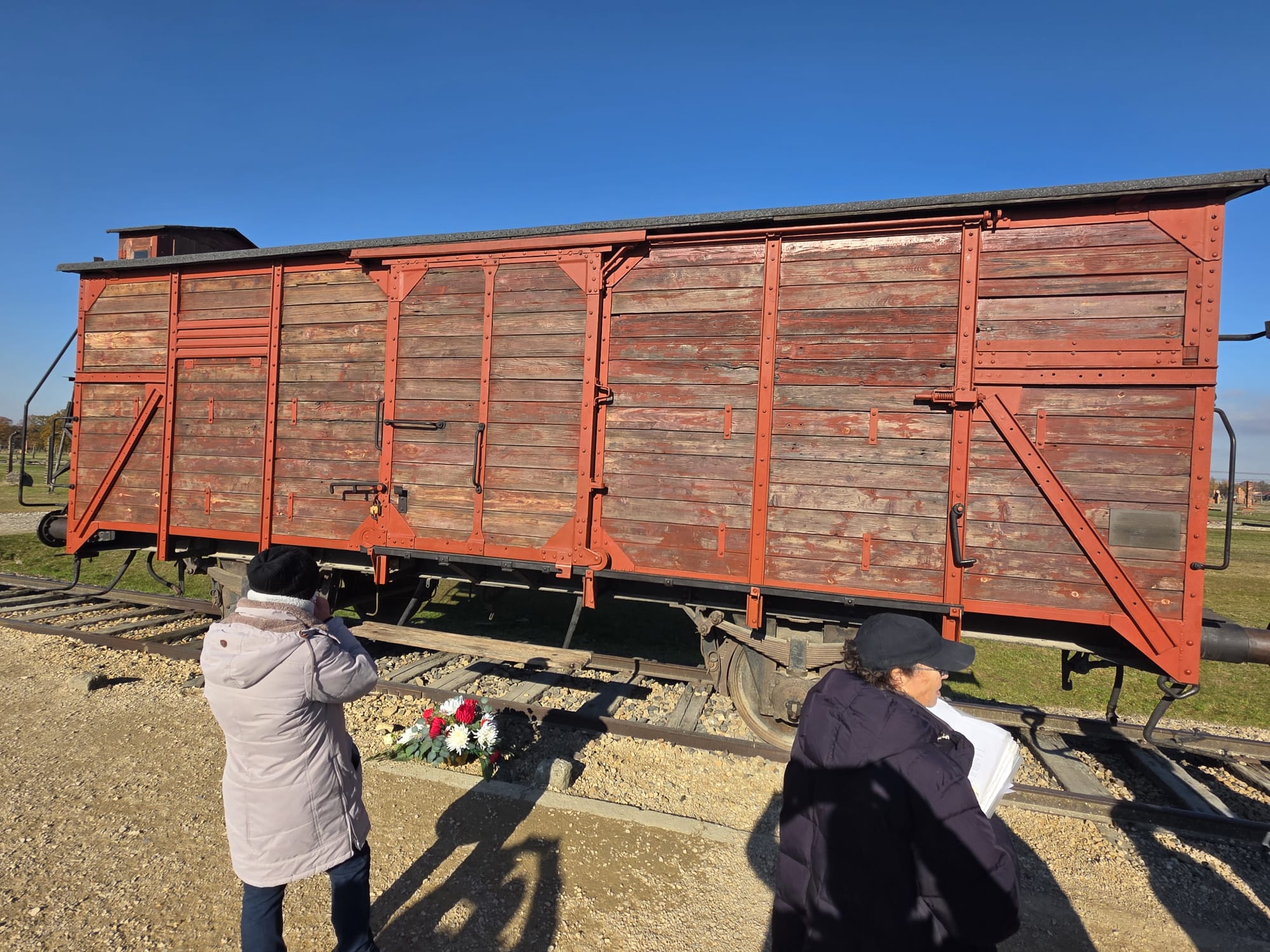
(Photos courtesy of the author)
I spent last week walking through places where Jews no longer live. Not because they moved to better neighborhoods or found opportunities elsewhere. They were murdered, driven out, or scattered, and the communities they spent centuries building were destroyed.
For nearly a thousand years, Poland was one of the great centers of Jewish life. Jews built synagogues, yeshivas, businesses, and families. They studied Torah, argued about politics, celebrated weddings, raised children, and buried their parents. They were merchants, scholars, laborers, rabbis, and ordinary people trying to make a living and give their children a better future.
In some of the towns we visited, Jews once made up nearly half the population. Today, those communities are gone.
I knew the history before coming here. Many Jews do. We’ve read the books, seen the photographs, watched the documentaries, and heard the stories. I thought I understood it pretty well. There’s something very different, however, about standing where it happened. You can know the history without fully appreciating what it meant for the people who actually lived through it. I’m not sure anyone who wasn’t there can ever completely understand it.
Our journey through Poland was organized and led by Rav Binny Freedman, founder, and Dean of Yeshivat Orayta in Jerusalem, who accompanied us throughout the trip. We visited places where Jewish life had flourished for centuries, where it was destroyed, and where the remnants of that life still exist.
We began in Warsaw, visiting the old Jewish cemetery and walking through what had been the Warsaw Ghetto. We stood at the Umschlagplatz, where hundreds of thousands of Jews were assembled for deportation, most of them sent to Treblinka to be murdered. We learned about the Warsaw Ghetto Uprising, when a small group of Jews fought back against the Germans despite knowing they had almost no chance of surviving.
In Parczew, we saw a former synagogue that has become just another building. Without someone telling you what it once was, you might walk right past it. We went into the nearby forests where Jews hid from the Nazis, living in underground shelters, struggling through freezing winters, hunger, and the constant fear of being discovered.
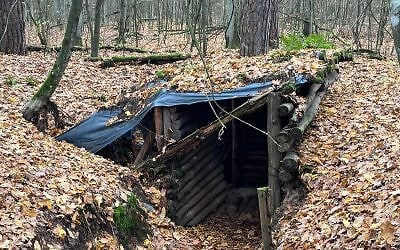
One story particularly stayed with me. Hundreds of Jews gathered in that forest on Yom Kippur in 1943 to pray together. Many had lost their families. They had no idea whether they would survive another day. Yet they gathered to speak to God.
Then came Majdanek. We walked through the gas chambers. On the walls and ceilings, we could see patches of blue staining, a chemical residue known as Prussian blue, associated with the use of Zyklon B, the cyanide-based pesticide the Nazis used in their killing operations. The discoloration was a disturbing reminder of the chemicals used in these rooms.
We walked through the rooms where prisoners were stripped of their belongings, and the crematorium. We saw thousands upon thousands of shoes taken from prisoners. Men’s shoes, women’s shoes, children’s shoes. Every pair belonged to someone. Someone who had a name, a family, a life, and probably plans for what they were going to do the following week.
We stood at the site where approximately 18,000 Jews were shot in a single day, November 3, 1943, as part of the Nazi operation known as Harvest Festival. We were there on November 3, exactly 83 years later.
Poland had been cold last week. Not terribly cold, perhaps 40 or 50 degrees, but damp and uncomfortable, with a chill that cuts through when you’re outside for a long time. We’ve been bundled up in coats and layers, and we’ve still complained about the weather.
I kept thinking about the prisoners who stood outside in freezing temperatures wearing thin uniforms, often without proper shoes or socks. They were starving, exhausted, beaten, and forced to work, tortured in conditions we can barely imagine.
We could get back on a warm bus, return to a hotel, take a hot shower, and eat a good meal. They had none of that. I wondered how anyone survived. I also wondered whether I would have had the strength to endure it myself – I don’t know.
The next morning, in Łańcut, we visited a magnificent synagogue built in 1761. Its walls and painted interior have been beautifully preserved, thanks in large part to a Polish Christian man who devoted decades to rescuing Jewish books and artifacts. The synagogue is still there. The community that built it is gone.
Later, in Markowa, we learned about Józef and Wiktoria Ulma, a Polish Catholic couple who sheltered eight Jews during the Holocaust. They had six young children, and Wiktoria was pregnant with their seventh. According to the account we heard, a Polish man who had been entrusted with property belonging to some of the Jews betrayed their hiding place after they sought to reclaim their belongings.
The Germans murdered the eight Jews and then killed the Ulma parents and their six children. We stood where it happened. Then, our discussion wasn’t only about the extraordinary courage of that family. It was also about the choices people made. Some Poles risked everything to save Jews. Others betrayed them, helped murder them, or stood by. Sometimes those people lived on the same street.
One of the most difficult questions raised during our visit was whether we would have done what the Ulmas did of roles were reversed. Or, would people we know have opened their door to a Jewish family knowing that doing so might result in their own children being murdered? Think for as minute; it’s easy to say yes when you’re standing safely in the sunshine, 82 years later. I don’t know what I would have done. I hope I would have had their courage.
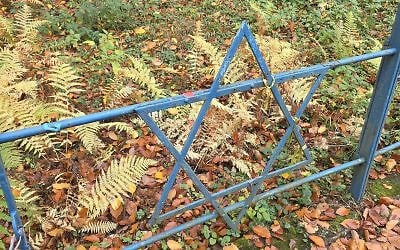
Perhaps the most personal moment of the trip came when we stood in the Łopuchowo forest at the mass graves of Jewish children. We were told that approximately 1,400 children had been murdered there. Some had been led into the forest believing they were going on an outing, unaware of what awaited them.
There were two L-shaped mass graves.
Standing there, we heard a story about a rabbi who returned after the Holocaust to a monastery where Jewish children had been hidden during the war. He wanted to identify the Jewish children and bring them back to their people, but determining which children were Jewish wasn’t easy.
The rabbi began reciting the Shema, the prayer Jewish parents have taught their children for generations. The children recognized the words. Some responded instinctively, remembering what their parents had taught them before they were separated. Those familiar words helped identify children who might otherwise have lost their connection to their families, their faith, and their people.
That story hit particularly close to home for me. Since my children were born, I’ve made it a point to say the Shema with them every night and sing HaMalach HaGoel, the prayer asking God to protect our children. On nights when I couldn’t be home, I recorded myself so my wife could play it for them. I wanted them to hear those familiar words every night, even when I wasn’t there.
Today, my children sing those same words to their children. Whenever I have the opportunity to put grandchildren to bed, I do it with them, too. Our bedtime routine doesn’t end there. After the Shema and HaMalach HaGoel, we sing Hatikvah, Israel’s national anthem, followed by The Star-Spangled Banner and the Pledge of Allegiance.
There’s a reason for that.
I want my children and grandchildren to understand who they are and where they come from. I want them to know that they’re part of a Jewish people whose history goes back thousands of years, with traditions and beliefs that have been passed from one generation to the next. I also want them to appreciate where they live. America has given our family the freedom and opportunity to build lives, raise families, practice our religion, and pursue happiness. Israel represents an essential part of who we are, our history, our people, and our homeland.
I want them to be proud of both, and grateful for the lives they’ve been given.
Standing there, I thought about how something as simple as a bedtime prayer could stay with a child long after everything familiar had been taken away. Those children remembered the Shema because someone had taught it to them, probably the same way I taught it to mine, and suddenly, that familiar bedtime routine meant even more to me.
Then we were asked to write letters to our families. I thought about my children, my grandchildren, and the grandchildren and great-grandchildren I hope will follow. I thought about the children buried beneath us and everything that had been taken from them. Not only their lives, but the lives that would have followed.
The marriages, the children, the grandchildren, the family celebrations, the ordinary days, the arguments around the dinner table, the holidays, the birthdays, the things we complain about, and the things we look forward to. Entire generations of people who should have been here today simply don’t exist.
I began writing to my family. I told them that more than anything, I wanted them to have good, happy lives. I wanted them to enjoy the freedoms those children were denied. To fall in love, raise families, travel, pursue their interests, make mistakes, learn from them, and live their lives the way they wanted.
I wanted them to be proud of being Jewish, to remain connected to their faith, their traditions, and one another. I also told them something I believe very strongly – I don’t want their Jewish identity to be defined by suffering.
Our history includes terrible persecution, certainly, but it also includes thousands of years of learning, accomplishment, tradition, celebration, humor, and family. There’s an enormous amount of joy in being Jewish, and I want them to experience that joy.
I wanted them to appreciate the simple fact that they have a future. Writing those words while standing at the graves of children who never had one was something I won’t soon forget.
Throughout the week, I also found myself thinking about what we’re seeing in America today. As we traveled through Poland, I was reading messages from friends back home, worried about the elections, the growing hostility toward Jews, and what the future might hold for Jewish life in America. Some believe the writing is already on the wall.
I understand their concerns. After what I’ve seen this week, I certainly don’t take them lightly.
One of the things we discussed throughout the trip was how many Jews in Europe believed that if they simply followed the rules, kept their heads down, and didn’t “make waves,” things might eventually get better.
The Nazis didn’t take everything away at once. They imposed restrictions, confiscated property, excluded Jews from schools and professions, limited their movements, and gradually stripped away their rights and opportunities. With each new restriction, people were forced to adjust to circumstances they could scarcely have imagined only a few years earlier.
There was also a terrible manipulation of hope. People wanted to believe that whatever they were enduring was the worst of it, that things couldn’t possibly get any worse. The Nazis exploited that hope, often deceiving Jews about where they were being taken and what awaited them.
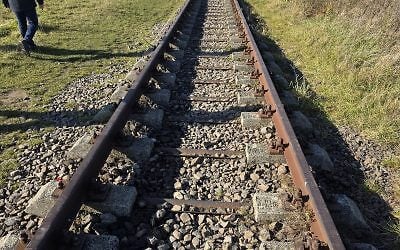
Families were told to pack clothing and belongings, as though they were being relocated somewhere they might begin again. They were crowded into cattle cars and transported under horrific conditions, often without knowing their destination; to be relieved once the train stopped at Birkenau. At some camps, prisoners were told they would be working. At killing centers, victims were sometimes told they were going to shower or be disinfected.
Even the infamous words Arbeit Macht Frei, “Work Sets You Free,” displayed at the entrance to the camp, offered a cruel suggestion that obedience and hard work might eventually lead to freedom. The deception served a purpose. It helped the Nazis maintain control, reduce resistance, and move enormous numbers of people through a system designed to exploit and murder them.
Of course, many Jews understood the danger, resisted, or desperately tried to escape. Others had little choice but to comply, hoping to keep themselves and their families alive for another day. It’s eerie to know how easily hope, something we ordinarily consider a source of strength, could be turned against people whose only desire was to survive.
Of course, many Jews recognized the danger. Some resisted, some fled, and others desperately tried to get their families out. Many had nowhere to go. Others couldn’t imagine that the society in which they had lived for generations could become capable of what followed. By the time the full extent of the danger became clear, opportunities to escape or resist had narrowed terribly.
I don’t believe America today is Nazi Germany in the 1930s. Making that comparison too casually diminishes what happened here and ignores the enormous differences between the two societies. Neither do I believe we should dismiss what we are seeing because we find it difficult to imagine how much worse things could become.
History doesn’t repeat itself according to a script. It does, however, offer warnings about what happens when hatred becomes acceptable, when decent people remain silent, and when those being targeted convince themselves that everything will somehow work out.
We need to pay attention. We need to speak up. We need to protect our communities and stand together, even when we disagree about politics, religion, or Israel. Jewish unity doesn’t require us to think alike. It requires us to remember that we have a responsibility to one another.
I didn’t come away from Poland believing that the lesson of Jewish history is simply to be afraid. There was another lesson waiting for us. After Majdanek, we visited the Chachmei Lublin Yeshiva, once one of the great institutions of Jewish learning in Europe. The building survived the war and has since been restored. We sat in its study hall and learned Talmud.
The passage concerned Rabbi Yosei, who entered one of the ruins of Jerusalem to pray. The prophet Elijah waited for him and warned him against entering ruins. Rab Binny explained that there comes a point when you cannot remain trapped in what you’ve lost. You have to continue forward, even when you cannot imagine what the future will look like.
That lesson stayed with me.
Our journey didn’t end in Poland, and we flew to Israel. This Shabbat I found myself in Jerusalem, at Orayta, spending time with Rav Binny and his students. After days of walking through abandoned Jewish neighborhoods, empty synagogues, forests where Jews hid, and places where Jewish children were murdered, I was suddenly surrounded by young Jewish men learning Torah, singing, dancing, laughing, and celebrating Shabbat. They were happy. They were proud. They were Jewish, and they weren’t hiding it.
There was no need to explain who they were or apologize for it. They were living their lives, studying the same Torah their ancestors studied, in Jerusalem, in a sovereign Jewish state. Still, I kept thinking about the places we’d just left behind.
The empty synagogue in Parczew. The shoes at Majdanek. The Jews praying in the forest on Yom Kippur. The Ulma family and the people they tried to save. The magnificent synagogue in Łańcut, still standing, but without the community that built it. Most of all, I thought about the children buried in that forest.
Only a few days earlier, I had stood at their graves and written a letter to my children and grandchildren about the importance of living their lives fully, being proud of who they are, and appreciating the opportunities they have. Now I was watching young Jewish men doing exactly that. – Learning, singing, dancing, celebrating Shabbat, and looking forward to their futures.
A friend who made the journey with us said something that captured the entire week better than anything I could have come up with. After seeing Poland and then watching these boys dancing, learning, happy, and proud, there was only one conclusion.
Hitler lost.
We won.
That doesn’t mean the six million Jews who were murdered somehow won. They didn’t. Their lives were stolen, their families destroyed, and entire communities erased. Nothing that has happened since can undo that. It doesn’t mean antisemitism has disappeared or that Jewish life is secure everywhere. We know better.
Hitler’s ambition went beyond murdering the Jews of Europe. He wanted to eliminate the Jewish people and everything we represented. Yet here I was, in Jerusalem, watching another generation of Jews doing exactly what he wanted to make impossible. Learning Torah. Celebrating Shabbat. Singing. Dancing. Building friendships and preparing for lives and families of their own.
There was something almost defiant about their happiness, although I doubt the boys were thinking about defiance at all. They were simply being Jewish. Maybe that’s what made it so powerful.
We spend so much time talking about Jewish survival that sometimes we forget survival isn’t the ultimate goal. We didn’t endure thousands of years of persecution simply to remain alive. We survived to live. To raise families. To study, argue, celebrate, create, and contribute. To love our children, watch them build lives of their own, and give future generations the same opportunities.
Standing at those children’s graves, I wrote to my family that I wanted them to live long, healthy, happy, and meaningful lives, surrounded by people they love and who love them. Watching the students at Orayta, I realized I was looking at precisely the kind of future I had been writing about.
I began this week standing in places where Jewish life had been destroyed. I ended it in Jerusalem, surrounded by young Jews whose lives are still ahead of them. After everything I saw in Poland, I cannot take that for granted.
The lesson isn’t simply that we’ve survived. It’s that we must never become complacent or take our freedom, our safety, or our future for granted. We must remain vigilant, stand up for ourselves and one another, and continue to build lives worth living. We owe that to ourselves, to those who came before us, and to the generations who will follow.
A friend said it best.
Hitler lost. We won.
We’re still here. We’re not just surviving. We’re thriving, and we must do everything we can to make sure it stays that way.
Related Topics
Related Posts