
From ‘Zombie Mode’ to ‘Sippy Cups’: Biodiversity in a Fulbright Friendship
Research and writing skills are essential to college and grad courses in nearly all fields of academic inquiry. But one Fulbright Israel scholar took those terms to a whole new level. He blends neurons and narratives in ways that give a fuller picture of Israeli life.
I met Tomer Langberg in 2023 while on a tour of Israel with Fulbright. All I knew about him was that he was a neuroscientist on a postdoc at Tel Aviv University, and that we’d likely not have much in common. I’m not exactly sure if it was his 1970s-era wire-framed, disco-fever glasses, or if it was his cult obsession with the 90s surfer-thriller Point Break, one of my all-time favorites, but he made a lasting impression on me. And we became friends.
He remained in Israel after his Fulbright ended. I sporadically checked on him, especially during the wars. On June 12, 2025, after the preemptive strikes on Iran’s nuclear facilities, I sent him a text, concerned about the escalation of a war. “You in Israel?” I asked.
“Whatsup cpj,” he responded. “Red alert situation here just stayin at home near shelters.”
A few days later, on June 15, war loomed. Then missiles. Anchored to the news, my professional work inert, he shot a text. It was a picture of a window frame on his living room floor. “Missile nearly hit me, my window flew off, glass and broken building pieces all over the neighborhood.” The 12-day Iranian war had begun.
It’s not easy to know what to say in these situations. Having experienced missile strikes on a lesser scale, I knew my message might have felt routine, yet still warranted deep concern.
I kept it short, letting him know “I’m very happy to hear you are safe and made it through.” His response summed up his personality: “Thx g.”
In one sleep-deprived exchange the following week, he referred to being in “zombie mode,” and noted the “city is dead,” referring to Tel Aviv, where he lives.
Before I moved to Israel, I had no idea that most of the population is secular, that Tel Aviv was like a miniature New York City, or that Israelis differ significantly on their moral vision of the nation. I didn’t know I’d find a friend there with a similar linguistic code or film genres. If I were to listen to the news, I’d think it’s just a perpetual conflict zone, a place rather than a people. A people of manifold ideas, interests, and identities. It’s not all Bibi, haredim, and holiness.
I can’t speak about Tomer’s spirituality or religious background because it’s not a part of our relationship. Our friendship rotates around the axis of mutual interest and a common human dignity, not religion. One mutual interest we share is writing, a subject to which Tomer has taken with surprising skill.
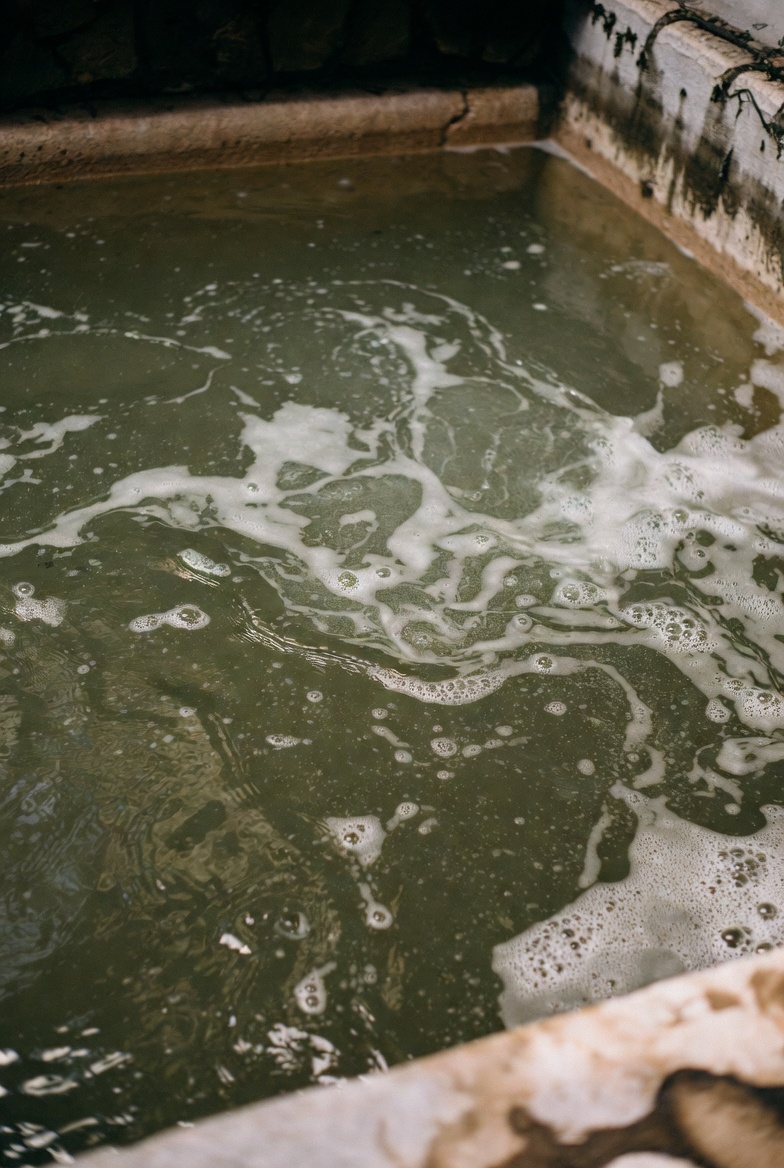
Sitting in an airport, I read his wittily titled Frank about Barb, a short story detailing the main character’s frank speech about a friend, Chester, marrying a girl he loved, Barb. As I read, I blurted out a pffft, laughing at his use of “sippy” to describe the beverage chalice from which he sipped while hot-tubbing with a barrel-chested Bill. Immersed in the water, they evaluate the surface-level scum rising to the surface, describing with precision the organic matter washed off their bodies. This pseudo-scientific dialogue serves as a leitmotif of past shames that sit just on the surface, washed away in a Flood, and that, eventually, bubble up in vulnerable moments.
Now warm and drunk, the story continues: he confesses to Bill his tryst with Barb one steamy “mosquito summer,” a biting memory of a past that gave him life and drained his lifeblood. He allows his emotions to rise, sharing his scummy acts and a longing for what could have been. Then Barb shows up and they have one last dance before the wedding, after which he finds himself defeated and uncertain, with nowhere else to turn. He finds resolve back in the grimy tub – a mikveh – and at the bottom of a bottle as he gets “sippy” to ease the pain.
The tragicomic dialogue caught me off guard with its ability to evoke universal feelings of regret and guilt, laden with sardonic, dream-like narration. The story is a reminder of our human brilliance and glorious faults, and his writing helped me understand the complexity of human emotion and a shared inheritance of personal struggles. Whether the story is fiction or not, I do not know, but the ability to tap into the human psyche and share in universal struggles allowed me to see my friend – this big-brained scientist – as more than neurons firing in a cranial vault.
So, I now sit in tension, thinking about my friend living as a zombie in Tel Aviv, trapped in a bomb shelter and writing about the snares we set for ourselves in this life. It got me thinking about the ways we entrap others into fixed images and stereotypes, and how many think about Jews or Israelis as genocidal colonizers and conquerors. Tomer is all but these essentialized shapes of an Israeli.
Just a few weeks ago, I had a short spat with a Jewish graduate student about Israel. “Israeli lives are precious,” I said. She was ready to argue, shifting to Palestinian suffering, unwilling to affirm. I held my ground, gently re-emphasizing that the subject was Israeli lives. She furiously took notes, as if I’d handed her a homework assignment on university social justice. Such empathy-dodging is all too common.
Tomer’s literature is one access point to the complex identity of Israelis. A grown-up neuroscience researcher using childlike language like “sippy” is just one particle of a larger molecule that offers a more nuanced view of the overly simplistic narratives on Israelis. Tomer, as with us all, has overlapping identities that defy neat narratives about Jews, Israel, Israelis, or otherwise. Israel is full of Tomers whose brilliance transcends a single identity.
Tomer’s story – our story – reminds me why programs like Fulbright are lifelines and life preservers in an age of anti-Israel bandwagons. International academic exchange is crucial in serving the interests of the United States, if for no other reason than to help Americans move beyond surface-level interaction and war narratives to global friendships. Our friendship extedned the boundary markers of research and writing beyond the lab to the domain of personal text exchanges, ones that bind us, whether living as zombies or getting sippy.