
From Kibbutz to the global stage
Future Rescue Technology: Live AI-Dog Systems for Battlefields and Earthquakes
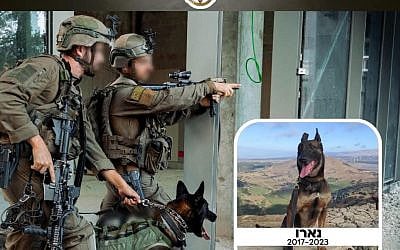
When a Dog Becomes a Living Sensor System in the Age of AI.
From the Tragedy in Shejaiya to a New Vision of Human-Animal-Machine Interfaces.
In December 2023, Pank, a dog from the Oketz Unit, was sent on an operational mission in the Shejaiya refugee camp in Gaza. Days later, after her body was recovered, it was revealed that the camera attached to her had recorded voices speaking Hebrew inside the building she had entered — voices later identified as those of the three Israeli hostages mistakenly killed by Israeli forces: Yotam Haim, Alon Shamriz, and Samer Al-Talalka.
This tragedy raises not only painful questions, but also a futuristic one:
Could AI-connected rescue dogs one day identify human distress in real time, transfer accurate information to forces in the field, and perhaps even help prevent similar disasters?
The Fog of War and the Identification Problem:
Modern battlefields are filled with uncertainty. Soldiers are forced to make life-and-death decisions within seconds, under extreme pressure, where every sound or movement may be interpreted as a threat.
In this tragic case, Hebrew voices were heard, yet within the operational chaos they were interpreted as a possible Hamas deception. This is the essence of the “fog of war” — a situation in which even real information struggles to become verified intelligence.
This is where a new layer of mediation may emerge in the future: the combination of animals, AI systems, and real-time communication.
The Dog as a Biological Sensor:
Rescue dogs and special military units are not merely “technological tools.” Dogs possess extraordinary sensing abilities.
They can detect fear, distress, stress, scents, and movement in ways that humans often struggle to interpret in real time.
Studies already show that artificial intelligence can analyze canine body language, movement patterns, behavioral responses, and even stress or scent-detection indicators — sometimes more accurately than humans interpreting the dog’s reactions.
In the future, biometric and neurological sensors may enable some of these responses to be analyzed in real time and integrated into advanced AI systems.
How a Human-Dog-Machine System Could Work:
Instead of sending a dog equipped only with a camera, future systems could combine:
-AI-connected cameras and microphones.
-Real-time voice analysis of human speech.
-Detection of language, stress, distress, or cries for help.
-Analysis of the dog’s own behavioral responses.
-Live transmission to field commanders or operational headquarters.
Such a system would not replace human judgment — but rather add another layer of verification under conditions of uncertainty.
The Dog as a Communication Mediator:
In the future, voice-enabled systems may even allow basic interaction between trapped civilians and rescue forces.
For example, an AI-connected speaker attached to the dog could say:
“This is a rescue forces dog. Who is inside the building? Please identify yourselves.”
The information could immediately be transmitted to forces on the ground, analyzed in real time, and combined with video, audio, and behavioral data from the dog itself.
In situations involving rescue operations, earthquakes, collapsed buildings, or urban warfare, even a few minutes can mean the difference between life and death.
Not Only Military — Civilian Life-Saving Applications:
This field is not limited to the battlefield.
Human-animal-machine systems could eventually assist in:
-Locating missing persons
-Earthquakes.
-Fires.
-Rescue of trapped civilians.
-Assisting people with disabilities
-Natural disasters
-Maritime rescue operations.
Already today, AI and robotics are integrated into autonomous rescue systems, smart drones, and distress-detection technologies. The future integration of animals may create an entirely new layer of “bio-computational sensing.”
Between Biology and Artificial Intelligence:
For thousands of years, animals have assisted humans — horses, dogs, pigeons, and dolphins.
But the AI era may create a new stage: not merely using animals, but forming a shared cognitive system between humans, animals, and machines.
This vision is still in its early stages, and parts of it belong more to future research than to current operational capability. Yet the direction is already emerging: combining biological intuition with computational power, real-time communication, and AI.
Perhaps in the future, rescue dogs will no longer serve only as the “eyes and ears” of soldiers — but as part of a living sensing system helping humans make better decisions in situations where every second matters.
Related Topics
Related Posts