
Gadi Eisenkot: Does He Want to Govern Israel—or Simply Become Prime Minister?
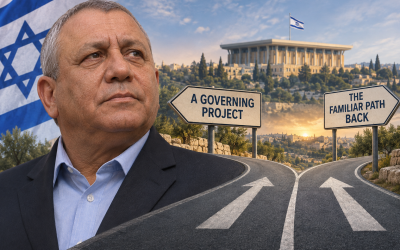
Israel’s former army chief stands at the threshold of the premiership. But military distinction and personal integrity cannot substitute for political experience—or a plan to govern a deeply divided country.
Gadi Eisenkot may soon become Israel’s next prime minister. The remarkable thing is not that a former general is aspiring to lead the country. Israel has seen that before. It is that Eisenkot has reached the threshold of the premiership with comparatively little political experience, overtaking politicians who have spent years learning the difficult business of governing.
Naftali Bennett has served as prime minister, defense minister, and education minister. Yair Lapid has been prime minister, foreign minister, and finance minister. Avigdor Liberman has held the defense, foreign affairs, and finance portfolios. All three have negotiated coalitions, managed government ministries, and confronted the complexities of diplomacy and civilian administration.
Eisenkot has commanded armies. He also served as a Knesset member from 2022 to 2025 and as a minister without portfolio in the wartime government. His distinguished military career, culminating in his service as chief of staff, unquestionably qualifies him to speak with authority about Israel’s security. But the ability to command an army is not the ability to govern a society.
Israel’s experience with generals who entered politics should have taught it that distinction. Yitzhak Rabin, Ehud Barak, and Ariel Sharon reached the premiership after distinguished military careers. Their political achievements and failures were very different, but none demonstrated that military distinction automatically produces effective political leadership.
A general operates within a hierarchy. A prime minister must govern through negotiation, persuasion, compromise, and the continuous reconciliation of conflicting interests. The skills are not interchangeable.
Why, then, has Eisenkot emerged as the principal figure in a political camp containing leaders with considerably greater experience in government?
Part of the explanation lies in his public image.
The Humility of Ambition
Eisenkot has been presented as an unusually modest political figure: quiet, restrained, serious, and uncomfortable with political theatrics. His demeanor contrasts sharply with the personality-driven politics that have dominated Israel for years.
His family’s sacrifices have reinforced his moral standing. His son Gal and two nephews were killed during the war in Gaza. Eisenkot has borne these losses with a dignity that deserves profound respect.
But personal dignity is not a qualification for political office, and modesty of manner is not necessarily humility of judgment.
Political humility should also include recognizing the limits of one’s preparation.
When Eisenkot entered politics in 2022, he joined Benny Gantz’s National Unity alliance. He later broke with Gantz and established his own party, Yashar. Disagreements over party democracy and leadership played a role, but the separation also created a vehicle for Eisenkot’s independent political ambitions.
His refusal to become Bennett’s number two was particularly revealing. He had not left his position as Gantz’s deputy, he explained, merely to become someone else’s deputy.
There is nothing improper about ambition. But Eisenkot had another path available.
He could have joined a government led by one of the opposition’s more experienced politicians, accepted a senior cabinet position, and spent four years acquiring the political and administrative experience that his military career could not provide. In 2030, he might have sought the premiership with a record of civilian government to complement his military achievements.
Such a course would not have demonstrated a lack of ambition. It would have demonstrated an understanding that ambition and preparation are different things.
Instead, Eisenkot chose to seek the highest office immediately.
The question is not whether he has the right to do so. It is whether the image of a humble, reluctant politician adequately describes the political ambitions he has demonstrated.
A Program, but Not Yet a Method
The more consequential issue is not Eisenkot’s ambition but the purpose to which he would put political power.
Israel’s problems extend far beyond national security. The country is divided over religion and state, judicial authority, military service, economic priorities, the place of Arab citizens in national life, and its future relationship with the Palestinians.
These divisions preceded October 7, 2023. Indeed, the internal crisis that engulfed Israel before the Hamas attack revealed a society already struggling with fundamental questions about its national identity and political institutions.
A government that defends Israel against external enemies while leaving its internal divisions unresolved will not have addressed the country’s central predicament.
Eisenkot has spoken about national unity, institutional integrity, public responsibility, and security. His party has not been vague. Its platform comprises ten policy documents, with specific deadlines and commitments: a security doctrine within 150 days, a commission of inquiry in the government’s first weeks, and a ceiling on Torah-study deferrals.
What it does not clearly supply is a method for governing a country whose citizens disagree about the very character of their state.
Individual policies, however reasonable, do not necessarily amount to a coherent approach to government. How would an Eisenkot administration rebuild trust among Israelis who disagree about the country’s fundamental identity and direction?
Naftali Bennett has argued that Israelis agree on roughly 70 percent of the issues confronting them and disagree on the remaining 30 percent.
The figures are a political formulation, not a statistical finding. But the proposition is significant.
Rather than allowing the most divisive questions to paralyze the country, a government could concentrate on areas of broad agreement, restore the effectiveness of public institutions, and gradually rebuild the capacity for cooperation.
The remaining disagreements would not disappear. Some could not responsibly be postponed. But a society that has recovered the habit of working together might eventually become better equipped to confront them.
Such an undertaking could require a decade of sustained political effort.
Whether Bennett’s approach would succeed is open to debate. Its significance is that it offers a method of governing a divided society, not merely a candidate for governing it.
What is Eisenkot’s comparable project?
His security credentials cannot answer that question. Nor can the promise to replace Netanyahu.
The Coalition That Could Change Israel
The October election created an unusual political opportunity.
Netanyahu’s bloc won 53 seats. The opposition bloc led by Eisenkot won 48. The Arab parties won 19. Together, the parties outside Netanyahu’s bloc hold 67 seats in the 120-member Knesset.
That arithmetic does not automatically produce a governing coalition.
Lieberman opposes reliance on Arab parties. Yair Golan, leader of the Zionist left, has advocated a minority government supported by Arab parties. Those parties have recommended Eisenkot for the premiership despite their disagreements with his security outlook.
This is a remarkable development.
Bennett and Lieberman are themselves security hawks, with military backgrounds and extensive experience in government. Golan is a former senior general. The willingness of such different political forces to consider cooperation suggests that security disagreements need not prevent the formation of a government.
The more difficult question is whether their leaders can distinguish between the issues on which agreement is possible and those on which disagreement must continue.
Here, Bennett’s 70/30 proposition becomes more than an attractive slogan. It offers a possible foundation for cooperation across political and communal boundaries.
Including Arab citizens more meaningfully in the governance of Israel would introduce serious challenges. But it could also represent an important step toward rebuilding a shared civic framework.
Such a government would not eliminate ideological differences. It would attempt to make democratic cooperation possible despite them.
That is a political project.
Instead of concentrating exclusively on this possibility, Eisenkot has also pursued negotiations with Likud.
The distinction between negotiating with Likud and restoring Netanyahu to the premiership matters. Eisenkot has opposed Netanyahu’s continuation as prime minister, and Bennett has supported exploring a broad coalition under Eisenkot that could include Likud.
A broad government might offer greater parliamentary stability. Yet the negotiations raise an unavoidable question: What would make this arrangement different from earlier experiments?
In 2020, Benny Gantz entered a unity government with Netanyahu under a rotation agreement. The government collapsed amid disputes over the budget and the implementation of the agreement, before Gantz could become prime minister.
Eisenkot himself participated in the emergency government formed after October 7 and left the war cabinet with Gantz in June 2024, criticizing the absence of a satisfactory strategy for the war.
These experiences do not prove that every future agreement involving Likud must fail. But they place a burden on anyone proposing another such arrangement to explain what would prevent a repetition of the past.
What guarantees would make the agreement durable? What political changes would Likud accept? Would the resulting government represent a departure from the Netanyahu era, or would it preserve many of its governing assumptions?
The negotiations may reflect an understandable effort to explore every parliamentary possibility. But pursuing familiar arrangements is not, by itself, evidence of political imagination.
And a coalition is not a governing program simply because it includes parties that normally oppose one another.
The Difference Between Leading and Governing
Eisenkot has identified Israel’s internal divisions as a grave national danger. That diagnosis deserves attention.
But a diagnosis is not a treatment.
His military career established his capacity to exercise command. His political career has demonstrated his determination to lead. What remains less clearly established is the political project through which he proposes to govern.
The distinction is especially important because Israel’s next government will inherit more than the consequences of war. It will inherit a crisis of social cohesion and political legitimacy that no general, however accomplished, can resolve through military expertise alone.
Israel does not merely need another prime minister.
It needs a government capable of restoring a shared sense of purpose to a deeply divided country.
The question is not whether Gadi Eisenkot can become prime minister. It is whether he can imagine a future for Israel that does not repeat the mistakes of its past—and whether he possesses the experience and knowledge to make that future possible, or at least the humility to recognize his limitations and draw upon those who possess what he lacks.