
Middle East Analyst
Gaza is Widening the Saudi Arabia–UAE Rift
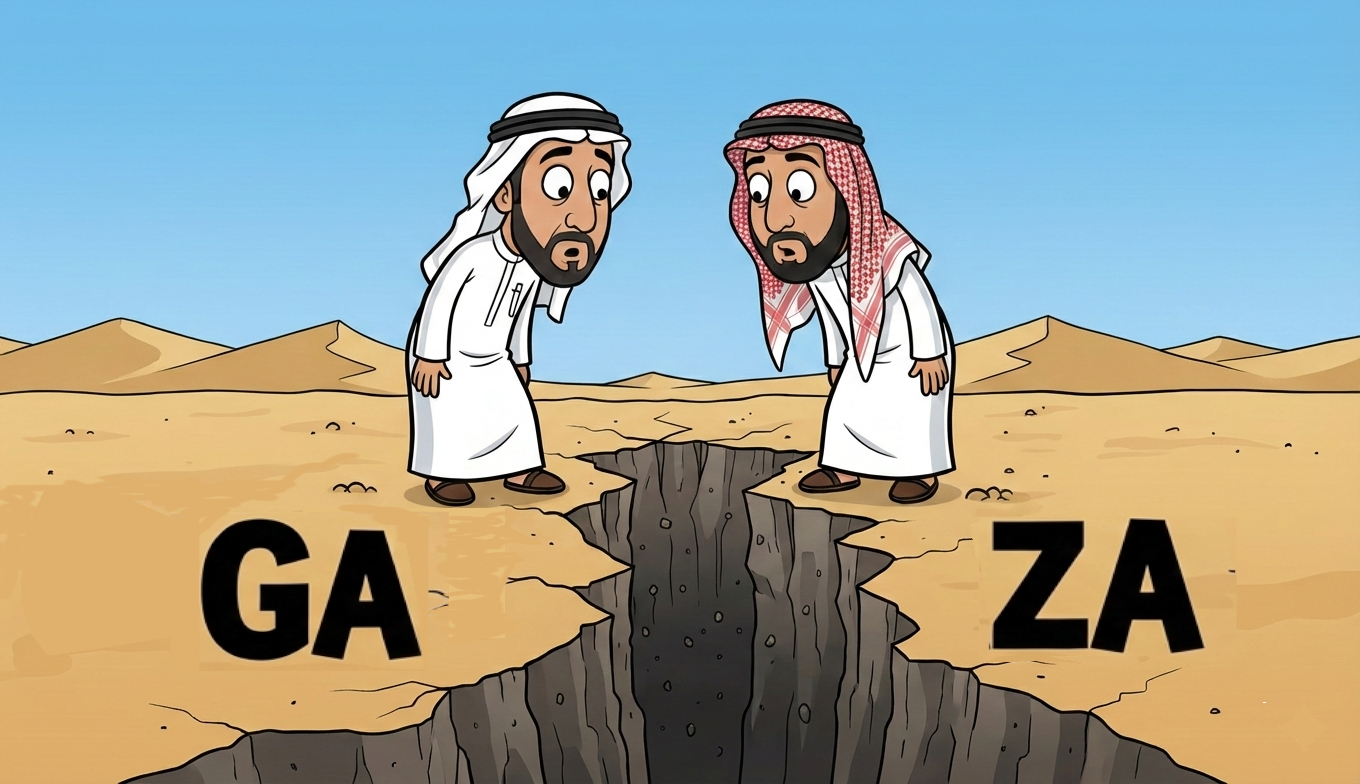
The war in Gaza has become more than a humanitarian catastrophe and a regional shock. It has also accelerated and exposed a widening strategic rift between Saudi Arabia and the United Arab Emirates—two states whose partnership once anchored Gulf coordination and shaped regional outcomes from Yemen to Sudan. Gaza did not create this divergence, but it has brought into sharp relief the fundamentally different security doctrines and political priorities that now separate Riyadh and Abu Dhabi.
For much of the past decade, Saudi Arabia and the UAE projected an image of close alignment. They cooperated on counterterrorism, shared concerns about Iranian influence, and presented a united front on regional diplomacy. Beneath that surface, however, important differences were already emerging—particularly over how to manage fragile states, political Islam, and the balance between sovereignty and influence. Yemen was the first arena where these tensions became unmistakable.
Saudi Arabia entered Yemen committed to preserving the country’s territorial integrity and restoring a unified, internationally recognized government that could secure Saudi Arabia’s southern border. The UAE pursued a different course, backing the Southern Transitional Council (STC), a separatist movement intent on carving out an independent South Yemen and controlling key ports and coastal infrastructure.
That divergence culminated in late 2025 when STC forces overwhelmed the Saudi-backed Yemeni government in the Hadhramaut and Al Mahrah, materially weakening Riyadh’s southern flank and eroding the very state authority Saudi Arabia was trying to sustain. Saudi Arabia responded with a rare and revealing moment of direct confrontation. Saudi jets struck materiel being unloaded at the port of Mukalla—cargo Riyadh assessed as linked to UAE support for southern forces operating outside the control of the Saudi-aligned government. Following the strike, Saudi officials issued an ultimatum warning that further action would follow if the UAE did not withdraw its forces. Shortly thereafter, Abu Dhabi announced that it was ending its remaining military presence in Yemen, framing the move as a voluntary redeployment rather than a concession. Whatever the public messaging, the episode marked a decisive break: Saudi Arabia was willing to use force to defend its conception of sovereignty and border security—even against a close partner.
Sudan offered a second illustration of the same underlying split. Saudi Arabia backed the Sudanese Armed Forces (SAF) as the embodiment, however flawed, of state continuity. Despite denials the UAE is widely believed to be aligned with the Rapid Support Forces (RSF), a powerful paramilitary actor whose rise has contributed to Sudan’s fragmentation. Each side justified its position in pragmatic terms, but the contrast was stark. Riyadh prioritized institutional survival and territorial coherence; Abu Dhabi favored influence through non-state actors capable of shaping outcomes on the ground, even at the expense of Sudanese national unity. Widespread atrocities committed by the RSF and a devastating humanitarian crisis further compounded reputational damage for the Emiratis.
Gaza has now become the most consequential arena where these competing doctrines collide. Unlike Yemen or Sudan, Gaza carries enormous symbolic, political, and reputational weight across the Arab and Muslim worlds. The war has forced regional actors to clarify not only how Gaza should be governed after the fighting stops, but what political horizon—if any—should accompany reconstruction and security arrangements.
Saudi Arabia has aligned itself with an internationally mandated framework rooted in UN Security Council Resolution 2803. The resolution authorizes the creation of transitional governance mechanisms, including a technocratic Palestinian administration and an Executive Board tasked with overseeing security, reconstruction, and stabilization. While the legitimacy and feasibility of these bodies remain contested, their legal basis is multilateral, not unilateral. Crucially for Riyadh, the framework embeds a credible political horizon tied to Palestinian self-determination and statehood—an element Saudi leaders have insisted is essential to any durable post-war arrangement and to any future normalization with Israel.
For Saudi Arabia, the lesson of Gaza is that technocratic fixes without a political endpoint merely freeze instability in place. Without a pathway toward Palestinian statehood, Hamas—or its successors—will remain entrenched, and Gaza will continue to function as a perpetual source of regional volatility.
The UAE has taken a different approach. Abu Dhabi has emphasized security first, prioritizing the total exclusion of Hamas and other Islamist actors while seeking a more direct role in reconstruction and administration—often in ways that dilute the influence of the Palestinian Authority, Turkey, and Qatar. The UAE has long been perceived by the West as a marker of regional modernization and pragmatism; however, it is close alignment with Israel on Gaza has become politically costly as images of destruction in Gaza dominate Muslim and Western public discourse. More broadly, the UAE’s preference for working through proxies and bespoke arrangements has reinforced Saudi concerns that Abu Dhabi’s approach risks fragmenting already fragile political landscapes rather than stabilizing them.
These differences have widened as Riyadh has grown more willing to engage Turkey and Qatar—states it once viewed with deep suspicion—as necessary actors in managing Gaza’s transition and containing Hamas within a broader political framework. For the UAE, Ankara and Doha remain ideological adversaries whose influence should be constrained, not accommodated. What would have been unthinkable a decade ago—a Saudi tilt toward Turkey and Qatar—now reflects a pragmatic recalibration driven by Gaza’s political realities.
The rift is also playing out in Washington. Saudi Arabia presents itself as a stabilizing force committed to internationally mandated solutions, territorial integrity, and a credible political horizon for Palestinians. The UAE emphasizes its hardline opposition to Islamist movements and its reliability as a security partner. Gaza has intensified this competition, with each state seeking to shape U.S. perceptions of what order should replace the war.
The implications are significant. A fractured Saudi–UAE relationship weakens Gulf coordination at a moment of extraordinary regional stress. It complicates U.S. efforts to manage Gaza’s transition, deter Iranian escalation, and stabilize conflict zones from the Red Sea to the Horn of Africa. It also signals a broader realignment, as Saudi Arabia explores deeper coordination with Turkey, Qatar, and Pakistan around diplomacy and security.
Gaza did not cause the Saudi–UAE rift, but it has made it impossible to ignore. The conflict has exposed the limits of a partnership once assumed to be durable and has forced both states to reveal their underlying strategic doctrines. As the region enters an uncertain post-Gaza phase, the widening gap between Riyadh and Abu Dhabi will impact not only Gaza’s future, but the broader architecture of Middle Eastern politics.
Related Topics
Related Posts