Gaza: Winning the Postwar Peace
In 1945, who could have imagined that Germany and Japan would, only a few decades later, become two of the United States’ closest allies?
German cities lay in ruins. Hiroshima and Nagasaki had suffered atomic attacks. Germany and Japan had experienced defeat, occupation, and the collapse of the political systems that had led them to war.
Everything seemed in place to fuel an inexpiable hatred of the American victor for generations to come.
Yet something else happened.
After disarming their former enemies, the United States and its allies did not content themselves with controlling their territories. They gradually rebuilt their societies, institutions, and economies. They dismantled the structures of Nazism and Japanese militarism, while also creating the conditions that allowed a new generation to see the future as preferable to a return to the past.
Military victory had destroyed the capacity to wage war. Reconstruction had to make war itself lose its appeal.
This may be the most important lesson of 1945 for Gaza.
The comparison obviously has its limits. Gaza is neither Germany nor Japan in 1945. Hamas is not a state, and the Israeli-Palestinian conflict has its own national, territorial, and religious history.
But one principle remains: Israel’s security will only be lasting when Hamas has lost not only its weapons, but also its ability to pass its ideology on to the next generation.
This is where the postwar period begins.
Disarming Hamas Is Not Enough
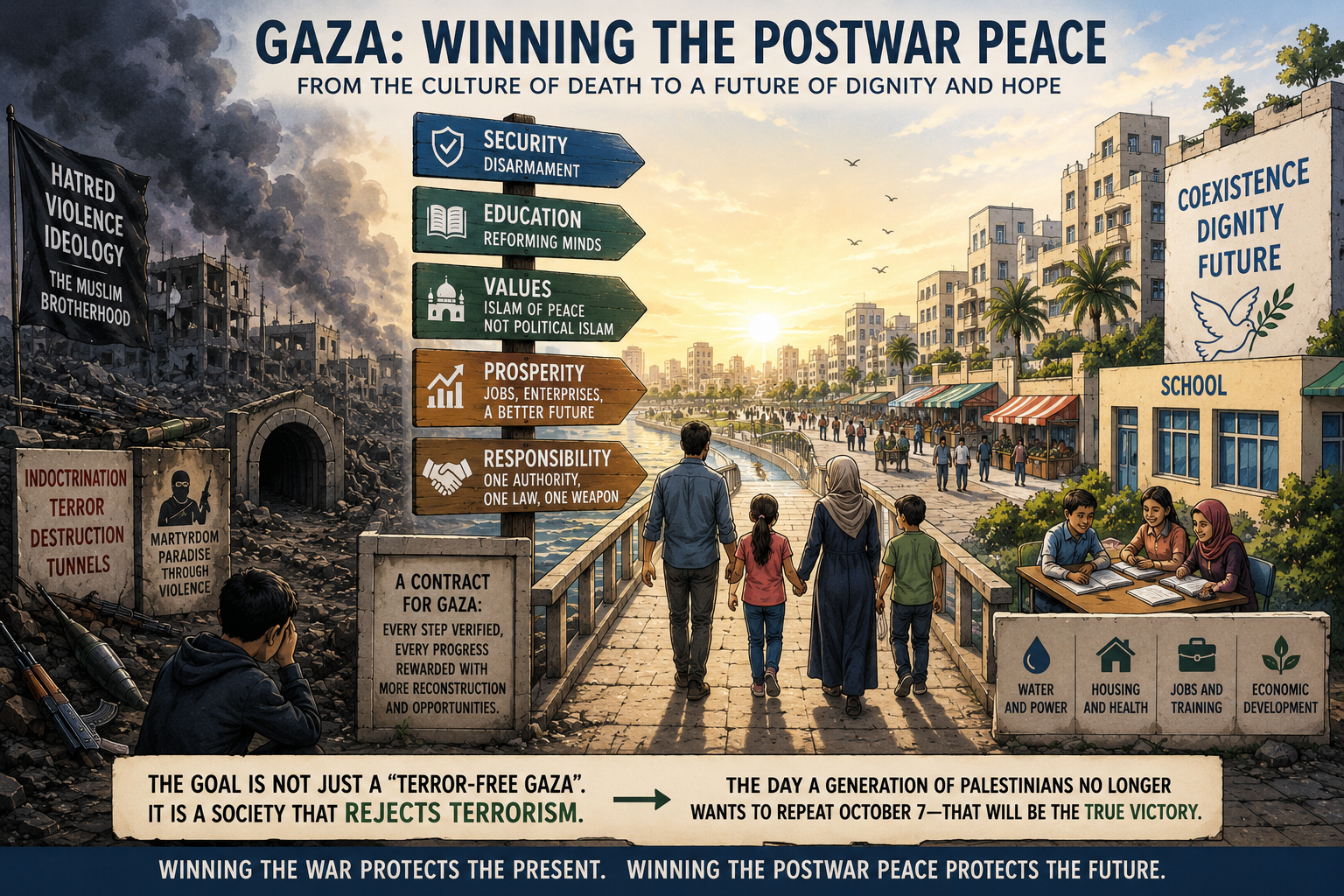
The Board of Peace’s program for Gaza provides an architecture that moves in this direction: dismantling Hamas’s military infrastructure, verified disarmament, the principle of one authority and one weapon, an international stabilization force, a vetted Palestinian police force, and economic reconstruction.
This architecture addresses a first question: How can Hamas be prevented from doing it again?
But it leaves a more difficult question unanswered: How can we ensure that a new generation no longer wants to do it again?
Hamas is not merely a military organization. It is part of the broader Islamist political movement rooted in the Muslim Brotherhood, and it has built around this ideology a system of religious, educational, social, and media influence.
Destroying tunnels and confiscating weapons will therefore not be enough if the same ideas continue to be transmitted in schools, mosques, associations, and social media.
An organization can be destroyed.
An ideology can survive its destruction.
We therefore need to envisage a second form of disarmament: after military disarmament, ideological disarmament.
This does not mean fighting Islam.
It means confronting a political and religious conception that turns hatred of the other, violence, and the destruction of Israel into collective obligations.
And above all, it is not enough simply to suppress this ideology. It must be confronted with an alternative.
This is where certain Arab states can play an essential role.
The United Arab Emirates has chosen to confront political Islam and organizations linked to the Muslim Brotherhood while simultaneously promoting an official discourse of tolerance, religious coexistence, and openness.
The goal is not to import the Emirati political model into Gaza. But some of its institutions and practices deserve to be studied.
Emirati religious institutions could help train Palestinian imams. Foreign funding for mosques and associations should be transparent and subject to oversight. Preachers who call for violence should be excluded from institutions financed through the international reconstruction effort.
Above all, a different religious message needs to be given a much greater public platform:
Being Muslim does not require hating Jews; being Palestinian does not require wanting to destroy Israel.
This battle is decisive.
An ideology that promises death must be confronted with a culture of life.
Start with the Children
The first arena for this transformation is the school.
Gaza’s schools must be rebuilt, but so must its educational curricula.
A Palestinian, Arab, and international commission should review textbooks, curricula, and digital content intended for children.
The glorification of terrorism, the killing of civilians, and violent martyrdom must disappear.
But prohibition alone is not enough.
Children must be offered something else: science, languages, history, civic education, general knowledge, understanding of other religions, and learning how to coexist.
Progress should be measured.
The attitudes of students toward violence, terrorism, Jews, and Israel should be assessed periodically.
The objective is not to create a generation that loves Israel.
The objective is to create a generation that no longer sees Israel’s destruction as necessary for its own future.
The same logic must apply to mosques, media, and funding.
Foreign funding should be transparent.
Organizations involved in reconstruction should be subject to rigorous screening and oversight procedures.
Content calling for terrorism should be systematically challenged.
But here again, suppression is not enough.
A competing alternative must be created: Palestinian media, religious leaders, teachers, intellectuals, and online voices capable of offering a different narrative.
A narrative that says that social success comes through education and work; that dignity comes from building rather than destroying; and that the Palestinian cause can be defended without terrorism.
Make Peace More Profitable Than Violence
Reconstruction is the third lever.
It should not be conceived merely as a humanitarian operation intended to restore Gaza to its previous condition.
It must produce economic transformation.
Water, electricity, housing, hospitals, and schools are obviously essential. But businesses, jobs, vocational training, and opportunities for young people must also be created.
International funding must be controlled and tied to verifiable results.
The principle should be simple:
Violence must yield nothing; stability must yield much.
Terrorism must provide neither power, prestige, nor economic benefits.
Conversely, every verifiable advance in disarmament, educational reform, and the fight against incitement to violence should open the way to greater investment and reconstruction.
Young Palestinians should be able to see in concrete terms that their future is better when they study, work, and build businesses than when they join an armed organization.
A Contract for Gaza
The Board of Peace program provides a foundation for organizing this transformation.
But we should go further and establish a genuine Contract for Gaza.
Each stage should be verified before the next is triggered.
The objective is to create a new relationship between collective behavior and collective prospects.
Reconstruction must never become a reward for Hamas.
It must become the dividend of its disappearance.
A Terror-Rejecting Society
The Board of Peace program speaks of a “terror-free” Gaza.
That is necessary, but it is not enough.
A society can be rid of terrorism by force and return to it a few years later.
The objective must be more ambitious: to make Gaza not only a “terror-free zone,” but a society that itself rejects terrorism.
This is precisely what distinguishes military victory from historical victory.
Germany and Japan were not simply prevented from resuming the war. They gradually built societies in which the militarism that had led them to catastrophe lost its legitimacy.
Germans did not stop being German. Japanese did not stop being Japanese.
They simply stopped viewing confrontation with their former enemy as the condition of their national greatness.
The same transformation must become possible for Palestinians.
They must be able to preserve their identity, their memory, and their national aspirations without seeing Israel’s destruction as the condition of their own fulfillment.
And Israel, for its part, must understand that a Palestinian does not have to love Israel in order to live peacefully alongside it.
Israel’s true victory, therefore, will not merely be the day when Hamas can no longer repeat October 7.
It will be the day when a generation of Palestinians no longer wants to repeat it.
Winning the war protects the present.
Winning the postwar peace protects the future.