
Award-winning feminist author, anthropologist, educator, coach, publisher, and activist
Gender equality in Israel is getting worse
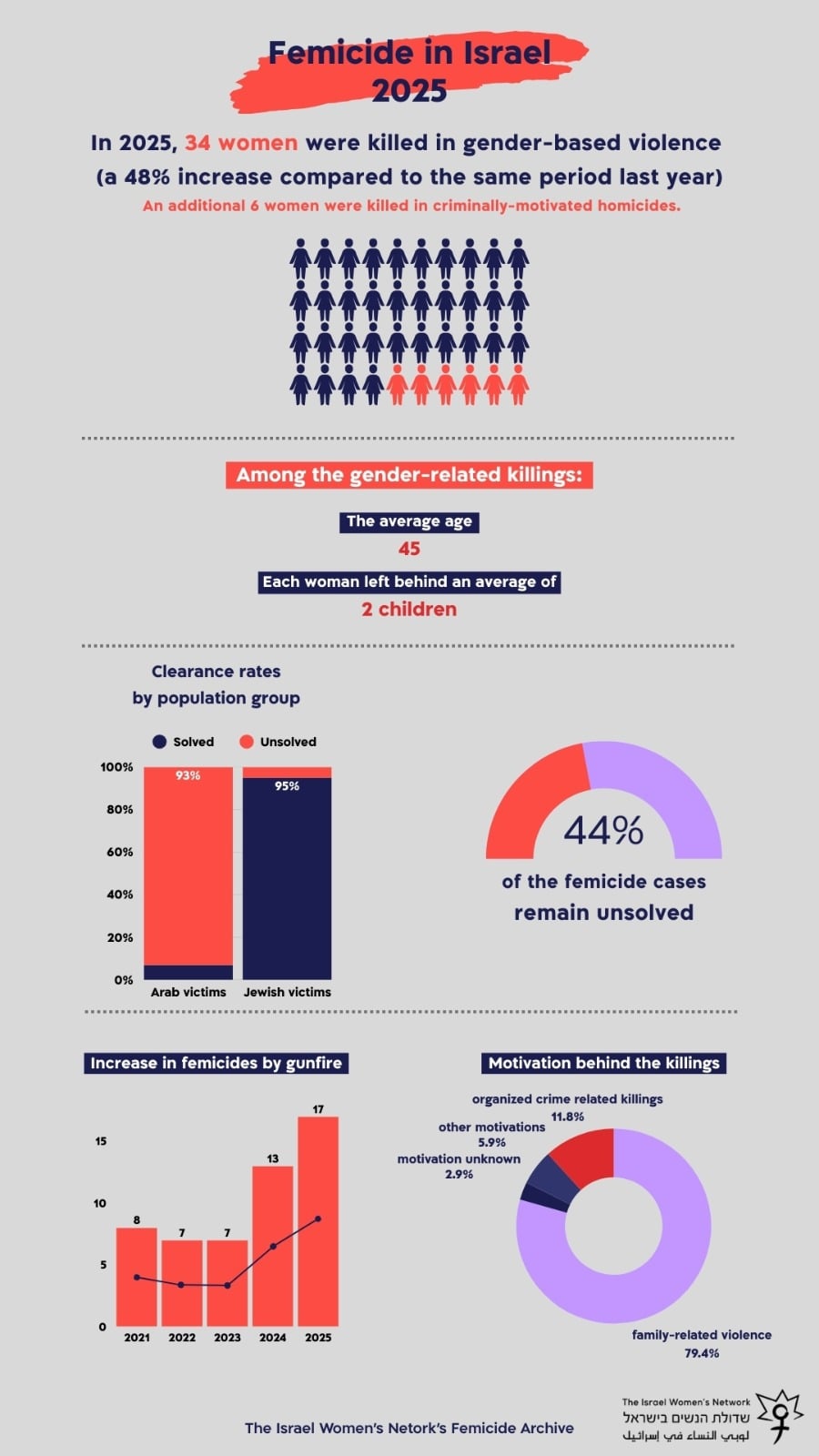
Infographic about femicide in Israel, courtesy of the Israel Women's Network
On the evening of September 11, Hodaya Fadida, 26, who was three months pregnant, was shot to death outside her home in the Gilo neighborhood of Jerusalem by her ex-husband, Matan Fadida. He used a licensed firearm he held through his work as a security guard. After shooting her, he shot himself.
Hodaya was not on any “at-risk” lists of the Welfare Department or the police, despite the fact that she told her mother that she was scared that her ex might do something with the gun he owned. They were separated, so some people might have assumed she was no longer at risk. The weapon was licensed. No emergency order had removed it from his possession. No mechanism intervened before the encounter turned lethal.
And yet, he shot her and killed her. Nobody protected her.
This killing was reported as a murder-suicide. But that doesn’t really tell the story. It was femicide, a case of murder committed against women against the backdrop of systemic misogyny, a culture in which violence against women is just part of the landscape. It is one of 35 cases this year in Israel alone in which women were killed, mostly by current or former partners or other family members, often with legally owned guns. As I wrote last week, women in Israel are being murdered at a rate of roughly one every nine days. Even though many of these cases involve men who were known to authorities, known to welfare systems, or known to pose risk, the women were not protected from the men who sought to kill them, men who retained access to weapons and proximity to their victims.
The case in Gilo did not occur in a vacuum. It occurred in a policy environment in which enforcement tools are limited, risk assessments are narrow, and gender-based violence prevention is treated as secondary to other priorities.
That environment is now documented in data.
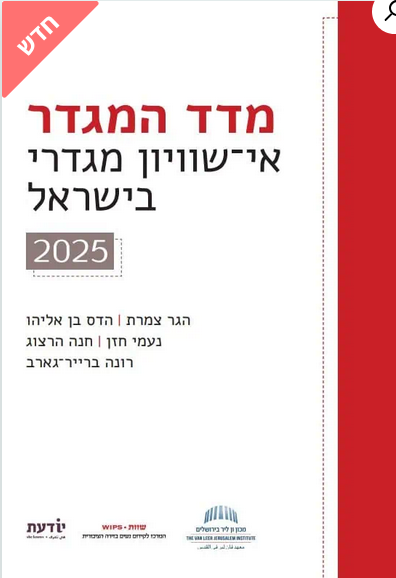
The Gender Index 2025, published this month by Women in the Public Sphere (WIPS) at the Van Leer Institute, founded by Prof Naomi Hazan, Prof Hannah Herzog, and Hadass Ben-Eliyahu, shows a measurable deterioration in women’s status in Israel over the past year. According to the report, overall gender equality declined by 6 percent, primarily due to a sharp drop in women’s political and economic power and their exclusion from centers of decision-making during the tenure of the current government.
A Long-Term Trend, Not a One-Year Anomaly
The Gender Index has been published annually since 2004. Over more than two decades, overall gender equality in Israel has improved by only 15 percent, less than one percent per year on average. In recent years, progress has stalled. In 2025, it reversed.
The areas showing the most significant deterioration are political and economic power, violence, occupational segregation, health, and time use.
The most unequal domain remains political power. Under the current government, women’s representation has declined across multiple levels of authority:
- Fewer women serve as ministers and members of Knesset.
- There are no women serving as directors-general of government ministries.
- Women’s representation in senior civil service roles has fallen.
- Representation of women on boards of government-owned companies has dropped to 36 percent, despite legislation mandating equal representation, and nearly one-third of these boards now include no women at all.
These positions determine policy priorities, budget allocations, and enforcement practices. Their gender composition has practical consequences.
Violence as a Policy Outcome
The Index documents a deterioration across all indicators related to violence. Reports to sexual assault crisis centers have increased. More women are being treated by welfare services for domestic violence. Since 2022, police files opened for sexual offenses within families have risen gradually. The number of women murdered has also increased, with firearms used in roughly half of gender-based killings.
The connection between access to weapons and lethal domestic violence is well established. The report notes the sharp growth in private gun ownership and the lack of effective oversight mechanisms during a period marked by prolonged war and internal instability.
Women’s sense of personal safety reflects this reality. Between 2020 and 2024, women’s reported sense of safety walking at night declined by 18 percent, compared to a 12 percent decline among men.
The murder in Gilo fits this pattern. The availability of a firearm transformed a known risk into a fatal outcome.
War Without a Gender Lens
The report emphasizes that crises tend to widen gender gaps unless countered by deliberate policy. The ongoing war has intensified existing inequalities.
Women’s employment remains less stable and less remunerated than men’s. As defense expenditures rise and civilian services contract, women experience disproportionate economic weakening. Cuts to health, welfare, and education — sectors in which women make up the majority of workers and users — further compound this effect.
At the same time, caregiving responsibilities continue to fall primarily on women, limiting their geographic mobility, employment options, and earning potential. These constraints are reflected in persistent wage gaps and employment patterns that have not improved in over a decade.
Women in Israel earn 35 percent less than men on average, giving Israel the second-largest gender wage gap in the OECD. Unlike most OECD countries, this gap is not narrowing.
When Gender Inequality is Systemic
One of the report’s central findings is that gender inequality is not confined to “women’s issues.” It is shaped by governance structures.
The exclusion of women from decision-making, combined with the weakening of democratic checks and balances and the rise of conservative governance, is embedded into Israeli culture and systems. This reality produces broad ripple effects throughout. Policies designed without women’s participation fail to account for gendered risks, including those related to violence prevention, welfare enforcement, and firearm regulation.
The report states explicitly that excluding women from policy-making undermines democratic foundations and produces tangible harm.
This is not an abstract claim. It is visible in how threats are assessed, how enforcement tools are applied, and how resources are allocated.
Violence against women is preventable
The woman killed in Gilo did not die because the danger was unknowable. She died because systems designed to identify risk and intervene failed to act in time.
The Gender Index makes clear that such failures are not isolated. They are the predictable result of policy environments in which gender considerations are consistently deprioritized. The report also makes clear that regression is not inevitable. Gender-responsive budgeting, enforced representation, and systematic use of disaggregated data have been shown to prevent precisely these outcomes.
What the data shows, taken together with recent cases, is a structural warning. When women are absent from power, their realities are absent from policy. In periods of crisis, that absence becomes visible quickly — and sometimes fatally.
Who is paying attention?
The Israel Women’s Network has been maintaining a database of femicide in Israel in ways that no other group has. In fact, IWN has been doing this because the Israeli government has consistently failed to do so itself. Reliable data is the foundation of effective policy: without accurate documentation and analysis, it is impossible to understand which policies are failing, which interventions are needed, and how women’s lives can be meaningfully improved. IWN continues this work not only to prevent future harm, but to demand accountability and justice for women who can no longer fight for themselves.
IWN, along with other organizations in the field such as the Michal Sela Forum, advocates specific measures that would make deaths like Hodaya Fadida’s less likely to occur. IWN’s research and policy work focus on strengthening risk assessment protocols, expanding the use of high-risk intervention tools such as electronic monitoring for domestic abusers, improving data sharing between police and social services, and tightening enforcement of firearm restrictions for individuals with documented patterns of intimate-partner violence. These are not theoretical proposals. They are concrete, evidence-based practices that have been shown in other contexts to reduce lethal outcomes. In its policy briefs and testimony before the Knesset, IWN has tracked how gaps in enforcement, data collection, and cross-agency coordination contribute to preventable violence and has recommended targeted reforms to address those gaps.
The IWN policy agenda also reflects the interconnected nature of these gaps. IWN has consistently shown that violence prevention cannot be separated from economic and political inequality. Strengthening risk assessment, expanding the use of high-risk intervention tools such as electronic monitoring, improving coordination between police and social services, and tightening enforcement of firearm restrictions are all targeted at reducing preventable lethal violence. At the same time, IWN’s work on economic equality — such as advocating for closing the gender wage gap, expanding access to affordable childcare, and securing stable employment protections — addresses the underlying material conditions that shape women’s vulnerability. Similarly, IWN’s focus on leadership and representation, including pushing for sustained compliance with gender parity laws and increasing women’s participation in decision-making bodies, targets the structural exclusion that leaves policy blind to gendered risks. Together, these strands of work reflect a core principle: gendered harm in Israel is not random; it tracks gaps in economic power, political voice, and systemic attention to risk. Closing those gaps — in policy design, enforcement, and leadership — is a necessary condition for reducing preventable harm.
There is no problem that cannot be addressed. The question is one of political will and government priorities.
Related Topics
Related Posts