Ghassemlou: Murder at the Negotiating Table
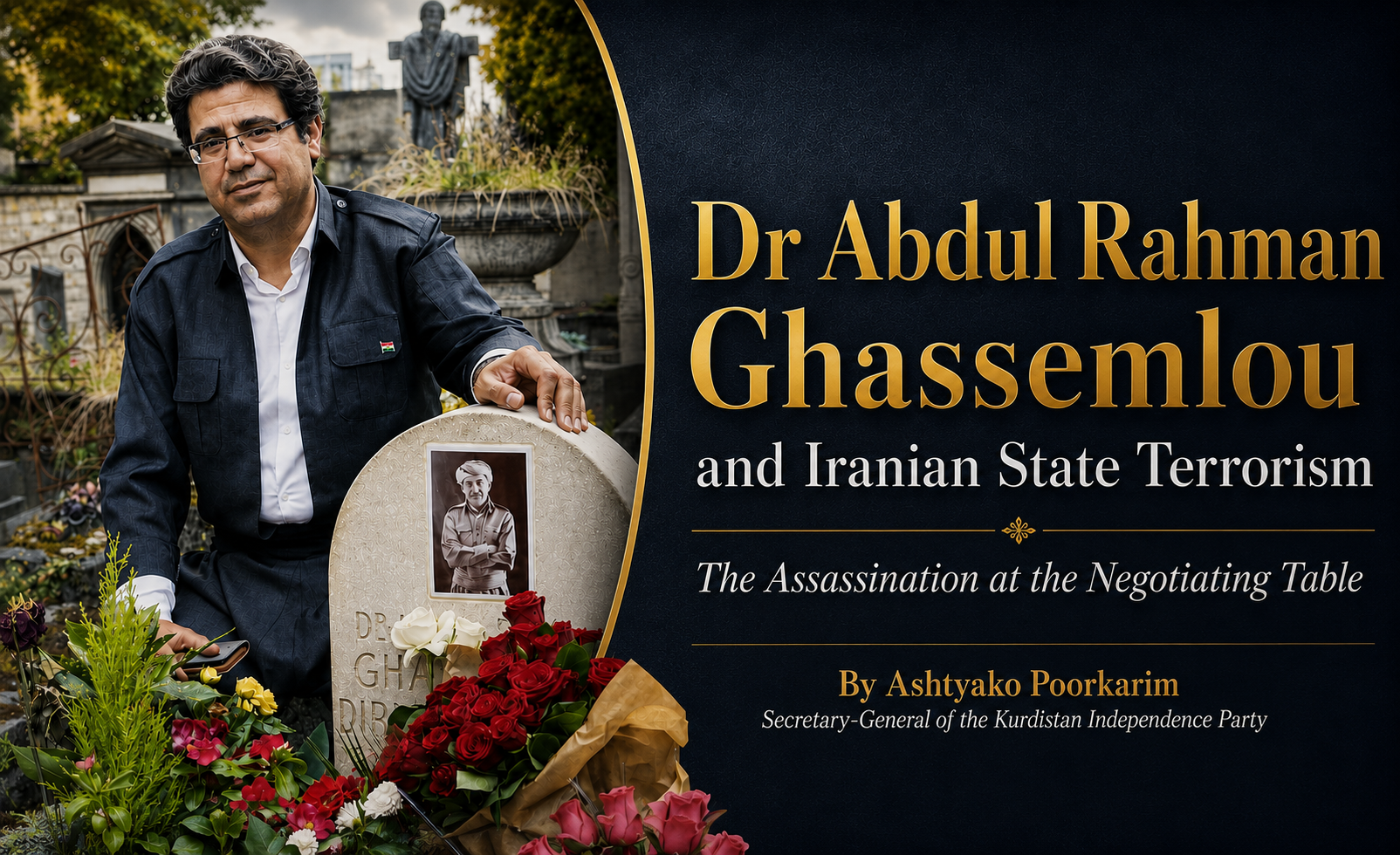
The Vienna Negotiating Table: Ghassemlou’s Assassination and Iran’s State Terrorism
Thirty-seven years after a Kurdish leader was murdered while negotiating with Iranian representatives, the world has still not fully learned the lesson of Vienna.
On 13 July 1989, Dr Abdul Rahman Ghassemlou, Abdullah Qaderi-Azar and Fadhil Rasul entered a meeting in Vienna to explore the possibility of a political settlement with representatives connected to the Islamic Republic of Iran. They did not return alive.
They were not killed on a battlefield. They were not caught in an exchange of fire. They were shot at close range in the very place where dialogue was supposed to replace violence. The assassination and its circumstances have been extensively documented by human-rights organisations and examined in official Austrian parliamentary records. (Abdorrahman Boroumand Center)
The assassination of Ghassemlou was therefore more than the murder of a Kurdish political leader. It was an attack on diplomacy itself, on Kurdish political representation, and on the fundamental principle that political disputes should be resolved through negotiation rather than assassination.
The Vienna crime remains especially relevant today because governments continue to negotiate with the Islamic Republic while often treating diplomacy, terrorism, hostage-taking, proxy warfare and transnational repression as separate matters. They are not necessarily separate. For Tehran, dialogue can coexist with intimidation, coercion and covert violence. The negotiating table may serve as a place of discussion, but it may also be used to buy time, gather intelligence, weaken opponents or create a false sense of security.
The lesson of Ghassemlou’s assassination is not that dialogue must always be rejected. It is that dialogue with a state that has used political assassination as an instrument of policy cannot be based on trust alone.
A Kurdish statesman without a state
Ghassemlou was one of the most sophisticated Kurdish political leaders of the modern era. He combined leadership, academic knowledge, international experience and diplomatic ability in a way rarely seen in the politics of the region. (Iranica Online)
For decades, the Kurdish struggle had often been presented to the outside world through the language of rebellion, tribal conflict and regional instability. Ghassemlou helped transform that image. He appeared before international audiences not merely as the leader of an armed movement, but as an intellectual, economist, multilingual diplomat and representative of a stateless nation.
He explained that the Kurds were not simply a dissatisfied minority or an administrative problem for central governments. They were a people with a historical homeland, a distinct national identity and the right to determine their political future.
This ability made him especially important—and especially threatening—to a state determined to present the Kurdish question solely as an internal security issue.
Military resistance can be labelled insurgency. Kurdish organisations can be prohibited. Demands for national rights can be dismissed as separatism or foreign conspiracy. But a credible Kurdish statesman capable of speaking directly to international institutions challenges the state’s monopoly over the political meaning of Kurdistan.
Ghassemlou moved the Kurdish question from the margins of security discourse into the language of democracy, secularism, human dignity, political representation and national rights. He demonstrated that the Kurdish people were not merely victims asking for sympathy, but political actors capable of articulating a coherent and legitimate national project.
His decision to negotiate did not indicate weakness. It reflected political responsibility. A leader representing a people subjected to war and repression has a duty to examine whether bloodshed can be ended through a political settlement.
The responsibility for his murder belongs entirely to those who planned and carried out the assassination. Yet the manner of his death also reveals how an authoritarian state may exploit an opponent’s commitment to dialogue as an operational vulnerability.
When diplomacy becomes strategic deception
Negotiation normally depends on a minimum assumption: the participants may remain political enemies, but they accept that the process itself will not be used to physically eliminate one another.
In Vienna, that minimum principle was destroyed.
The apparent willingness of the Iranian side to discuss a political solution created access to Ghassemlou and his colleagues. It helped establish the time and location of the meeting. It reduced suspicion and weakened the security barriers that would normally surround the leader of a political movement in conflict with a state.
The negotiating process did not merely precede the assassination. It appears to have created the conditions that made the assassination possible.
This is what makes Vienna so politically significant. It was not simply a killing that happened during a period of dialogue. Dialogue itself was transformed into a mechanism of access and deception.
The operation demonstrated that diplomatic language does not necessarily signify diplomatic intention. A government may speak of peace while pursuing objectives that have little to do with compromise. Negotiations may be used to reduce international pressure, delay decisions, divide opponents, collect information, improve tactical positioning or conceal preparations for coercive action.
This does not mean that every negotiation with Tehran is automatically fraudulent. Political conflicts frequently require bitter enemies to sit at the same table. Refusing all contact can close possible paths to de-escalation and prolong suffering.
But the Islamic Republic’s participation in negotiations should never, by itself, be interpreted as evidence of good faith.
Any serious process involving this regime must include reliable security arrangements, independent mediation, documented mandates, transparent procedures and enforceable consequences for violations. Meetings with opposition figures must take place under the protection of responsible states and institutions. Negotiators must not be left dependent on informal assurances from the very authorities with which they are in conflict.
Vienna teaches us that diplomacy without deterrence, oversight and accountability may become another instrument in the hands of a state that does not consider the negotiating process inviolable.
State terrorism beyond Iran’s borders
The assassination of Ghassemlou should be understood within the broader concept of state terrorism. Academic research has long challenged the tendency to examine terrorism exclusively as violence committed by non-state organisations. (Cambridge University Press & Assessment)
Terrorism is often discussed as a method used by non-state organisations. Yet states can also employ targeted violence, assassination, disappearance, hostage-taking and intimidation to create fear and alter political behaviour.
A political assassination abroad is not intended only to remove one individual. It sends a message to an entire political community. It tells activists that exile does not guarantee safety. It warns organisations that their leaders can be reached. It pressures journalists, dissidents and families into silence. It demonstrates to foreign governments that their sovereignty may be violated.
State terrorism possesses capabilities unavailable to ordinary clandestine groups. A government can draw upon intelligence services, diplomatic missions, official documents, state budgets, proxy organisations and international political pressure. Suspects may receive diplomatic protection or be allowed to leave the country where a crime occurred. Requests for judicial cooperation can be delayed, obstructed or ignored.
The lack of a universally accepted legal definition of “state terrorism” does not remove legal responsibility. Extrajudicial killing, conspiracy to murder, abuse of diplomatic status, violation of another state’s sovereignty and obstruction of justice remain serious offences.
The term state terrorism is politically important because it connects these individual violations and exposes the strategic system behind them.
Austria and the cost of impunity
The Vienna assassination was not only a crime against Kurdish representatives. It was a grave violation of Austrian sovereignty and European security.
The subsequent failure to bring the principal perpetrators and planners before an effective court deepened the damage. Questions surrounding the treatment and departure of suspects, the reported role of diplomatic connections and the apparent influence of political considerations created a lasting impression that relations with Tehran were given greater weight than justice.
Official documents of the Austrian Parliament record parliamentary questions, diplomatic communications and concerns surrounding suspects connected to the killing, including information that one wanted Iranian citizen was believed to have been sheltered inside the Iranian Embassy in Vienna. (parlament.gv.at)
This failure had consequences far beyond the Ghassemlou case.
When a state observes that it can assassinate opponents abroad and avoid meaningful punishment through diplomatic pressure, obstruction or political caution, the cost of future operations decreases.
Impunity is therefore not merely the absence of justice after a crime. It is a political condition that encourages repetition.
European governments have often tried to separate relations with Tehran from the operations of Iranian intelligence services. In practice, such a distinction can be artificial. Diplomatic engagement that ignores attacks on dissidents may communicate that assassinations will be treated as unfortunate complications rather than fundamental assaults on sovereignty and the rule of law.
A democratic state cannot credibly defend its sovereignty if foreign security institutions can conduct lethal operations on its soil without decisive legal and political consequences.
From Vienna to Mykonos
Three years after Ghassemlou’s murder, his successor, Sadegh Sharafkandi, was assassinated alongside Fattah Abdoli, Homayoun Ardalan and Nouri Dehkordi at the Mykonos restaurant in Berlin.
The Mykonos case differed from Vienna in one essential respect: the German judiciary conducted an extensive investigation and trial. The court established the political nature of the operation and connected it to senior structures within the Islamic Republic.
Following the judgment, the German Bundestag formally condemned the involvement of Iranian state institutions in the Mykonos attack as a flagrant violation of international law. The parliamentary resolution also welcomed the recall of the German ambassador, the expulsion of Iranian Embassy officials and the suspension of the European Union’s “critical dialogue” with Tehran.
The judgment demonstrated that the assassination of Iranian and Kurdish opponents abroad could not simply be dismissed as private disputes or the acts of isolated individuals. It revealed an operational system involving state institutions, intelligence structures, intermediaries and high-level political authority.
The findings in Berlin do not, by themselves, judicially prove every disputed detail of the Vienna case. Each crime must be judged according to its own evidence. But Mykonos provides indispensable context.
In Vienna and Berlin, senior Kurdish leaders from the same political movement were targeted in European capitals. The killings served the same strategic purpose: weakening organised Kurdish representation and preventing the Kurdish question from obtaining an influential international voice.
Taken together, the two cases reveal a pattern, not a coincidence.
Internal repression exported abroad
The Islamic Republic’s foreign operations cannot be separated from its system of repression at home.
Inside the country, political opposition has been confronted through imprisonment, execution, torture, surveillance and enforced confessions. In Kurdistan, these practices have been intensified by militarisation, collective suspicion and the denial of independent national representation.
For the Iranian security state, an opponent who escapes the country does not cease to be a target. Exile changes the operational environment, but not the regime’s political objective.
Detention may be replaced by surveillance. Judicial execution may be replaced by assassination. Direct state agents may be supplemented by proxies, intermediaries or criminal networks. Pressure on activists abroad may be combined with threats against their relatives.
The assassination of Ghassemlou was therefore not an isolated departure from the Islamic Republic’s domestic behaviour. It was the international extension of a system that had already defined Kurdish political mobilisation as a security threat rather than a legitimate national question.
The same basic doctrine remains visible in more recent threats, kidnapping plots and attempted assassinations directed against journalists, activists and dissidents outside the country. The methods evolve, but the principle remains the same: political opposition must not be allowed to operate securely, even beyond Iran’s borders.
A report published by the UK Parliament’s Intelligence and Security Committee described increasing intent by Iranian intelligence services to conduct lethal operations in the United Kingdom and characterised the threat as serious. (isc.independent.gov.uk)
The use of criminal intermediaries is also no longer theoretical. In the United States, two organised-crime figures were sentenced to 25 years in prison for a murder-for-hire plot targeting Iranian-American journalist Masih Alinejad on behalf of the Iranian government. Evidence presented at trial connected the plot to instructions from senior members of the Islamic Revolutionary Guard Corps. (Ministère de la Justice)
An attack on Kurdish political representation
Ghassemlou was not simply an Iranian opposition politician. He represented a national movement.
The Kurdish question concerns the status of a people whose homeland has been divided among several states and whose right to determine their own future has repeatedly been denied. Within the Iranian political system, Kurdish demands have commonly been reclassified as separatism, tribal unrest, foreign manipulation or a threat to territorial integrity.
This framing prevents the central question from being asked: has Tehran’s authority over Kurdistan ever been based on the free and democratic consent of the Kurdish people?
When a state refuses to recognise a people as a legitimate national subject, it will also resist recognising their representatives as equal political interlocutors. Kurdish leaders are treated as security targets rather than representatives of a nation. Their demands become crimes, while state violence is presented as the restoration of order.
Ghassemlou challenged this structure by giving the Kurdish cause an international political language. He demonstrated that the Kurdish question could not be erased through military campaigns or ideological denial.
From a Kurdish independence perspective, his assassination was therefore an assault on the right of the Kurdish nation to possess its own political voice. The target was not only the individual. The target was the capacity of Kurdistan to speak to the world through leaders of its own.
The lesson the world has not learned
The Vienna assassination must remain central to any contemporary discussion of negotiations with the Islamic Republic.
Governments often treat nuclear negotiations, hostage diplomacy, commercial relations, proxy warfare and the persecution of dissidents as separate policy areas. Tehran may not view them separately. Diplomacy, military pressure, intelligence operations and coercive bargaining can function as interconnected elements of the same strategy.
The world should therefore learn several fundamental lessons.
Iran’s presence at a negotiating table cannot be confused with its commitment to peaceful conduct. Agreements without verification and enforcement are structurally fragile. Political refugees and dissidents require active protection, not merely formal asylum. Diplomatic missions must not be considered untouchable when credible evidence suggests involvement in surveillance or operational activity. Relations with Tehran must never take precedence over the investigation of violence committed on democratic soil.
Above all, political memory matters.
States that forget Vienna and Mykonos make themselves vulnerable to the repetition of the same methods. Engagement without memory becomes naivety. Diplomacy without accountability risks becoming permission.
Justice remains necessary
Justice for Ghassemlou is not merely a commemorative demand. It remains essential to preventing future crimes.
The case requires continued examination of available evidence, greater access to official archives, cooperation among European judicial authorities and scrutiny of the decisions that prevented effective prosecution.
Responsibility exists at several levels. Individuals who planned, facilitated or carried out the assassination should be identified and prosecuted wherever legally possible. The role of institutions of the Islamic Republic must be formally investigated. Austria must confront whether institutional failures, political considerations or diplomatic pressure obstructed justice.
The passage of time does not reduce the importance of the case. In crimes involving state power, delay can become part of impunity. Witnesses disappear, evidence weakens and officials escape responsibility. But archives may also open, new evidence may emerge and political conditions may change.
Revisiting the Vienna assassination would honour the victims and affirm that Europe cannot remain a permanent theatre of unpunished transnational repression.
Memory against impunity
Dr Abdul Rahman Ghassemlou went to Vienna because he believed the Kurdish people deserved a political solution. The Islamic Republic brought to that table the logic of the security state.
On one side stood a Kurdish leader prepared to explore dialogue after years of conflict. On the other stood a regime whose representatives appear to have transformed dialogue into an opportunity for elimination.
The assassins ended Ghassemlou’s life, but they did not eliminate the political question he represented. The Kurdish nation continues to exist. Kurdistan remains a political reality. The demand for self-determination has not disappeared.
The world must learn from the bloodstained negotiating table of Vienna.
Negotiation with a regime that has used assassination as an instrument of policy can only be meaningful when accompanied by deterrence, independent monitoring, enforceable guarantees and judicial accountability.
Dialogue without protection may become entrapment. Engagement without memory may become complicity. Pragmatism without justice may prepare the ground for further violence.
Ghassemlou died while pursuing a political settlement. The responsibility of the present generation is not to abandon diplomacy, but to ensure that diplomacy is never again used as a cover for murder, that state sovereignty does not shield terrorism and that the interests of governments do not bury the rights of victims.
The memory of Dr Abdul Rahman Ghassemlou, Abdullah Qaderi-Azar and Fadhil Rasul remains inseparable from the struggle for justice, freedom and the right of the Kurdish nation to determine its own destiny.