
CEO of Time to Stand Up for Israel
Good Cop, Bad Cop: Who Is Playing Whom?
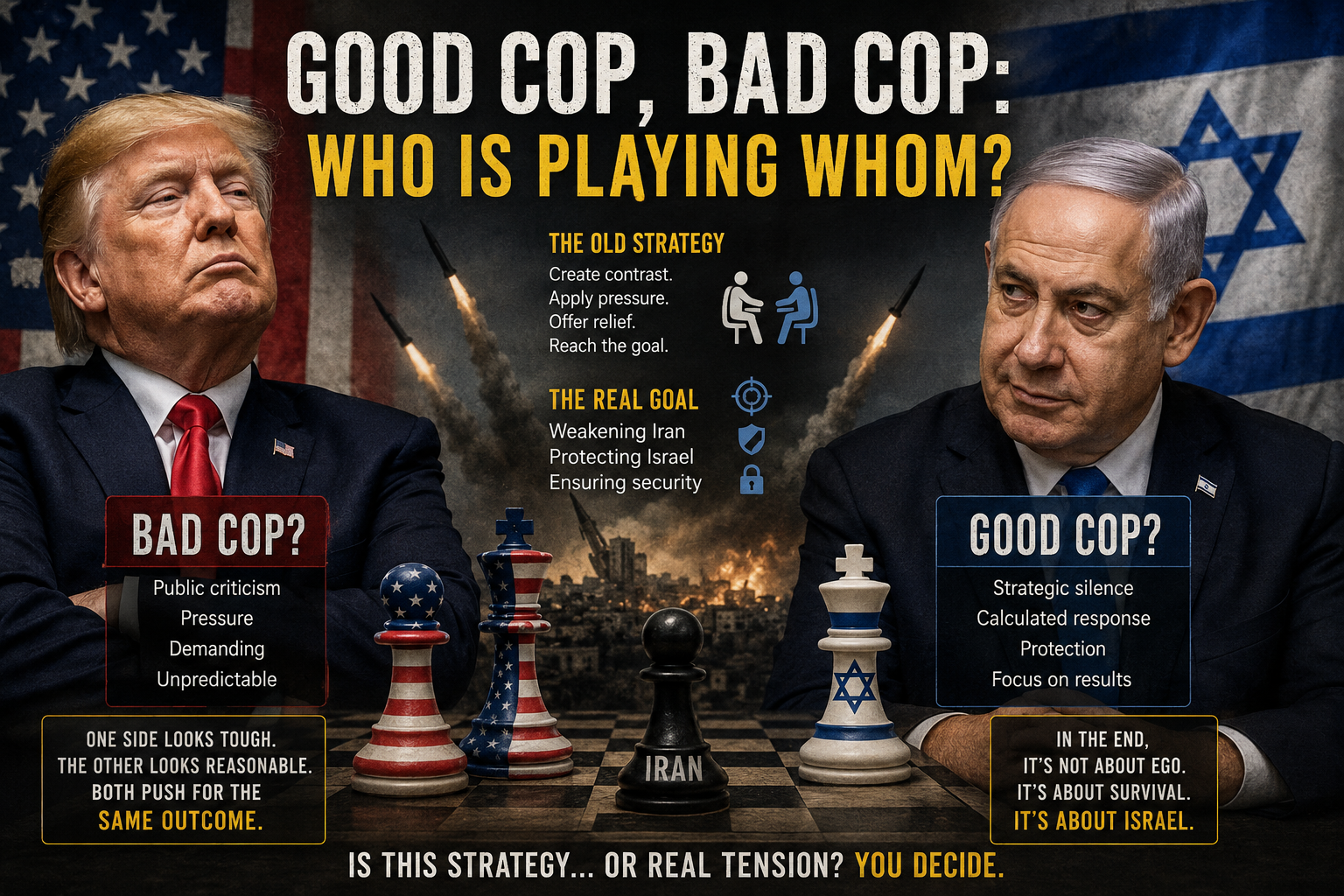
Photo Credits: Sabine Sterk ( AI)
First of all, I am a pro Israel advocate, not a pro USA advocate. Democrat or Republican, I honestly could not care less. Which president sits in the White House matters far less to me than whether Israel can survive and defend itself.
Over the last years, what I have mostly seen are two old men trying to rule, or perhaps ruin, the world.
Looking at the recent confrontation between Israel and Iran and the incomprehensible attitude of Donald Trump, I became furious. Yes, I admit it. Furious at the United States.
Some time ago, after Trump helped get hostages home, I gave him credit. He handled that situation well. But beyond that, I came to another conclusion. Trump is a pure narcissist. And the best way to deal with a narcissist is usually not to interact at all. Ignoring them completely is often the most effective response.
Unfortunately, Trump is not some random man seeking attention. He is the President of the United States.
Why do I believe he is a narcissist?
What sane person publicly states that he deserves the Nobel Peace Prize for his own fantastic efforts? We have heard endless self praise about Gaza, diplomacy, and peace initiatives. We have seen proposals for a peace board involving participants that make little sense from an Israeli security perspective.
Qatar, a country widely accused of financing extremist movements.
Erdogan, whose government has repeatedly positioned itself against Israeli interests.
Pakistan, a nation struggling with extremism and instability.
Yet somehow these are presented as reliable partners for peace.
Trump did not get his Nobel Prize. Meanwhile, almost a year later, Hamas has regrouped. Hamas grows stronger. Terror attacks against Israel continue. The threats have not disappeared.
Well done, Mr. Trump.
Then came the conflict with Iran.
Israel initiated the first confrontation. The United States joined later. Yet, as always, Trump seemed eager to take all the credit.
Now he is once again trying to negotiate.
In fairness, this is not unique to Trump. American presidents have been doing the same thing for decades. It is easy to advocate restraint when your country is thousands of miles away.
The United States cannot be hit the way Israel can.
Israel lives within missile range of extremist regimes and terrorist proxies.
Iran finances Hezbollah.
Hezbollah attacks Israel.
Israel responds.
That is the reality.
So what happens when Israel fights Hezbollah in a war against terror?
Trump tells Israel to stop.
The timing, apparently, is not convenient.
Iran launches a barrage of rockets. Trump reportedly warns Benjamin Netanyahu not to retaliate.
The message sounds simple enough.
Please allow yourself to be attacked.
Please absorb the rockets.
Please think about diplomacy while your enemies think about destruction.
Yet Netanyahu says little publicly and Israel’s magnificent air force strikes military targets inside Iran.
Within twenty four hours there is a ceasefire.
Then an American aircraft is reportedly brought down. Suddenly the United States attacks Iran.
And this is where my frustration reached its peak.
As a European, I see things through a different lens. To me, Trump’s behavior looked inconsistent, self serving, and dangerous.
Then one of my Israeli friends offered a completely different interpretation.
“Sabine,” he told me, “this is a game.”
A game?
He explained the famous Good Cop, Bad Cop strategy.
One side appears hostile, demanding, and unreasonable.
The other appears friendly, understanding, and willing to compromise.
The target feels pressure from the bad cop and relief from the good cop. Eventually, both steer the target toward the same outcome.
The technique is used in negotiations, diplomacy, business, politics, and conflict resolution.
Suddenly I began wondering whether what I was witnessing was not chaos at all.
What if it was choreography?
What if Trump’s public outrage toward Israel was intended for Iranian ears?
What if Netanyahu’s silence and subsequent military action were part of a larger strategy?
What if the apparent disagreement between Washington and Jerusalem was designed to create uncertainty in Tehran?
After all, one of the clearest signs of the Good Cop, Bad Cop strategy is that both parties ultimately push toward the same objective while pretending to disagree.
The contrast distracts observers.
The emotional drama captures headlines.
Meanwhile, the real policy moves forward.
I do not know whether that is what happened here.
Perhaps Trump truly believed Israel should hold back.
Perhaps Netanyahu ignored him.
Perhaps there was genuine tension behind closed doors.
Or perhaps my Israeli friends are right and this was one of the oldest negotiation tactics in the book being played out on the world stage.
If so, it was remarkably effective.
Iran never knew exactly where the red lines were.
The world focused on Trump’s statements.
Israel continued acting according to its security interests.
And eventually both America and Israel demonstrated that neither was prepared to tolerate unlimited aggression.
I sincerely hope my optimistic Israeli friends are right.
Because if this was a coordinated strategy, it was clever.
If it was not, then the Western alliance looked confused at the very moment clarity was needed most.
Which leaves one final question.
When it comes to Israel, Iran, and the dangerous chessboard of the Middle East, who is really playing the good cop?
And who is playing the bad one?
Perhaps the more important question is whether they are both playing on the same team.
Related Topics