
Growing Gulf Discontent Challenges the Arab League
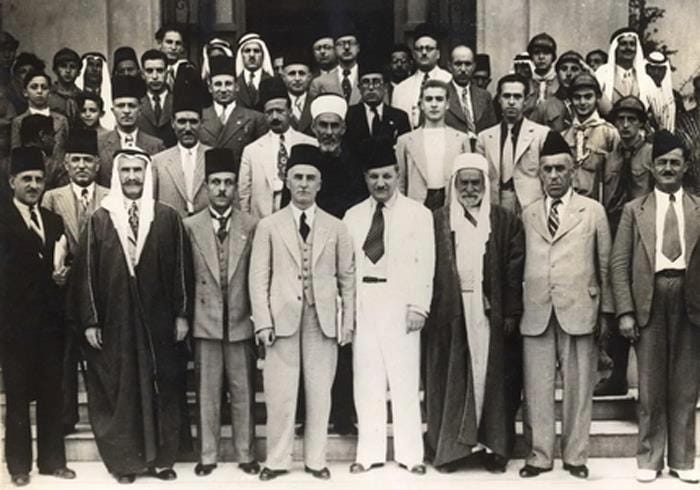
In 1937, Arab leaders gathered in Bloudan, Syria for one of the earliest coordinated efforts to articulate a shared Arab political identity, a moment that helped lay the groundwork for the Arab League, founded in 1945. The League was conceived as the institutional expression of Pan-Arabism: a forum for collective decision-making, regional solidarity, and coordinated response to shared threats.
Nearly a century later, that original vision feels increasingly remote, and nowhere more acutely than in the Gulf.
Bludan Conference, 1937. Source: Wikimedia Commons. This image is in the public domain (PD-Syria) and is free for commercial use.
Public sentiment, particularly on Arabic-language social media, has increasingly turned skeptical of the Arab League’s relevance. But this shift is no longer confined to online commentary. It is now echoed in intellectual circles, policy discussions, and even among members of Gulf royal families, a convergence that signals something more significant than passing frustration.
The critique is structural. The Arab League operates by consensus, moves at the pace of its most reluctant member, and possesses no binding enforcement mechanisms. These limitations are not new. What is new is the environment in which they are being tested: a region marked by Iranian expansionism, proxy conflict, drone and missile attacks on civilian infrastructure, and rapidly shifting geopolitical alignments. Against this backdrop, the League’s characteristic response of formal statements, calls for restraint, and expressions of concern has come to feel not merely insufficient, but institutionally inadequate.
Three interlocking fault lines are driving this disillusionment.
Gulf identity is rooted in something older and more particular than Pan-Arabism. Tribal lineage, regional heritage, and the specific traditions of the Arabian Peninsula form the cultural bedrock of Gulf societies. These affiliations predate the modern nation-state and have, paradoxically, been reinforced by it: Gulf governments have actively cultivated distinct national identities (Emirati, Saudi, Kuwaiti) as part of their state-building projects over the past five decades.
Pan-Arabism, by contrast, was largely a mid-twentieth-century political project shaped by Egyptian and Levantine intellectual currents, and driven in significant part by the Palestinian cause and anti-colonial solidarity. Its cultural and ideological center of gravity was never the Gulf. As Gulf states have grown wealthier, more internationally connected, and more self-confident in their own national identities, the appeal of a broader Arab collectivism has weakened. The Arab League, in this reading, does not represent an extension of Gulf identity. It represents a different one entirely.
This is not a rejection of Arab heritage. It is a recalibration of which institutions are seen as genuinely representative of it.
The UAE and Saudi Arabia are among the Arab League’s primary financial contributors, channeling funds into its operational budget, development initiatives, and affiliated institutions. This financial dependence is well-documented: Gulf states have historically provided a disproportionate share of the League’s resources, a role that reflects both their wealth and their desire to shape regional outcomes.
Yet the return on this investment is widely perceived as negligible. Gulf funding has not translated into decisive political support during crises, reliable alignment on key votes, or meaningful solidarity in the face of security threats. The League has, at critical moments, been paralyzed by the competing interests of its members, many of whom maintain relationships with Iran or resist Gulf-led positions on regional security.
The result is a growing perception of asymmetry: Gulf states contribute financially while receiving little in return by way of political backing or collective action. As one Saudi commentator noted, the arrangement increasingly resembles subsidizing an institution that functions against your interests. Whether or not that characterization is fair, it captures the sentiment driving elite-level skepticism in Riyadh and Abu Dhabi.
The most consequential fault line is security. Over the past decade, Gulf states have absorbed a series of direct attacks on their territory and infrastructure. Saudi Arabia has sustained repeated drone and missile strikes attributed to Yemen’s Houthi movement, which receives weapons, training, and strategic guidance from Iran’s Islamic Revolutionary Guard Corps. The UAE faced a Houthi drone attack in January 2022 that struck Abu Dhabi’s international airport and an oil facility, killing three civilians. Critical Gulf energy infrastructure, including pipelines, refineries, and oil tankers, has been targeted repeatedly. In February 2026, Iran crossed a new threshold, directly striking all six GCC states within 24 hours, hitting airports, refineries, and LNG facilities across the region. Iran fired more than twice as many missiles at Gulf states as it did at Israel.
In each instance, the Arab League’s response has been largely rhetorical. Formal communiqués have condemned the attacks. Emergency sessions have been convened. Statements of solidarity have been issued. None of this has provided deterrence, altered the threat environment, or offered any operational support to the states under fire.
This is not simply a matter of institutional weakness. It reflects the deeper reality that the Arab League includes states whose interests diverge sharply from those of the Gulf, including countries with close ties to Tehran, or that see value in maintaining ambiguity on the Iran question. Consensus-based decision-making, in this context, is not a procedural limitation. It is a structural guarantee of inaction.
Gulf governments have drawn their own conclusions. Saudi Arabia and the UAE have deepened bilateral defense partnerships with the United States, France, and the United Kingdom. The Gulf Cooperation Council has increasingly become the preferred framework for coordinated Gulf security policy. The Abraham Accords, which normalized relations between the UAE, Bahrain, and Israel, were negotiated entirely outside the Arab League framework and reflected a willingness to pursue strategic interests without waiting for pan-Arab consensus.
Taken together, these three fault lines of identity distance, financial asymmetry, and security inaction constitute what analysts are beginning to describe as a legitimacy crisis for the Arab League among its most consequential member states.
The League is not facing dissolution. Gulf states remain formal members and continue to participate in its proceedings. But there is a growing gap between formal membership and genuine investment. The institution is increasingly treated as a diplomatic forum rather than a strategic actor, a venue for registering positions rather than coordinating action.
This matters beyond the Gulf. The Arab League’s ability to play a meaningful role in any future regional architecture, whether on Palestinian statehood, post-conflict reconstruction in Arab states, or the management of Iran’s regional influence, depends on the active engagement of its wealthiest and most capable members. If Gulf states conclude that the League is structurally incapable of representing their interests, they will continue to route their diplomacy elsewhere.
The question is not whether the Arab League will survive. It almost certainly will, as regional institutions rarely dissolve even when they atrophy. The question is what role it will play, and whether it can credibly claim to speak for the Arab world when its most powerful members are quietly disengaging.
For the Gulf, the answer is likely to come not through formal withdrawal but through strategic marginalization: continued participation in League proceedings alongside growing reliance on bilateral partnerships, the GCC framework, and new regional alignments that reflect actual shared interests rather than inherited solidarity.
This trajectory does not mark the end of Arab identity or even of Arab political cooperation. It does, however, represent a decisive shift in where Gulf states believe that cooperation can meaningfully occur.
The Arab League was built for a different era, shaped by different threats, and animated by a political vision that has not survived contact with the realities of the twenty-first century Gulf. Bridging that gap, if it can be bridged at all, will require more than statements of Arab unity. It will require institutions capable of acting on it.