Guarding Bab el-Mandeb and Somaliland’s Rise in the US Political Revolution
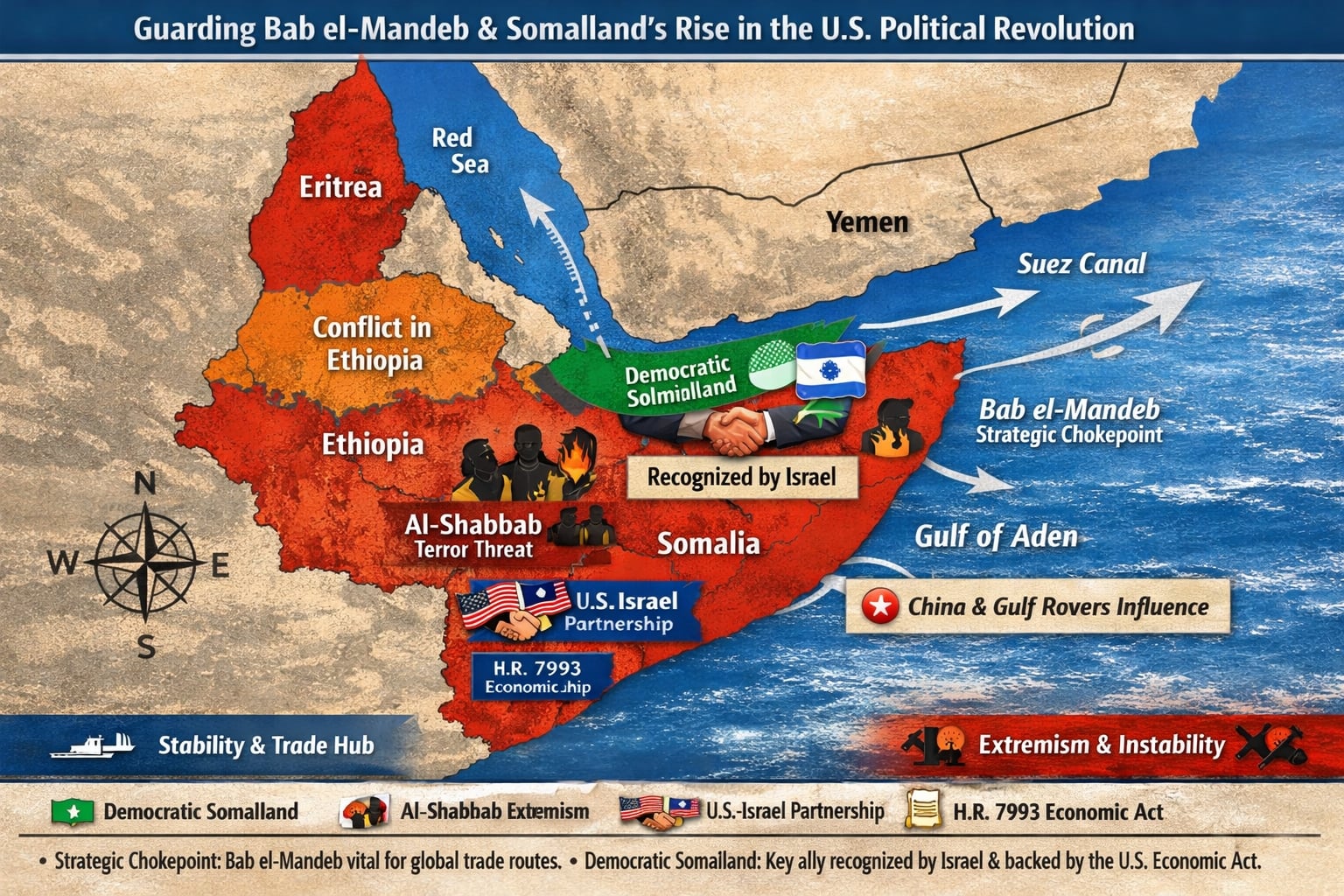
The United States is undergoing a political revolution. President Donald Trump’s restructuring of institutional checks on power is not weakening the U.S.-led order but rather enhancing it by recalibrating America’s leadership in strategic regions. This transformation is creating new opportunities for partners who align with Washington’s priorities. Somaliland, a self-declared republic on the Horn of Africa, has emerged as one such partner. Its recognition of Israel, combined with the introduction of H.R. 7993 — the Somaliland Economic Access and Opportunity Act — underscores its growing role in the global powers game and its emerging status within the US-led new world order.
Somaliland’s resilience is remarkable given its neighborhood. The Horn of Africa and Red Sea basin are dominated by authoritarian regimes and combustible politics. Ethiopia is consumed by internal conflicts, Eritrea remains one of the world’s most closed states, and Somalia continues to struggle with fragility and extremism. Yet Somaliland has built functioning institutions, held competitive elections, and maintained relative peace despite lacking formal recognition. This democratic exception in a volatile region makes Somaliland a credible partner for global powers seeking stability in a flammable environment. It is precisely this resilience that makes Somaliland indispensable to America’s recalibrated global order.
Somalia’s extremism, however, continues to pose grave risks. Al-Shabaab and other militant groups exploit Somalia’s fragility, destabilizing the Horn of Africa and threatening maritime security. Extremism in Somalia risks spilling across borders, undermining Red Sea stability and endangering global trade routes. In contrast, Somaliland has maintained peace and democratic processes, making it a safer and more reliable partner. Its stability is not only a local achievement but a global necessity, ensuring that extremist threats do not compromise the Bab el-Mandeb corridor and Gulf of Aden — two of the world’s most critical maritime choke points.
Somaliland’s recognition of Israel is a bold diplomatic move that strengthens its global standing. It signals a commitment to US-led alliances and democratic partners, while opening avenues for security cooperation and technological support from Israel. This recognition elevates Somaliland’s legitimacy, showing it can act independently and strategically in global affairs. It also serves as a gateway to broader recognition, as other nations watch closely how Somaliland positions itself within the US-led order. In a region where authoritarianism and extremism dominate, Somaliland’s decision to align with Israel and the United States demonstrates both courage and foresight.
The introduction of H.R. 7993 by the US Congress further demonstrates Washington’s recognition of Somaliland’s strategic importance. The act aims to unlock financial connectivity, investment, and development pathways, opening channels to international banking systems, encouraging US businesses to explore Somaliland’s port infrastructure, energy sector, and digital economy, and supporting governance reforms and resilience-building projects. For Somaliland, this legislation is more than economic opportunity; it is a signal that its stability and strategic location are valued within the US-led order. It also provides a framework for Somaliland to reduce dependency on aid and remittances by building a diversified economy tied to global markets.
Somaliland’s ports and coastline are critical to safeguarding one of the world’s busiest trade routes. Stability in Bab el-Mandeb ensures Somaliland’s port ambitions can thrive, linking Africa to global markets. As China, Russia, and Gulf states expand influence in the Red Sea, Somaliland’s alignment with the U.S. and Israel strengthens its position as a counterbalance. Its proactive diplomacy positions it as a stabilizing actor in the Gulf of Aden and Red Sea corridor, while its democratic resilience and recognition of Israel amplify its case for broader recognition. In this sense, Somaliland is not simply surviving in a volatile region; it is actively shaping the contours of the new world order.
The US political revolution is enhancing global order by recalibrating America’s leadership in strategic regions. Somaliland’s recognition of Israel, survival among authoritarian and volatile neighbors, and alignment with US priorities through H.R. 7993 place it at the heart of this transformation. By contrasting its stability with Somalia’s extremism, Somaliland demonstrates its indispensable role in securing the Red Sea, Gulf of Aden, and Bab el-Mandeb corridor. With US support and Israel’s recognition, Somaliland is no longer on the margins. It is waiting for many global friends who are ready to recognize its sovereignty and strategic importance. In a world of shifting power dynamics, Somaliland’s democratic resilience and strategic geography make it a partner the US cannot afford to overlook