Hadassah Volunteer, Hadassah Medical Organization, Hadassah Writers' Circle
Hadassah Hospital Hospice Diaries: The Families
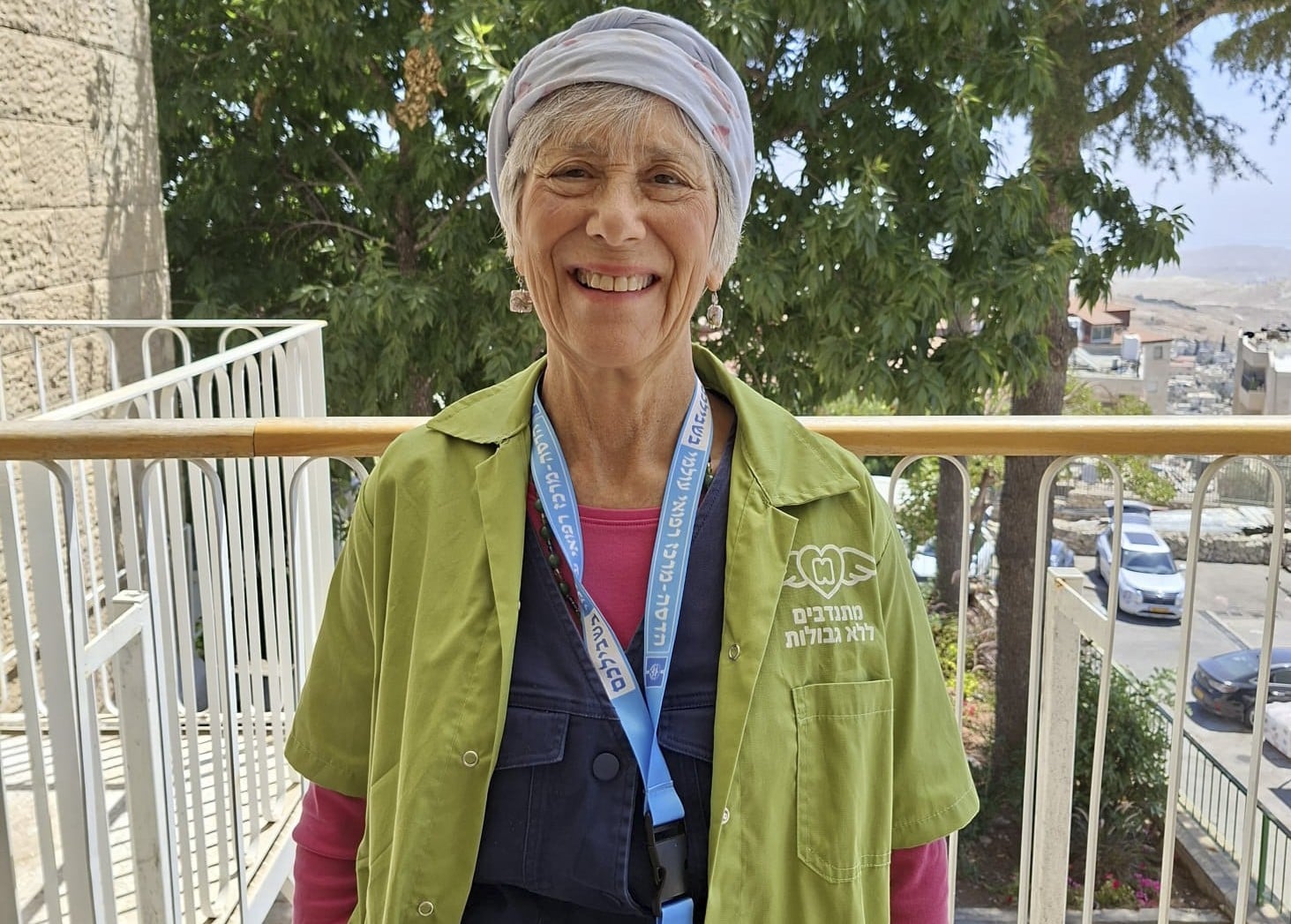
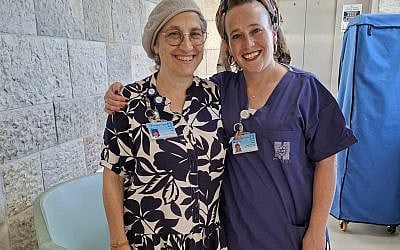
The author on the patio of Hadassah Hospital Mount Scopus Hospice. Photo courtesy of the author.
This is the fourth in an ongoing series on volunteering at the Ina and Jack Kay Hospice at Hadassah Hospital Mount Scopus.
“Suffering! We owe to it all that is good in us, all that gives value to life; we owe to it pity, we owe to it courage, we owe to it all the virtues.” – Anatole France
I’ve written about how the nurses and doctors are sensitive to alleviating as much pain as possible for the patients in the Hadassah Hospital Hospice. There are all kinds of medications for pain relief. I was thinking as I was walking from patient to patient this week, “What about pain relief for the families?” There are really no drugs for them to take, though their pain emanates from such a deep place, in the heart, the belly, the head.
When you are faced with losing a loved one, it is as if the world has gone into a spin – off its axis. You lose track of time, of schedules, and of dates. You forget to eat or you eat poorly. You forget to bathe or put on your deodorant, your makeup, your head covering.
You want to spend every moment that they have left in their lives with your loved ones; to tell them what needs to be told, to hope that they hear you and that you hear them. You don’t want them to suffer, but you also don’t want to let them go.
What medicine is there for this kind of pain? I’ve seen a daughter sitting next to her father, head on the bed, arms above her head, crying, mourning, praying. I’ve seen a husband holding his wife’s head in his arms, whispering to her, their child running back and forth to get whatever her mother asks for – both husband and child worried, exhausted, trying not to think about the inevitable.
What medicine is there for this kind of pain? The people who work at the Hadassah Hospital Hospice know what to do. They know how to talk to the families, they know how to explain this process of dying to them, to help them on this final journey with their loved ones.
The doctors, nurses, social worker, nurses’ aides and volunteers all listen to the families. Everyone is there for them as well as the patient.
The family members know that when they need to take a break, whether it is to go to another place in the hospital, or to go home, their loved one will not be alone. Their loved one is in good hands with people who care.
When the time comes for their loved one to leave this life, if they are not there, they will be called. Their loved one will not die alone; there will be someone there until they arrive at the hospice, someone who will even stay with them until the end. This is the medicine for this kind of pain.
Lena told me that she never worries when she must leave her mother to go to work because her mother will not be alone; her mother will have someone by her side when she needs that, until her daughter can return.
Svetlana knew when she fell and couldn’t come to visit her husband that there would be caring people at the hospice who would be with him. He was so grateful for everything everyone did for him, from popping the top on his soda bottle to turning his phone on in the morning (things he could no longer manage) to bathing him and changing his sheets.
Growing up in America, I was surrounded by almost all English speakers. I understood the conversations around me. In Israel, and at Hadassah Hospital Mount Scopus, I hear Arabic, Russian, French, English and Hebrew. I often don’t understand what people around me are saying. The language of suffering, however, is universal. We all experience it and it changes us forever. Hopefully, suffering causes us to become more sympathetic and empathetic; hopefully, we become stronger through suffering because we realize we can overcome it and go on. The suffering begins to fade, however the love for them remains. We may need help going forward, but the people who work in the Hospice understand that. They are there for the patients and the families. They are truly the medicine for this kind of pain.
The author does not speak on behalf of Hadassah and the views expressed herein are the author’s own and not necessarily those of Hadassah.
Karen is a member of the Hadassah Writers’ Circle, a dynamic and diverse writing group for leaders and members to express their thoughts and feelings about all the things Hadassah does to make the world a better place. It’s where they celebrate their personal Hadassah journeys and share their Jewish values, family traditions and interpretations of Jewish texts. Hadassah members are proud of their Zionist mission and their role as keepers of the flame of Jewish values, traditions and beliefs as well as advocating for women’s empowerment and health equity for all. Since 2019, the Hadassah Writers’ Circle has published nearly 900 columns in The Times of Israel Blogs and other Jewish media outlets. Interested in writing? Please contact hwc@hadassah.org.
Related Topics
Related Posts