Middle East Forum Fellow/North Africa Risk Consultant
Haftar Dynasty: A Rogue Militia Family Is Auctioning Libya to the Highest Bidder
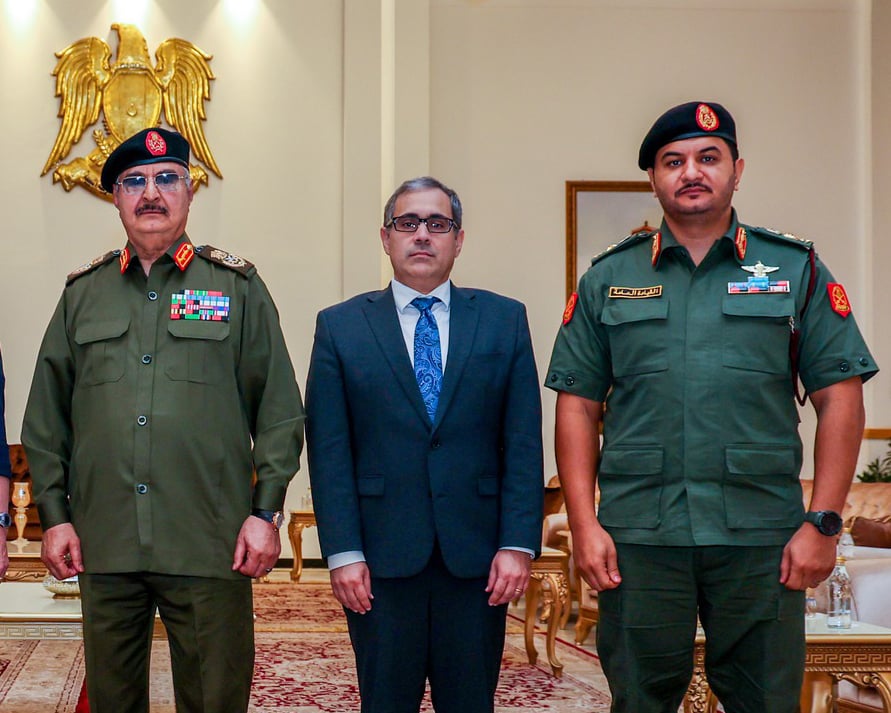
Haftar (left) and his son Saddam (right) with United States ambassador to Libya Jeremy Berndt in September 2024 https://commons.wikimedia.org/w/index.php?curid=153202696
For over a decade, the international community has viewed the Libyan National Army (LNA) led by Khalifa Haftar as a potential, if flawed, bulwark against the tide of Islamist extremism in North Africa. However, as 2026 unfolds, any remaining illusions of the LNA as a professional national institution have evaporated. Instead, Libya has been transformed into a family-run security enterprise—a “Haftar Dynasty”—that is systematically auctioning off Libyan sovereignty to a dangerous collection of global spoilers, from the Kremlin to a nuclear-armed Pakistan.
Under the guise of “regional stabilization,” Khalifa Haftar’s sons, Saddam and Khaled, have turned eastern Libya into the Mediterranean’s most volatile proxy chessboard. The current diplomatic flurry—highlighted by Saddam Haftar’s January 16 meeting with French military leadership in Paris and a subsequent high-level defense summit with Jordan’s Chief of Staff in Benghazi—is not a sign of legitimacy, but of a desperate search for new patrons to sustain a regime built on institutional necrosis and the weaponization of scarcity.
The Pakistan Gambit: Killing the Embargo
The most alarming development is the LNA’s recent $4.6 billion defense deal with Pakistan. This agreement, finalized in late 2025 between Saddam Haftar and Pakistan’s Chief of Army Staff, Field Marshal Asim Munir, represents the final, unceremonious death of the United Nations arms embargo. By procuring 16 JF-17 Thunder multi-role fighter jets and 12 Super Mushshak trainers, the Haftar family has successfully established a “South-South” military-industrial channel that operates entirely outside Western oversight or conditionality.
For Pakistan, a nation increasingly marketing its military as a “geopolitical commodity,” Libya is a lucrative proving ground for its indigenous hardware. For the Haftars, it is a way to achieve state-level air superiority without the “nuisance” of Western human rights demands. This deal also carries a shadow of Chinese influence, as the JF-17 platform allows Beijing to project power into North Africa while maintaining plausible deniability. The prospect of a nuclear-armed South Asian power deeply entrenching its military in the central Mediterranean should be a wake-up call for NATO’s southern flank.
Russia’s African Gateway
While Saddam Haftar courts the West and Pakistan, his brother Khaled serves as the primary liaison for Russia’s “Africa Corps”—the institutionalized successor to the Wagner Group. Moscow has moved beyond temporary mercenarism to permanent stakeholdership, securing a 25-year tripartite protocol with the LNA and Belarus. This agreement has effectively ceded 11.7 square kilometers of the port of Tobruk to Russian control, including naval logistics and UAV launch pads.
Libya has now been repositioned as Russia’s primary military hub for projecting power into the Sahel, propping up military juntas in Mali and Burkina Faso while threatening European energy security. Satellite imagery confirms that bases such as Al-Jufra and Maaten al-Sarra are being modernized not for temporary deployment, but for a long-term presence that allows the Kremlin to manipulate migration flows as a weapon against the European Union. By backing the Haftar brothers, Russia is securing a launchpad for global destabilization that stretches from the Mediterranean to the Red Sea.
Destabilizing the Neighborhood: The Sudan Connection
The Haftar family’s survivalist logic has also made them a central engine of the conflict in Sudan. Despite intense pressure from Egyptian President Abdel Fattah al-Sisi, Saddam Haftar has turned southeastern Libya into a lifeline for the Rapid Support Forces (RSF) and its commander, “Hemedti.”
Through the Kufra district and the newly established “17 crossing” on the Chadian border, the LNA facilitates the systematic diversion of subsidized fuel and weapons to the RSF in exchange for economic dividends from Darfur’s gold mines. This support—often mediated by the UAE—clashes directly with Egypt’s national security interests, creating a “Quad War” that threatens to spill over into the border triangle of Egypt, Libya, and Sudan. The Haftars’ willingness to fuel a regional genocide for financial gain proves they are not a partner for peace, but a catalyst for anarchy.
The Hydro-Weaponization of Unity
At home, the Haftar regime relies on “hydro-weaponization” to maintain its grip. The Great Man-Made River (GMMR), Libya’s vital 4,000-kilometer water network, has been transformed into a tool of political coercion. Armed groups loyal to the LNA frequently storm control stations to shut off the water supply to Tripoli, holding the population of the capital hostage to Benghazi’s political demands. This exploitation of a fundamental human need underscores the “zombie” nature of Libyan institutions, where central authorities compete not to govern, but to control the flow of life-sustaining resources for factional survival.
A Dynasty of Chaos
The rivalry between Saddam and Khaled Haftar—Saddam looking toward the West and Turkey, Khaled toward Russia and the Sahel—is a deliberate strategy of “hedging” that ensures no single power can hold the family accountable. However, this internal competition only deepens Libya’s fragmentation, turning the country into a collection of fiefdoms run by competing foreign occupiers.
The Haftar family’s pursuit of a “mercenary power” status is a threat to regional stability. By providing legitimacy to this dynasty, Western capitals are inadvertently funding Russia’s Mediterranean ambitions and Pakistan’s entry into the North African arms trade. The path to a sovereign Libya cannot go through Benghazi’s closed rooms; it requires the fundamental dismantling of the military-industrial model the Haftars have built. Until then, Libya will remain a “terrorist time bomb,” not because of the extremists it fights, but because of the regime that feeds on the chaos.
Related Posts