
Turning family court chaos into stories worth reading
Hague Convention Case With Excess Legal Baggage

Two doctors, three countries, two children—and one court forced to answer the great question of international family law: Who pays for Mom’s plane ticket?
People imagine international child-abduction cases as legal thrillers.
A parent crosses a border. Emergency papers are filed. Passports disappear into evidence folders. Lawyers begin saying “habitual residence” with the confidence of people who definitely know what it means.
Then the Hague Convention enters the courtroom. It brings international law, urgent procedures and the collective authority of more than 100 countries.
And after all that, the case comes down to one question:
Who is paying for Mom’s plane ticket? Not metaphorically.
An actual plane ticket. Preferably refundable.
A Love Story With Excellent Frequent-Flyer Potential
The couple were both doctors. They met while studying medicine in Europe, later moved to Manchester, England, and had two children.
Already, this relationship had accumulated more jurisdictions than most multinational corporations.
The mother was Israeli. The father was Canadian. They lived in England. They met in Europe. The father was reportedly considering employment in the United States. At some point, even Google Maps must have asked whether they wanted to continue.
The relationship deteriorated. According to the mother, the father wanted the family to move to America and attempted to control where she and the children would live. She also raised serious allegations concerning physical and financial abuse. The father denied those allegations completely.
He presented a very different account of the relationship and claimed that the mother had secretly left the family home in Manchester, traveled to a London hotel and then flown to Israel with the children.
The court did not decide which version was true. The decision was made without a factual trial and concerned only the temporary arrangements for returning the children. This distinction is important.
In family law, two people can describe the same kitchen argument so differently that you begin to suspect there were two kitchens.
Welcome to the Hague Convention
The father commenced proceedings in Israel under the Hague Convention on International Child Abduction.
Despite its dramatic name, the Convention does not decide which parent should ultimately receive custody. It generally asks a narrower question: Where should that decision be made?
The legal idea is straightforward. A parent should not be able to move children to another country and create a new jurisdiction by unilateral action. The children are ordinarily returned to their habitual country of residence, where the local court can examine custody, parenting arrangements and long-term welfare.
The Convention is therefore a kind of international legal reset button. A very expensive reset button. With affidavits.
In this case, the mother eventually agreed to return to England with the children. That resolved the central Hague question and saved considerable court time. Naturally, it did not end the disagreement. It merely allowed everyone to advance to the next level.
The £10,000 Packing List
The mother requested conditions for her return.
These included temporary financial support of £2,000 per month, a £10,000 guarantee, airline tickets, travel documents, suitable housing and a joint flight. This was no longer a simple journey from Israel to England. This was a relocation package.
All that seemed missing was lounge access and a chauffeur holding a sign at arrivals.
The father argued that a Hague proceeding was legal “first aid.” It was not the proper forum for deciding maintenance, permanent housing, custody or the entire history of the relationship. He agreed to pay for the children’s tickets. He was prepared to accompany them back to England. He did not agree to pay for the mother.
In his view, buying her ticket would amount to rewarding the very conduct about which he had brought the case. He did not object to her joining the flight. She was welcome to return. She simply had to arrive at the gate financially independent.
And so an international child-abduction proceeding involving Israel, England, Canada, Europe, the United States and the Hague Convention was reduced to one adult economy-class ticket.
Law school had once again failed to prepare everyone.
The House in Manchester Housing presented another small complication. The mother said the relationship was over and that the parties would certainly not live together after returning to England. She therefore sought arrangements for separate accommodation. The father said there was already a perfectly suitable home in Manchester: two floors, three bedrooms and a valid lease bearing both their names.
From his perspective, the house was not the problem.
From her perspective, the other adult in the house may have been the problem.
The court was not asked to resolve the entire relationship or decide where either parent should live permanently. It had to determine what immediate arrangements were necessary to return the children without turning the Hague proceeding into a full trial.
This is one of the strangest features of international family law.
A court may be considering an emergency return across national borders while simultaneously discussing who has the larger bedroom and whether the tenancy agreement expires next month. Global law meets local property management.
Passports, Vaccinations and Other Light Travel Topics
The parties also disagreed over possession of the children’s passports. The father argued that the travel documents should remain with him as the parent who, in his view, had obeyed the law.
He additionally sought an order preventing the mother from arranging medical procedures for the children in Israel, including vaccinations. The court declined to enter those disputes. They went beyond the narrow purpose of the emergency proceeding. This was probably wise. Once a hearing involves passports, vaccinations, visas, alleged abduction, disputed housing and three nationalities, the only missing issue is who forgot to pack the phone charger.
The Judge Becomes a Travel Agent
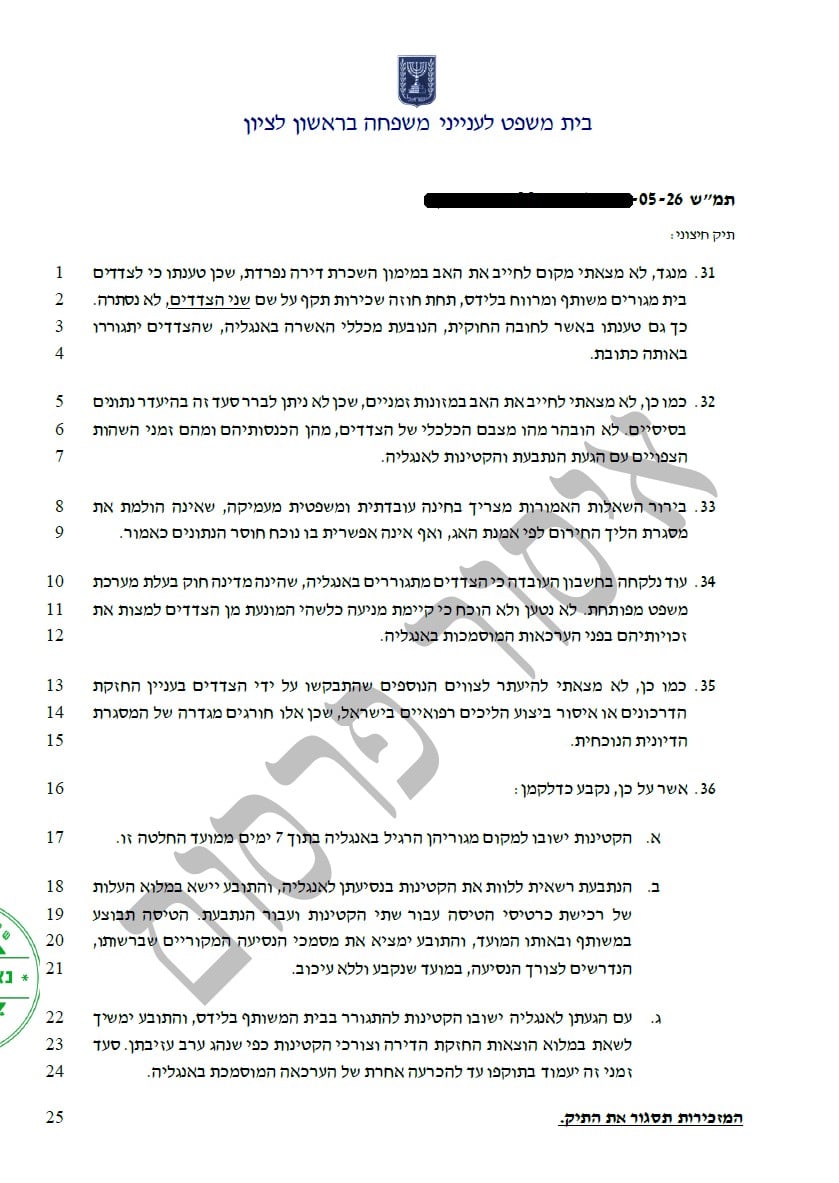
The court ordered the children to return to England within seven days. Their mother was permitted to accompany them. The father was ordered to pay for all three tickets.
The journey was to take place together, on the same flight, and the father had to provide the original travel documents without delay. Upon arrival, the children would return to the existing home in Manchester. The father would continue paying the household expenses and meeting their needs until an English court ruled otherwise.
The court did not order him to finance separate accommodation. It did not award the requested temporary maintenance or £10,000 guarantee. It did not decide who should permanently control the passports. It did not make the requested medical order.
The judgment essentially said: Everyone goes back to England. Everyone takes the same flight. Dad pays. Bring the passports. Do not be late.
Somewhere between international treaty law and family conflict, the court had become a highly authoritative travel coordinator.
Who Won?
The father achieved the principal result he had requested: the children were ordered to return to England. The mother secured the right to accompany them at his expense, with the children returning to an existing home whose expenses he would continue to cover temporarily. Neither party received everything.
In ordinary litigation, this might be called a mixed result. In family law, we call it Tuesday.
People often ask lawyers who won a case. They expect a clear answer because films have trained us to believe that every judgment ends with one side celebrating while the other side stares bitterly into the middle distance. Family law rarely works that way. The father won the return. The mother won the ticket. The English courts won the remainder of the dispute.
The airline won regardless.
The Funny Part Isn’t the Family
There is nothing amusing about children being caught between parents, nor about allegations of violence, medical concerns, or financial dependence. The court did not determine those allegations, and they should not be treated as established facts.
The comedy lies in the gap between the enormous legal machinery and the ordinary practical problem it must solve. International conventions can determine the correct country. Judges can define the limits of emergency jurisdiction. Lawyers can argue about undertakings, protective conditions and habitual residence.
But eventually someone must enter three names into an airline website, check the spelling against the passports and decide whether to pay extra for checked baggage. The law can send a family back to England. It cannot guarantee that they will sit together.

What the Case Taught Me
Family cases are rarely only about the legal question printed at the top of the application. A Hague Convention case may actually be about ensuring that a nursing infant is not separated from her mother during an international journey.
A housing dispute may really be about fear and trust. A disagreement over an airline ticket may represent something much larger: blame, responsibility and the refusal of either side to feel that the other has been rewarded. Lawyers speak in legal principles because that is our professional language. Families speak through houses, passports, money and plane tickets. The court’s task is to translate between the two.
This judge did not try to repair the relationship or decide every allegation. He did something more limited and perhaps more useful: he created a temporary bridge back to the proper jurisdiction. That bridge happened to fly to England.
It required three tickets.
And yes—
Dad had to pay for Mom’s too.
–
This article is inspired by a real, publicly available court decision. Names and identifying details have been omitted or altered to protect the privacy of the family and the children. The parties made conflicting allegations that were not adjudicated in the temporary proceeding. Nothing in this article should be understood as a factual finding against either party or as legal advice.
AI-generated image created by Salior Law using Canva AI. No third-party photograph was used.
Related Topics