
Relics from the Responsa Literature
Halakha’s Kármán Line: Imagined and Real Jews in Space
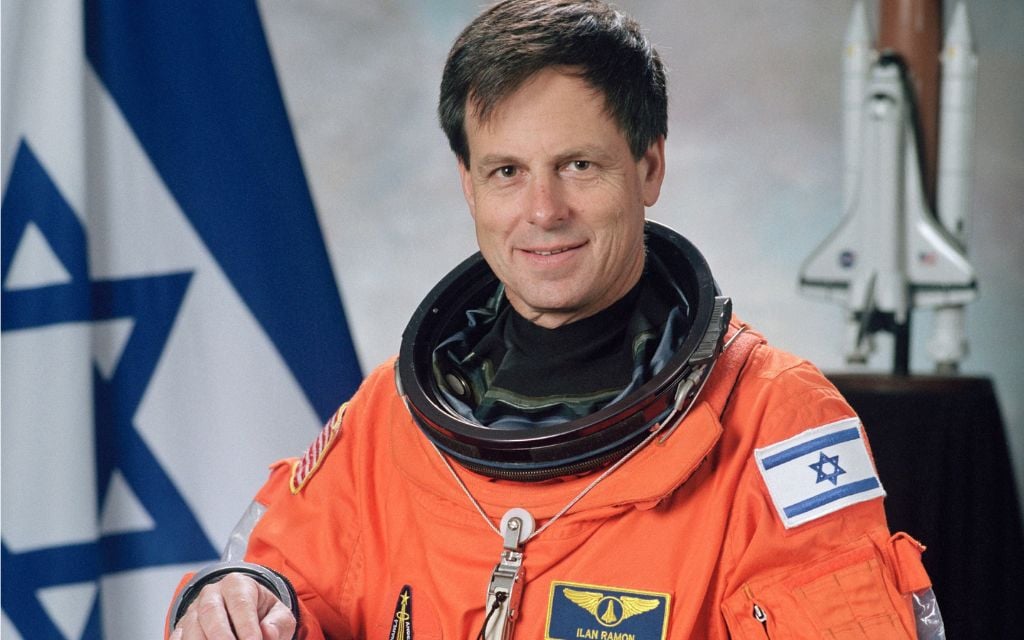
Ilan Ramon, November 2001, NASA
In the late 1960s or early 1970s, when Rabbi Solomon B. Freehof – the most prolific author of responsa in the American Reform movement – was asked for sources in Jewish law in preparation for “a discussion of the relationship of Jewish religious tradition and mankind’s new experience with space,” he opened his responsum with the following observation:
“The question is, of course, primarily an exploration of Jewish thought rather than a search for practical guidance, since there cannot be many Jewish astronauts to whom the problems might apply.”
After discussing various sources, Freehof concluded his responsum with an acknowledgment that there may be further questions that would one day need to be tackled:
“This, for the present, seems to be all that comes to mind with regard to space travel.”
Freehof had little choice but to use his imagination, since Space exploration was a new vista, and Jewish astronauts had yet to grapple with questions of practical halakhic guidance for life in Space.
****
From Soyuz to Starship
Rabbi Freehof’s “Halacha and Space Travel” responsum is undated. The questioner was Rabbi Albert Micah Lewis of Grand Rapids, Michigan. Lewis graduated from Hebrew Union College in 1969. He then served as the rabbi of the Moses Montefiore Congregation in Bloomington, Illinois, before moving to Temple Emanuel in Grand Rapids in 1972. He recalled being asked the question by one of the young members of his congregation – perhaps in his first position – and then pursuing sources by turning to Freehof.
When Freehof wrote “there cannot be many Jewish astronauts to whom the problems might apply,” the first Jew had already reached Space: Cosmonaut Boris Volynov (b. 1934). Volynov had a Jewish mother and a Russian father. His official documents listed his nationality as Russian, following his father’s line, rather than Jewish. Yet from the perspective of Halakha, Volynov was the first Jew in Space when he flew aboard Soyuz 5 for three days (January 15–18, 1969). Volynov returned to Space on another mission in 1976. Was Freehof thinking of Volynov?
Alternatively, Freehof drew on the imaginative power of Star Trek, which had envisioned the possibility of Jews in Space even before humans reached the Moon. Two Jewish actors reached fictional Space aboard the Starship Enterprise: William Shatner (b. 1931) travelled through Space as Captain James T. Kirk, as did Leonard Nimoy (1931-2015) in the role of Spock, whose famous Vulcan salute was modelled after the hand gesture of Kohanim during the recitation of the Priestly blessing.
Science fiction partially became reality in October 2021, when Jeff Bezos – an ardent Star Trek fan – invited Shatner aboard New Shepard 4 and blasted off to an altitude of 107km, thereby crossing the Kármán line, conventionally regarded as the edge of Space.
Alas, neither Kirk nor Spock were travelling as Jews. Spock was of mixed heritage – his father was Vulcan and his mother Amanda Grayson was human, but there are no indications that she was Jewish (though she was later played by two actresses with Jewish roots: Winona Ryder (b. 1971) in 2009 and Mia Kirshner (b. 1975) since 2017).
****
Zooming Along Rabbinic Responsa
The possibility of Jews in Space continued to excite the imagination. In 1981 – a year after Freehof’s responsum was published – Mel Brooks (b. 1926) visited the theme: His comedy History of the World, Part I was followed by a mock trailer for the next instalment of the franchise. The teaser ended with Jews in Space, a parody of the 1977 epic Star Wars. The trailer featured tallit-wearing religious Jews flying spaceships shaped as Stars of David. In Hebrew letters the word “Kosher” was emblazoned on the spacecraft. The accompanying musical number portrayed Space Jews as a protective force:
We’re Jews out in Space, we’re zooming along protecting the Hebrew race
We’re Jews out in Space, if trouble appears we put it right back in its place
When goyim attack us we give ‘em a smack we’ll slap them right back in the face
A year after Brooks’ Jews in Space parody, Rabbi Betzalel Stern (1911-1988) published the fourth volume of his responsa, Be-tzel Ha-hokhmah [In the Shadow of Wisdom]. Stern was born in Érsekújvár in the Austro-Hungarian Empire (today: Nové Zámky, Slovakia). From 1954, he served as a rabbi in Melbourne, Australia. In 1968, Stern moved to Vienna, Austria and then in 1982 he moved to Jerusalem. Among the responsa in the fourth volume was an undated responsum discussing prayer times and keeping Shabbat and Festivals in Space.
Stern concluded his responsum with a candid admission:
“I know that I have not discharged the obligation to examine this matter, and that one must delve deeper to analyse and clarify several more details and distinctions. But I also know that this is not currently a practical halakhic question, only an academic inquiry for the purpose of learning. Therefore, this note suffices for now.”
So when did the question of Jews in Space cease to be merely fanciful and theoretical, and become a matter of practical Halakha?
****
Jerusalem, We have a problem
The first female Jewish astronaut, Judith Resnik (1949–1986), reached Space in 1984. She was the fourth woman in Space, after cosmonauts Valentina Tereshkova in 1963 and Svetlana Savitskaya in 1982, and after astronaut Sally Ride in 1983. Resnik had grown up with a strong sense of Jewish identity. However, there is no record of her asking about Jewish observance in Space. Resnik died at the beginning of her second flight, when the Space Shuttle Challenger exploded 73 seconds after launch on January 28, 1986.
Astronaut Jeffrey Hoffman (b. 1944) followed Volynov and Resnik. In five separate missions, Hoffman clocked over 1,200 hours in Space. Hoffman took a dreidel with him, as well as a Hanukkah menorah. For safety reasons, Hoffman could not light Hanukkah candles in Space, and therefore did not have to deal with the question of when they should be lit.
During his fifth mission, Hoffman was joined by another Jewish astronaut, Scott J. Horowitz (b. 1957). Horowitz and Hoffman alternated use of the same bunk bed, to which they affixed a mezuzah with Velcro.
The distinction of being the first Jewish astronaut to attempt to keep time-related Halakha in Space falls to Ilan Ramon (1954-2003). Ramon, the first Israeli astronaut, did not lead an observant lifestyle, yet he felt that he was a representative of the State of Israel and the Jewish People. As such, he wanted to recite Kiddush on Friday night. The question was when was the correct time?
The Space Shuttle Columbia had taken off from NASA’s Kennedy Space Center in Florida. The local time in Florida was one candidate for when Shabbat should be observed in Space. Ramon, however, wanted to recite Kiddush on Friday night according to Jerusalem time – a position that had been raised, among others, back in 1969 when Rabbi Shlomo Goren (1918-1994) mused over the issue. Ramon asked Rabbi Zvi Konikov, director of Chabad of the Space and Treasure Coasts in Florida. In addition to offering a response, Konikov forwarded the question to other rabbis around the world, which sparked a lively halakhic discussion and a number of responsa were written on the issue. The rabbinic consensus was that Shabbat should be observed according to the time at Ramon’s departure point: Cape Canaveral.
Ramon remained in orbit for sixteen days. Alas, Columbia disintegrated when re-entering the Earth’s atmosphere and all seven crew members were killed on February 1, 2003.
****
Questions about Jewish law in Space began as imaginative musings, quests for relevant sources, and theoretical ruminations. Over the following three decades, hypothetical responsa gradually became practical guidance for Jewish astronauts seeking to preserve Jewish identity beyond the bounds of Earth. At least one astronaut, Ilan Ramon, grappled with the challenge of observing time-linked Halakha in Space: When is Shabbat in a reality that is not governed by the earthly concept of time? Could these challenges one day become a matter of widespread practical halakhic discourse with practical implications for future settlements on the Moon and beyond?
Perhaps the enduring value of probing questions of Jewish law in Space lies elsewhere. By probing how Halakha might function beyond Earth, responsa become a laboratory for legal imagination. Such legal analyses test not merely the limits of Jewish law, but its internal coherence, adaptability, and capacity to respond to new horizons that first exist in the imagination and only later become reality.
Related Topics
Related Posts