
The views expressed herein are solely mine.
Hamas Defies America — Iran Shows Why
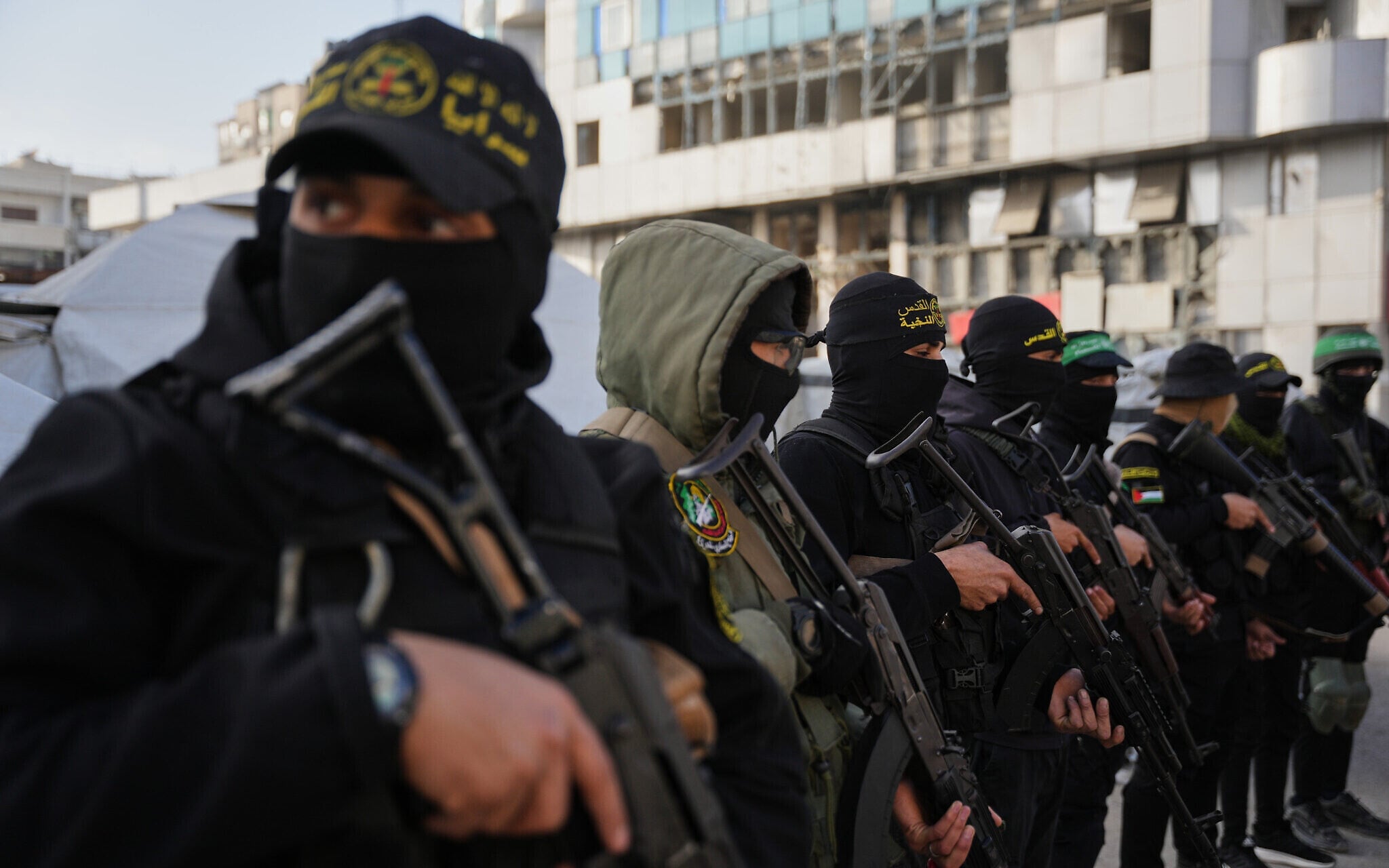
Illustrative: Armed members of Hamas and Islamic Jihad greet people gathering for Eid al-Fitr prayers in Gaza City, March 20, 2026. (AP/Abdel Kareem Hana).
Hamas has once again spat in the face of the Gaza Peace Board. As the U.S.-led disarmament deadline expires this weekend, its armed wing—hiding behind an impersonation of the eliminated spokesman Abu Obeida—vows not to surrender a single rocket or tunnel map.
This past Thursday’s meeting between the Board High Representative Nickolay Mladenov and Hamas officials was a total disaster. Hamas is making a cold geostrategic bet rooted in the clearest lesson Tehran’s proxies have learned from Washington: the United States talks tough, sets deadlines, and folds.
Recent events confirm the pattern. Just days ago, the United States and Iran agreed to a fragile ceasefire after weeks of exchanges following the assassination of a senior Iranian figure. Sold as a way to prevent wider war, the pause let Iran claim coverage across multiple fronts. Washington accepted short-term de-escalation. Israel dismissed the broader interpretation and escalated decisively, unleashing over 100 strikes on Hezbollah targets in a single wave—driving Lebanon toward peace negotiations with the Jewish state.
The message to every Iranian proxy, including Hamas, is unmistakable: American ultimatums come with expiration dates. Washington creates international bodies and deadlines but repeatedly chooses limited pauses over decisive victory. Iran absorbed the pressure, reshaped the regime with even more radical figures, virtually controls the minded Strait of Hormuz, preserved its proxy network and nuclear latency, and now awaits the next U.S. off-ramp. The ceasefire left Tehran’s entire architecture intact.
Domestic U.S. politics reinforces the perception of weakness. A Pew Research Center survey conducted March 23–29, 2026, found that 60 percent of Americans now hold an unfavorable view of Israel—up from 53% last year and 42% in 2022. Among those under 50, negative views cut across party lines, reaching 57% even among young Republicans. These numbers make sustained hard-power commitments politically costly.
Iran’s strategy depends on its proxy network stretching from the Mediterranean to the Persian Gulf. These groups let Tehran threaten energy shipments through the Strait of Hormuz, project power on the cheap, and advance its nuclear program without triggering direct war. The recent ceasefire preserved this structure.
Hamas is now running the same playbook in Gaza. It refuses to hand over heavy weapons or tunnel maps required in phase two of the Trump plan. That plan envisions eight months of Board-verified demilitarization before further Israeli withdrawals and large-scale reconstruction. Rebuilding Gaza is projected to cost over $80 billion, with over 60% of buildings damaged or destroyed.
Thus, only unrelenting military pressure has ever forced real concessions—as Hezbollah just discovered in Lebanon. After the Iran-directed escalation in March 2026, Israel responded with overwhelming force. The IDF has killed over 1,000 Hezbollah fighters since early March. This follows earlier operations that destroyed about 80% of the group’s medium- and long-range rocket arsenal. Israel established buffer zones up to the Litani River, and Lebanon’s government has opened direct negotiations with Israel on Hezbollah’s disarmament—an outcome years of diplomacy never achieved.
The same pattern played out in Gaza before the October 2025 ceasefire. Israeli forces eliminated Yahya Sinwar, Mohammed Deif, and dozens of brigade commanders, gutted Hamas’s rocket capabilities, secured control over more than half the territory, and recovered significant hostages. International pressure and shifting American opinion then forced a pause that halted the final phase.
Without similar pressure today, Hamas has no incentive to concede. It watches Washington prioritize calm with Iran and expects the same treatment in Gaza. The Board of Peace deadline will expire without progress. Reconstruction funds will certainly remain frozen.
Lebanon’s negotiations and Gaza’s pre-ceasefire gains demonstrate the region’s iron law: only decisive military pressure dismantles Iranian proxies. American deadlines and international boards offer diplomatic cover but cannot substitute for hard power. Until Washington learns this lesson, Hamas and its backers will treat American ultimatums as optional suggestions—making the next major attack only a matter of time.
Related Topics
- Anti-Zionism
- Antisemitism
- Benjamin Netanyahu
- Donald Trump
- Gaza
- Gaza Disengagement
- Gaza Reconstruction
- Gaza Rocket Attacks
- Gaza Strip
- Hamas
- Hezbollah
- IDF
- Iran
- Iran Nuclear Deal
- Islam
- Israel At War
- Israel-Iran Conflict
- Israel-US Relations
- Israeli Foreign Policy
- Israeli Politics
- Jewish-Muslim Relations
- Lebanon
- Middle East
- October 7 anniversary
- Pakistan
- Palestinian Statehood
- Palestinians
- Peace Process
- Terrorism
- The Arab World
- Trump Peace Plan
- Turkey
- United Nations
- US Midterm Elections
- US Politics
- Yemen
Related Posts