London based entrepreneur, cybersecurity analyst doing a PhD in AI
One Idea Tafsir No.19 – Fly Hackathon Challenge.
A fly is vastly more complex than the "pinnacle" of flying machines today - The F35. Scientists are nowhere near creating a "fly from scratch" - inorganic matter.
The Fly Hackathon – Short Tafsir On the Go – The Daily Brew
One Idea Tafsīr — Sūrat al-Ḥajj (22:73-74)
What would it take to create a living fly from scratch? From synthetic genomes to artificial cells, from neuroscience to the F-35 fighter jet, a scientific examination of one of the Qur’an’s most intriguing parables.
Preamble: The most difficult hackathon imaginable
Imagine announcing a global scientific competition.
You have unlimited funding, unrestricted access to laboratories, the world’s most powerful supercomputers, and the collective expertise of humanity’s leading scientists.
Your task is deceptively simple:
Create one living fly. From scratch.
Not a robotic fly. Not a computer simulation. Not a genetically modified fly produced from an existing embryo.
You must construct a complete biological organism from non-living molecular components, without beginning with an existing living cell or fertilised egg.
Your fly must be capable of sensing its environment, obtaining energy, flying, maintaining its internal systems and reproducing.
As of November 2026, despite extraordinary progress in biotechnology, humanity has not demonstrated this feat. Nowhere near close enough. By a long shot. This is less likely than “going to mars”.
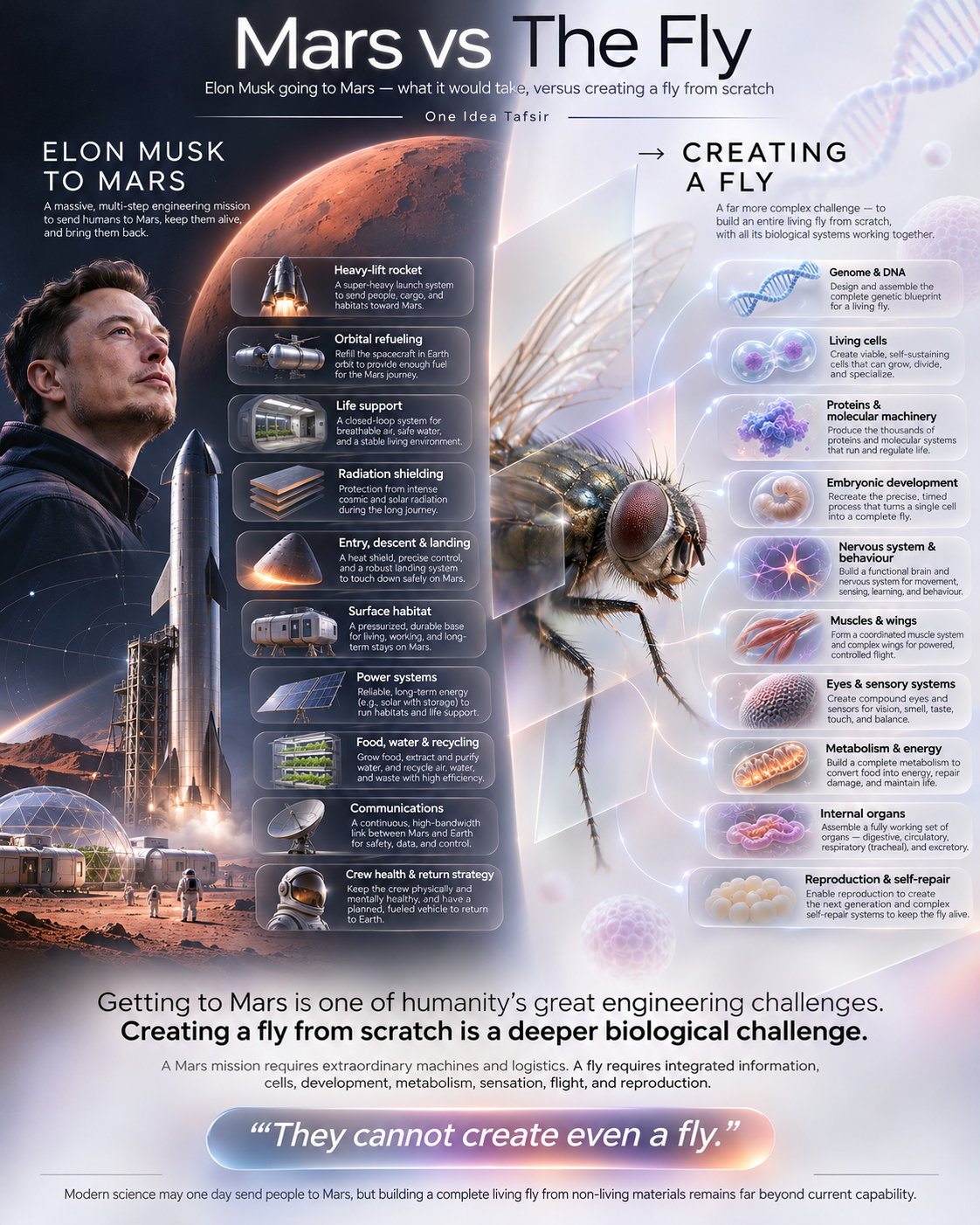
What makes this particularly interesting is that more than fourteen centuries ago, the Qur’an invited its listeners to contemplate precisely this apparently insignificant creature.
1. The Qur’anic challenge: Even a fly
يَـٰٓأَيُّهَا ٱلنَّاسُ ضُرِبَ مَثَلٌ فَٱسْتَمِعُوا۟ لَهُۥٓ ۚ إِنَّ ٱلَّذِينَ تَدْعُونَ مِن دُونِ ٱللَّهِ لَن يَخْلُقُوا۟ ذُبَابًا وَلَوِ ٱجْتَمَعُوا۟ لَهُۥ ۖ وَإِن يَسْلُبْهُمُ ٱلذُّبَابُ شَيْـًٔا لَّا يَسْتَنقِذُوهُ مِنْهُ ۚ ضَعُفَ ٱلطَّالِبُ وَٱلْمَطْلُوبُ ٧٣
O humanity! A lesson is set forth, so listen to it ˹carefully˺: those ˹idols˺ you invoke besides Allah can never create ˹so much as˺ a fly, even if they ˹all˺ were to come together for that. And if a fly were to snatch anything away from them, they cannot ˹even˺ retrieve it from the fly. How powerless are those who invoke and those invoked! (Quran 22:73)
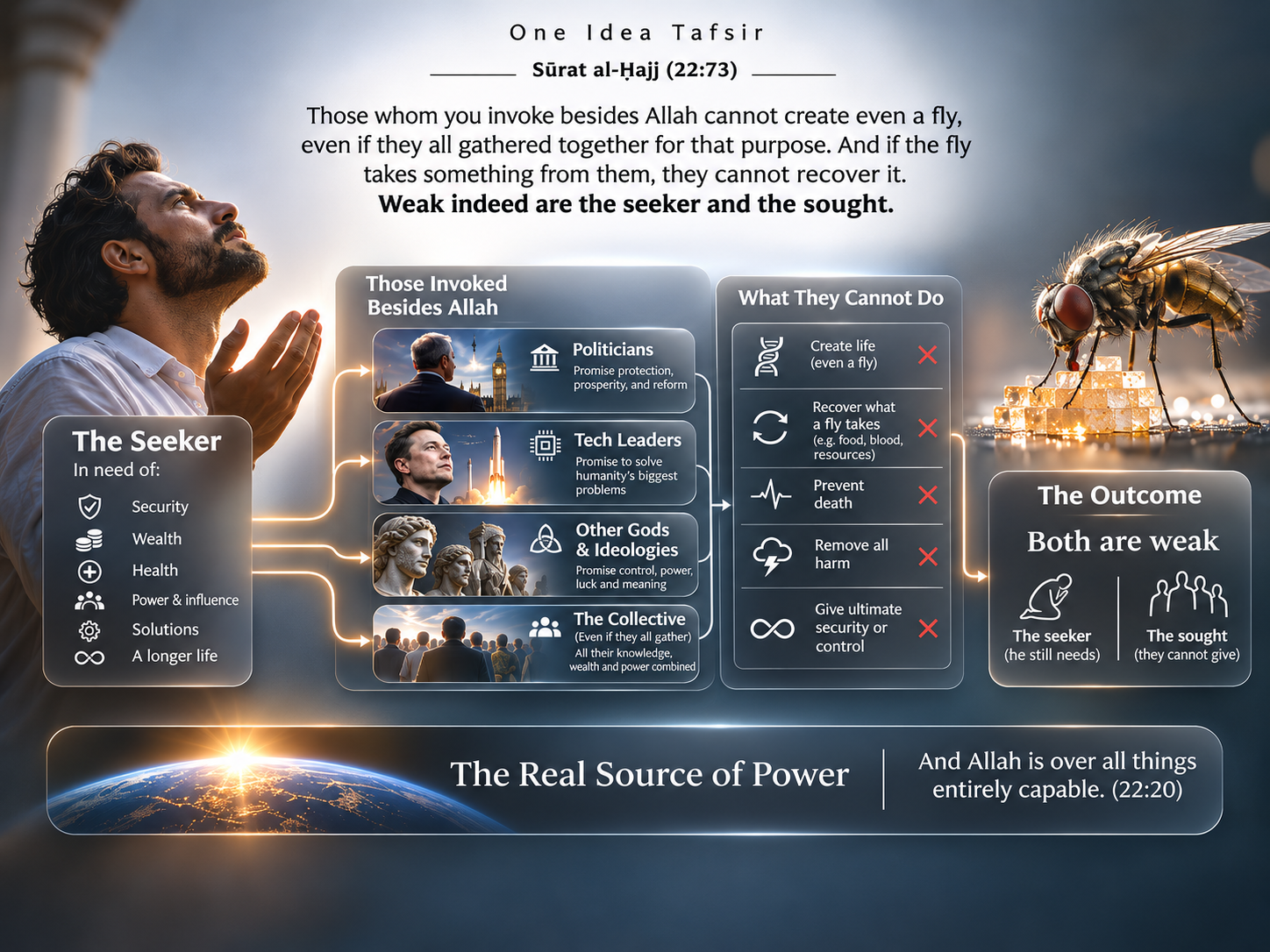 The verse is especially striking for its choice of subject.
It does not challenge false objects of worship to create a mountain, an ocean, a planet or a star.
It chooses a fly.
An ordinary creature that humans frequently dismiss as irritating or insignificant.
The challenge also introduces an important condition: even if they gathered together.
The Arabic expression وَلَوِ ٱجْتَمَعُوا۟ لَهُۥ invokes collective effort. The objects of worship would remain powerless even if they combined their capabilities.
In his Tafsīr, Ibn Kathīr explains that this parable demonstrates the powerlessness of idols and false deities. Even their combined power could not create the smallest creature, nor could they recover something taken by a fly.
What does it actually take to create a fly?
2. The Fly Hackathon: Assembling humanity’s finest minds
Suppose we invite the world’s leading research institutions to participate.
For the extensively studied fruit fly, Drosophila melanogaster, that means a genome containing roughly 14,000 protein-coding genes and a vast collection of regulatory sequences.
But even successfully manufacturing every DNA molecule would not produce a fly.
DNA is not a living organism.
Genes provide biological information, but that information must be interpreted by existing molecular machinery. Gene expression depends on proteins, regulatory networks, cellular conditions and the surrounding developmental environment.
So the second team would need to manufacture a functioning cell.
That requires membranes, cytoplasm, ribosomes, energy-producing systems, transport mechanisms, molecular repair processes and the ability to regulate internal chemistry.
The cell must maintain the chemical conditions required for life while avoiding destructive reactions.
This is already a formidable challenge.
The third team would need to make those cells reproduce, differentiate and organise themselves into tissues.
The fourth would need to construct a complete nervous system.
The fifth would have to solve the biomechanics of flight.
Others would have to integrate digestion, respiration, sensory perception, immune responses, reproduction and the many regulatory mechanisms that coordinate them.
And there is a deeper difficulty.
A fly is not simply a collection of biological components. It is a system in which the components continuously create, maintain and regulate one another.
A digestive system without functioning metabolism is insufficient. A nervous system without energy cannot operate. Muscles without neural control cannot produce coordinated movement. DNA without an appropriate cellular environment cannot direct development.
Every subsystem depends on other subsystems.
The hackathon is not merely an exercise in manufacturing parts.
It is a challenge to establish an entire self-maintaining biological process.
3. What has modern science already achieved?
2010: The first cell controlled by a chemically synthesised genome
Researchers led by Daniel Gibson and colleagues at the J. Craig Venter Institute reported the successful construction of a bacterial genome from chemically synthesised DNA.
The genome, approximately 1.08 million base pairs long, was transplanted into a recipient bacterial cell.
The resulting cells were controlled by the synthetic genome and reproduced.
This was a landmark achievement.
However, the researchers had not constructed the entire cell from non-living components. They relied on an existing recipient cell with membranes, proteins, ribosomes and other functioning biological machinery.
They had synthesised and successfully introduced a new genetic operating system into an already living biological environment.
That distinction matters.
2026: Synthetic versions of all sixteen yeast chromosomes
The international Synthetic Yeast Genome Project, known as Sc2.0, represents another remarkable development.
By 2026, researchers had produced functional synthetic versions of all sixteen native chromosomes of baker’s yeast.
Yeast is a eukaryote, meaning its cells possess a nucleus and internal structures that make them more comparable to animal cells than bacteria are.
But engineering chromosomes and integrating a complete synthetic genome into one functioning eukaryotic cell are distinct achievements.
Moreover, even a yeast cell with a completely synthetic genome would still not necessarily have been constructed from non-living components.
The surrounding cellular machinery is just as important as the genome itself.
2025–2026: Building artificial cells from molecular components
Perhaps the most relevant research comes from bottom-up synthetic biology.
Rather than modifying an existing organism, researchers seek to assemble systems with the fundamental characteristics of life from molecular parts.
A major article in Nature Communications, published in August 2025 under the title Building a Synthetic Cell Together, describes the international effort to construct such systems.
Researchers have developed artificial compartments, biochemical reaction networks, gene-expression systems and individual processes associated with living cells.
In 2026, another study reported combining DNA self-replication and membrane-lipid biosynthesis within synthetic cellular compartments.
These developments are substantial.
But a system capable of copying DNA or producing membrane components is not automatically an autonomous living cell.
It must also integrate energy generation, molecular transport, maintenance, growth and division, with the processes coordinating reliably across successive generations.
The central unsolved problem is not simply producing the individual components.
It is making them function together as a sustainable, autonomous living system.
And that challenge exists before we even begin constructing a multicellular insect.
4. Inside the fly: A biological system of extraordinary complexity
Consider one component of the fly: its brain.
In October 2024, the FlyWire Consortium published a landmark reconstruction of the brain of an adult female fruit fly.
Researchers mapped 139,255 neurons and approximately 54.5 million synapses.
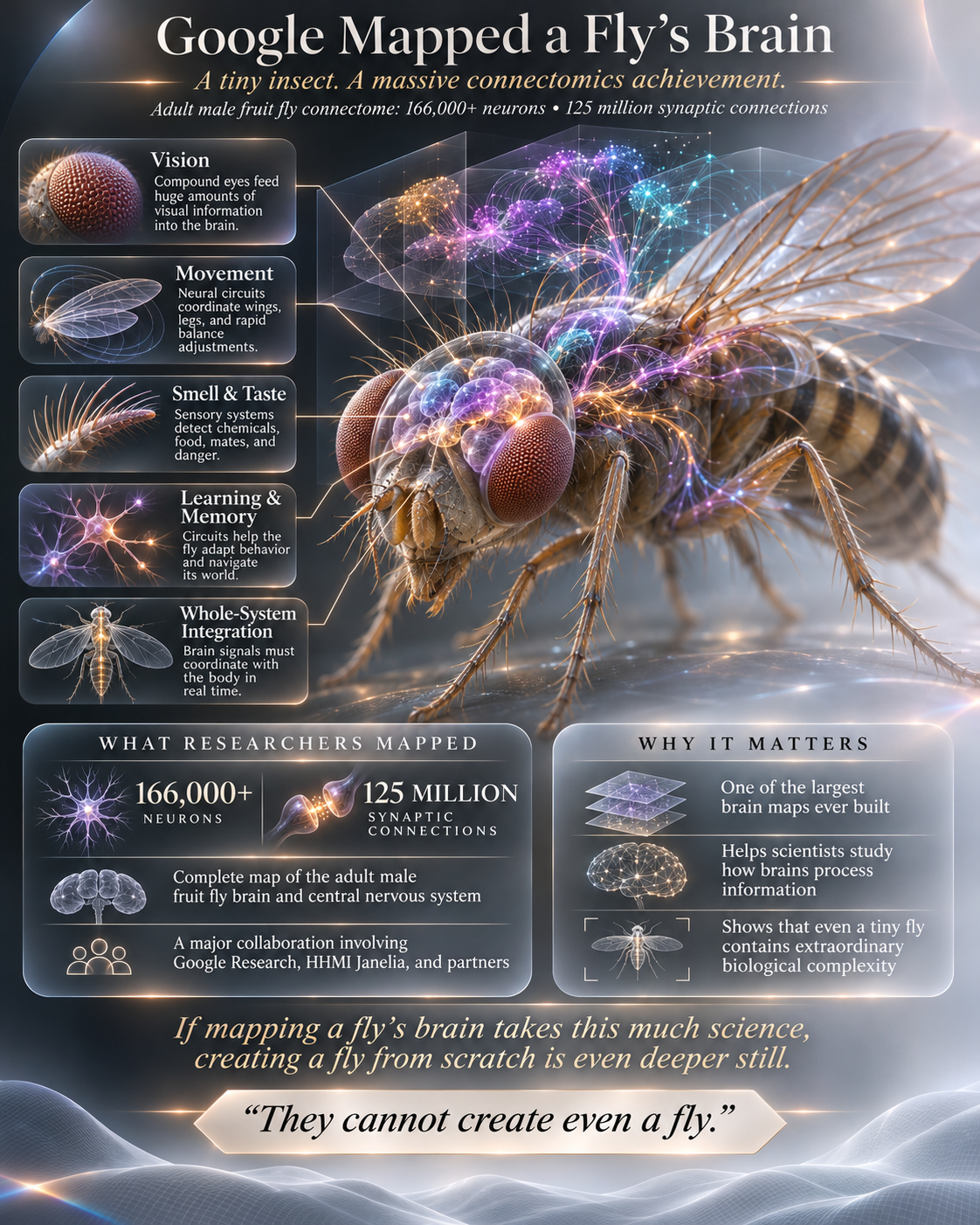
Those figures describe the brain of the particular fruit fly species and specimen studied, not every fly species.
The achievement is extraordinary because it provides a detailed wiring diagram of a complete adult insect brain.
But mapping the network is not the same as manufacturing it.
Nor does knowing its connections immediately explain everything about its operation.
The fly’s nervous system must interpret visual information, detect movement, process chemical signals, coordinate muscles, avoid obstacles and regulate behaviour.
Its brain does not function independently.
It interacts with sensory organs, endocrine signals, the rest of the nervous system and the physical environment.
Consider the wings.
A fly’s flight is not simply a matter of attaching wings to a small body.
Its flight muscles must contract in precisely coordinated patterns. Wing movements must generate the necessary aerodynamic forces. Sensory feedback must continuously correct instability.
Specialised balancing organs, called halteres, help the insect detect changes in body rotation.
The result is an extraordinarily agile flying organism.
Consider its eyes.
The compound eye consists of many individual optical units, providing the insect with specialised visual information.
Its nervous system then transforms sensory input into behaviour.
And the fly does all of this while maintaining its metabolism, processing nutrients, responding to injury and preserving the internal conditions necessary for life.
Yet there is another system that may be even more astonishing.
5. The most difficult component: Building itself
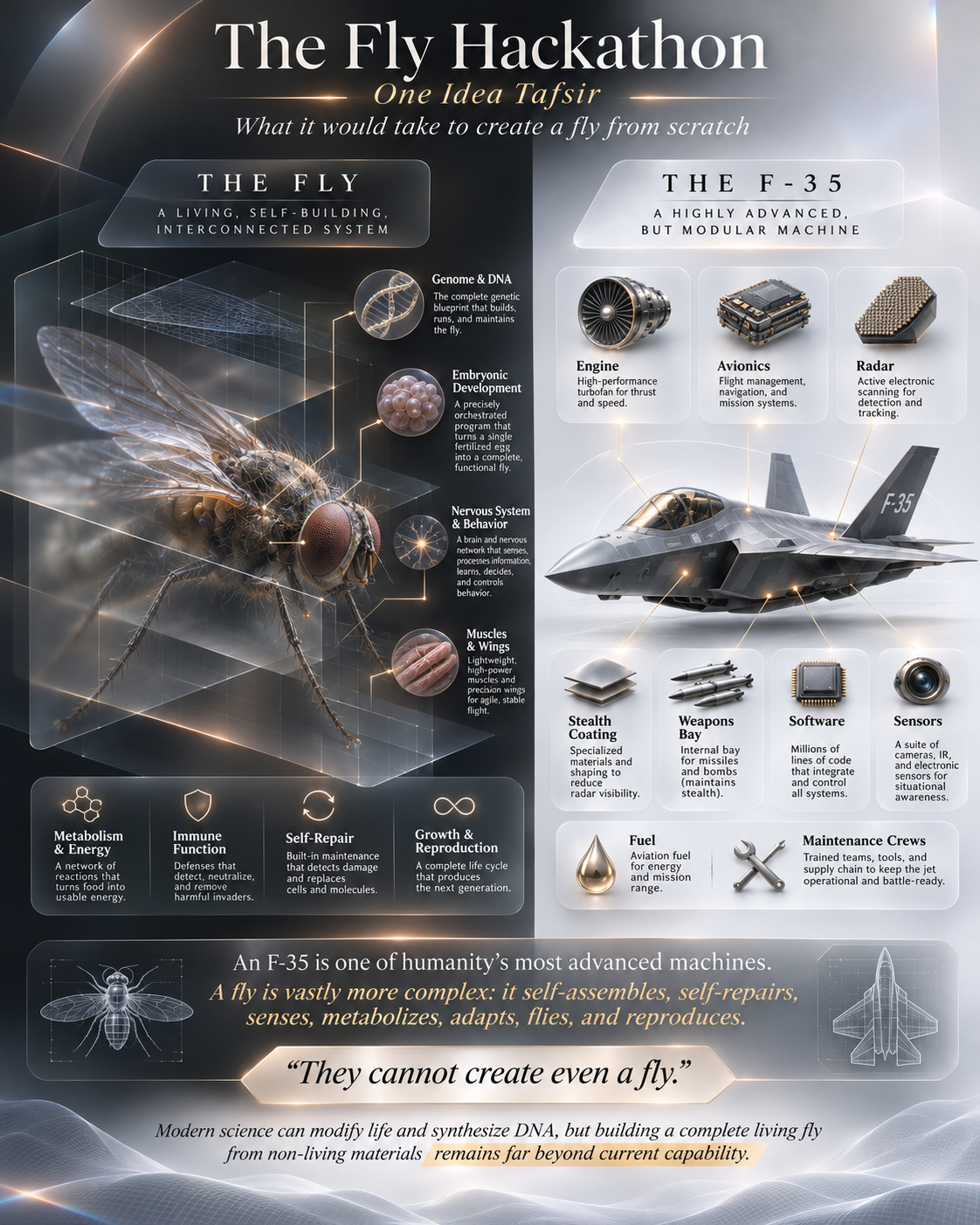
An F-35 fighter aircraft is manufactured in a factory.
Thousands of components are produced separately, assembled, tested and integrated by engineers and specialist manufacturers.
The fly follows a fundamentally different developmental process.
A fertilised egg contains cellular machinery and inherited molecular organisation. Through regulated cell division, signalling, gene expression and physical interactions, a developing organism gradually takes shape.
Different cells acquire different identities.
Tissues form.
Organs develop.
The nervous system establishes its connections.
In species such as Drosophila, the organism proceeds through larval and pupal stages before emerging as an adult fly.
No external assembly team positions every individual neuron, connects every muscle or manually constructs each organ.
These structures arise through biological developmental processes.
This does not mean the fly constructs itself without any external resources. Development requires nutrients, an appropriate environment and the biological machinery inherited from earlier generations.
But it does mean that much of its organisation emerges internally through processes regulated by the developing organism.
This is the central difference between constructing a machine and developing a living animal.
The fly is not merely manufactured.
It develops, maintains itself and participates in producing the next generation.
To create a fly from scratch, our hypothetical hackathon would need to reproduce not only the final adult anatomy but also the biological processes capable of generating that anatomy.
6. Why understanding every part is not enough
Suppose tomorrow scientists managed to synthesise every protein required by a simple biological cell.
Would that mean they had created life?
Not necessarily.
Imagine collecting every component of a functioning aircraft and placing them in a warehouse.
Possessing all the components would not automatically produce a functioning jet.
They must be arranged, connected, calibrated and operated correctly.
Biology introduces an additional difficulty.
Many molecular systems must remain functional while other systems are being assembled. The processes required to build one component may themselves depend on machinery that has yet to be constructed.
For example, ribosomes are needed to synthesise proteins, while the production and assembly of ribosomes require many proteins and other molecular components.
The system must overcome these interdependencies.
Scientists call this challenge systems integration, among other things.
The deepest challenge is not simply knowing what the parts are.
It is understanding how their interactions produce a stable, functioning whole.
7. Can science ever create a fly from scratch?
Here we must distinguish scientific evidence from philosophical speculation.
As of November 2026, there is no demonstrated achievement of constructing a complete, living, reproducing fly entirely from non-living components without beginning with an existing living cell or embryo.
That is a statement about the current state of experimental science.
Indeed, scientific progress makes the question more interesting.
The more we discover about biology, the more precisely we can identify the achievements and the remaining obstacles.
8. Would creating a fly refute the Qur’an?
This question deserves a careful answer.
The Qur’anic verse does not simply state that no human being will ever be able to manufacture a biologically functioning insect using laboratory techniques.
It states that those invoked besides Allah cannot create even a fly, even if they combine their efforts.
The immediate argument concerns the helplessness of false objects of worship when compared with Allah’s creative power.
Classical tafsīr establishes this interpretation independently of modern scientific discoveries.
The verse continues by describing the inability of these objects of worship to recover something taken from them by a fly.
Ibn Kathīr explains the illustration as an additional demonstration of their weakness.
The following verse makes the theological conclusion explicit:
مَا قَدَرُوا۟ ٱللَّهَ حَقَّ قَدْرِهِۦٓ ۗ إِنَّ ٱللَّهَ لَقَوِىٌّ عَزِيزٌ ٧٤
They have not shown Allah the reverence He deserves. Surely Allah is All-Powerful, Almighty. (Quran 22:74)
The point is divine sovereignty and the error of attributing godlike power to that which lacks it.
Modern biological engineering operates by using matter, chemical processes and physical laws.
Whether such activity counts as creation in the theological sense is a separate philosophical and religious question.
Within classical Islamic theology, Allah’s creative power is not equated with the human ability to rearrange or manipulate existing materials.
Consequently, a future laboratory breakthrough would require careful interpretation, not an automatic declaration that the Qur’anic parable had been disproved.
Equally, the present absence of a bottom-up synthetic fly does not constitute an experimental proof of Allah’s existence. This is a matter of belief – and those who believe [like me] see it as the enduring truth of the Quran.
Even if, tomorrow, hypothetically, we created a fly from scratch – the DNA, and the inorganic matter, all of it is “borrowed” – the “design” and the “materials”. Although, I consider this almost impossible to happen.
The Qur’an’s theological argument and the scientific investigation of biological complexity operate at different explanatory levels.
They can be considered together without confusing them.
9. From scientific understanding to reflection
These verses establish reflection upon creation as a meaningful intellectual and spiritual activity.
Scientific inquiry can reveal details about living systems that earlier generations could not have imagined.
An insect that seems simple to the naked eye turns out to involve extraordinary coordination among genes, cells, molecular pathways and anatomical structures.
The religious reflection is not that scientific investigation should stop where knowledge becomes difficult.
Quite the opposite.
One can continue to investigate the mechanisms of life while contemplating the broader questions of existence, dependence and creation.
The Qur’an’s invitation to reflection does not require hostility towards science.
And the scientific method does not require treating theological interpretations as laboratory measurements.
10. The deeper question: Can chemistry become life?
Perhaps the most intriguing implication of our imaginary Fly Hackathon lies in a much smaller objective.
Before we can create a fly from scratch, we must first understand whether we can construct a self-maintaining, self-reproducing cellular system from non-living components.
This is one of the foundational ambitions of bottom-up synthetic biology.
The question involves more than assembling chemicals.
A living system must maintain boundaries, manage energy, preserve and process information, regulate internal reactions, and reproduce its essential organisation.
Some artificial systems can already reproduce individual characteristics of life.
But fully integrating these characteristics into an autonomous biological system remains a major research objective.
And even if that goal is achieved, constructing a multicellular organism with the developmental complexity of a fly would introduce further layers of difficulty.
From a scientific perspective, the pursuit is legitimate and potentially transformative.
From a theological perspective, the pursuit can also inspire reflection on the extraordinary organisation of living things.
Neither perspective needs to be distorted to accommodate the other.
11. Finally – The smallest yet a seemingly unsurmountable challenge
The Fly Hackathon begins with an apparently modest demand.
Make one fly.
Yet that single requirement forces us to confront almost the entire architecture of life.
Fourteen centuries ago, the Qur’an chose a fly to illustrate the helplessness of false objects of worship before Allah’s creative power.
Its primary message is theological, not a forecast of biotechnology.
Yet its imagery remains striking when examined alongside the accomplishments and limitations of modern synthetic biology.
Perhaps that is what makes the parable so effective.
It directs attention away from the grandeur of the heavens and towards something readily overlooked.
A fly.
A small creature that appears ordinary until we begin to investigate what being alive actually requires.
The more closely we examine it, the less trivial it becomes.
And the verse concludes by reminding its listeners that the real question is not the size of the creature.
It is the recognition of the Creator.
“They have not regarded Allah with the esteem due to Him.” — Qur’an 22:74
References and further reading
Qur’anic and classical sources
- The Noble Qur’an, Sūrat al-Ḥajj 22:73–74.
- Ibn Kathīr, Tafsīr al-Qur’ān al-ʿAẓīm, commentary on Sūrat al-Ḥajj 22:73.
- The Noble Qur’an, Sūrat an-Naḥl 16:17.
- The Noble Qur’an, Sūrat Āl ʿImrān 3:190.
Scientific literature
- Gibson, D. G., et al. (2010). Creation of a Bacterial Cell Controlled by a Chemically Synthesized Genome. Science, 329, 52–56. DOI: 10.1126/science.1190719.
- FlyWire Consortium et al. (2024). Neuronal Wiring Diagram of an Adult Brain. Nature, 634, 124–138. DOI: 10.1038/s41586-024-07558-y.
- Building a Synthetic Cell Together. (2025). Nature Communications, 16, 7488. DOI: 10.1038/s41467-025-62778-8.
- One Yeast, Sixteen Synthetic Chromosomes, Infinite Possibilities. (2026). Yeast. DOI: 10.1002/yea.70026.
- A Synthetic Cell with Integrated DNA Self-Replication and Lipid Biosynthesis. (2026). Nature Communications. DOI: 10.1038/s41467-026-69531-9.
- Lockheed Martin. F-35: The World’s Most Advanced Fighter. Technical overview.
Author’s note: This essay is an instalment of One Idea Tafsīr, an independent reflective writing series exploring Qur’anic themes through contemporary science, philosophy and everyday experience. The author is not a scholar of Islamic jurisprudence or classical tafsīr. The scriptural discussion is grounded in recognised Sunni commentary, particularly Ibn Kathīr, while the scientific comparisons are offered as contemporary reflections rather than definitive interpretations of the Qur’an. Scientific findings are stated according to the evidence available as of 24 November 2026.
Related Topics
Related Posts