
Writer covering Israel–Africa, Jewish affairs, and Israel worldwide
Hamas Must Be Understood, Israelis Buried: Why Israel Must Solve Everything
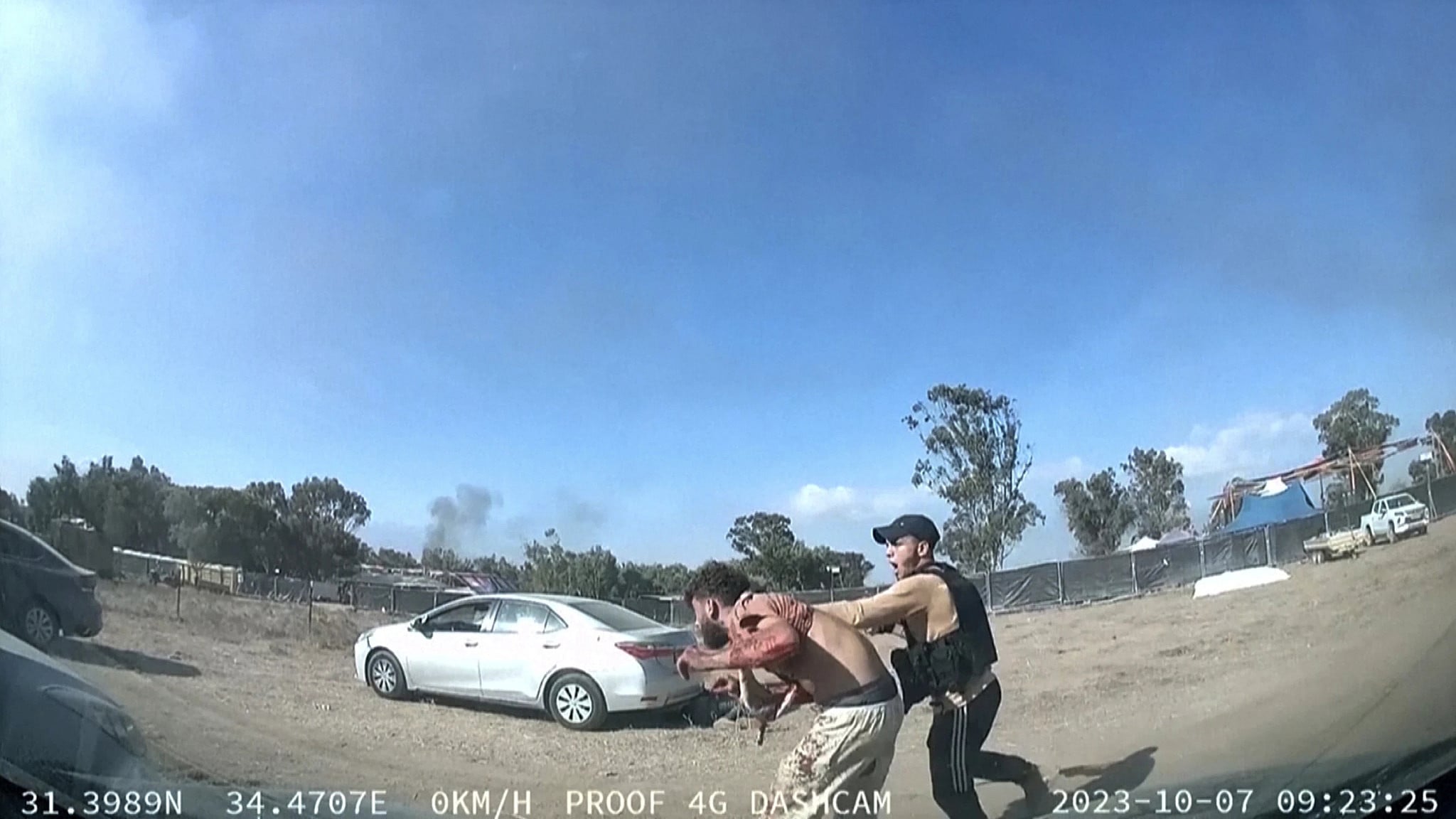
In this image from video provided by South First Responders, a man holding a weapon grabs another man next to a car during an attack by Hamas militants at the Tribe of Nova Trance music festival near Kibbutz Re’im in southern Israel on Saturday, Oct. 7, 2023. (South First Responders via AP)
There was a time when violence demanded explanation from those committing it. Today, the greater burden seems to fall upon those defending themselves against it.
Whenever Hamas commits atrocities, Hezbollah launches rockets into Israeli towns, or Iran’s regime threatens Israel with destruction, a remarkable phenomenon occurs. For a brief period, the world condemns the attack. Then comes the inevitable pivot. The discussion shifts away from what the terrorists did and toward what Israel supposedly did to make them do it.
Before the victims are buried, the commentators are already at work, assuring us that the true story is not the massacre itself but the complex web of historical, political, and sociological factors that somehow matter more than the people who carried it out.
This reflex has become so predictable. Hamas commits atrocities. Hezbollah fires rockets. Iran funds another proxy army. And immediately comes the familiar chorus: You cannot defeat an idea. Military force does not work. Israel must address the root causes.
Root causes. The two favorite words of the modern foreign-policy establishment.
According to this worldview, every act of terrorism is merely a symptom. Violence is never really about the people committing it. It is about history, grievances, oppression, colonialism, occupation, economic conditions, psychological trauma, climate change, or whatever fashionable explanation happens to be circulating this week.
The terrorists themselves become strangely absent from the discussion.
There is, of course, nothing wrong with studying causes. Understanding history matters. Understanding ideology matters. Understanding why conflicts emerge matters. But there is a profound difference between understanding a cause and excusing a crime. More importantly, there is a profound difference between understanding a problem and deciding how to respond to it.
When a nation is attacked, its first obligation is not to solve every historical grievance that may have contributed to the conflict. Its first obligation is to protect its citizens.
This is not a uniquely Israeli principle. It is a universal one.
When America was attacked on September 11, nobody expected the Situation Room’s first order of business to be an inquiry into whether America might have done something to provoke the attacks. The conversation did not revolve around whether the attackers had a point. It revolved around the fact that they had flown commercial airliners into buildings.
The immediate priority was security.
The immediate priority was justice.
The immediate priority was ensuring that those responsible paid a price.
Whether one agrees with every decision made afterward is beside the point. The point is that nobody considered the basic desire for consequences to be unreasonable. When a nation is attacked, people expect it to fight back. Only Israel is expected to skip this stage. Israel is routinely informed that before defending itself, it must first solve Middle Eastern history, settle every territorial dispute, cure extremism, satisfy the United Nations, and perhaps discover the meaning of life along the way.
Any other country is allowed to behave like a country.
Perhaps the most popular slogan used against Israeli military action is the claim that “you cannot kill an idea.”
Correct. You cannot kill an idea
But you can kill terrorists.
You can destroy weapons.
You can dismantle infrastructure.
You can reduce operational capability.
You can create deterrence.
Because the objective is not to eliminate every dangerous thought that exists. The objective is to stop people from acting on those thoughts. Nobody argues that law enforcement has failed simply because crime continues to occur. The existence of an idea is not proof that it cannot be confronted. The existence of an idea is often the reason confrontation is necessary.
This brings us to Hamas.
Much of the criticism directed at Israel since October 7 rests on a curious assumption: that if Hamas survives in some form, then Israel’s military response must have failed. By that standard, nearly every military campaign in human history would be considered a failure.
The question is not whether every member of Hamas disappears from the face of the earth.
The question is what price Hamas paid.
Were its capabilities degraded?
Were its leaders eliminated?
Were its infrastructure networks destroyed?
Were future attacks made more difficult?
Was deterrence restored?
The same applies to Hezbollah.
Critics often point out that Israel has fought Hezbollah before and Hezbollah still exists.
True.
Firefighters have been battling fires for centuries and fire still exists.
Police have been fighting crime for generations and crime still exists.
The continued existence of a threat is not evidence that efforts to contain it are pointless. If anything, it is evidence that such efforts remain necessary. Underlying much of the root-cause argument is another troubling tendency: the disappearance of moral agency.
Notice how often discussions about Hamas begin with explanations rather than choices.
What made Hamas do this?
What circumstances produced this?
What grievances caused that?
These questions often obscure a more important question. Why did Hamas choose to do it?
Human beings possess agency.
Terrorist organizations possess agency.
Leaders possess agency.
At some point responsibility must belong to those who commit atrocities rather than those who suffer them. Rainstorms have causes, earthquakes have causes, and terrorist attacks have planners. There is a reason we do not speak of Hamas the way we speak of hurricanes.
One is a natural phenomenon.
The other is a moral choice.
And then there is the endless faith placed in diplomacy.
Diplomacy is valuable.
Negotiation is valuable.
Compromise is valuable.
But all three require willing participants. A peace process is not a magical spell capable of transforming every movement into a partner for coexistence. Diplomacy works best when both sides regard peace as the destination. It works considerably less well when one side regards ceasefires as a convenient intermission before the next round of fighting.
What ultimately makes the root-cause obsession so strange is that it confuses two entirely different questions.
The first question is why conflicts exist.
The second question is how nations should respond when attacked.
Those questions are related, but they are not identical.
A government may spend decades trying to address deeper problems. It may pursue diplomacy, reform, economic development, coexistence, and reconciliation. None of that changes its immediate obligation when its citizens are being murdered.
The first duty of a government is protection.
Not theory.
Not symbolism.
Not academic elegance.
Protection.
After October 7, Hamas had to pay. When Hezbollah launches rockets at Israeli communities, consequences must follow. When Iran openly funds, arms, and directs forces dedicated to Israel’s destruction while pursuing capabilities that could make those threats far more dangerous, Israel has every right to act.
This is not vengeance.
It is not an abandonment of peace.
It is the oldest responsibility of any sovereign state.
Defend your people.
Punish aggression.
Deter future attacks.
Civilizations survive because aggressors fear consequences. The day consequences become immoral is the day aggression becomes free. And if the international community truly believes that every massacre should first be met with a seminar on root causes rather than a response to those responsible, it should at least have the honesty to apply that standard everywhere else.
Until then, Israel will continue doing what every normal country does when attacked.
Defending its citizens.
Making aggressors pay.
And leaving the therapy sessions for later.
Related Topics