
Hamas’s hunger playbook: Famine as a weapon of war
TL;DR: Famine and starvation narratives in Gaza have been strategically used throughout the Israel-Hamas conflict to exert diplomatic pressure on Israel and influence global opinion. An examination of thousands of news articles reveals clear spikes in famine-related language timed with major conflict events, highlighting how Hamas, media, and advocacy groups have shaped the narrative. Over time, coverage shifted from general hardship to stark images of starvation, while Hamas reportedly blocked aid and manipulated visuals, including recycled and unrelated images, to fuel outrage and gain diplomatic leverage. This deliberate use of a real humanitarian crisis extends suffering, turning famine into a weapon of war rather than a mere tragedy.
In the ongoing conflict between Israel and Hamas, images of wretchedness and suffering in Gaza dominate global headlines. Claims of famine, starvation, and humanitarian collapse are portrayed not only as tragic war consequences but also as powerful narratives with strategic motives. For Hamas, these narratives serve more than propaganda purposes: they are a calculated component of asymmetric warfare designed to pressure Israel diplomatically, shape international opinion, and mobilize external actors. The brutal October 7 attacks on Israel, which killed over 1,200 people and saw more than 250 hostages taken, set this cycle of violence and narrative warfare into motion.
Hunger in Gaza has been widely reported since the outbreak of war, but little attention has been given to how these claims surged, when they peaked, and what purpose they served. The famine narrative is not static; it intensifies and shifts strategically. Understanding these patterns is crucial because they uncover the intersection between humanitarian discourse and information warfare. This exploration focuses on one main question: How has the use of famine-related language shifted over time, and what does its timing indicate about Hamas’s overall strategy?
To explore this question, I gathered articles from the LexisNexis database – a comprehensive archive of global news sources – using the search term “gaza AND starv*.” I limited the search to English-language articles referencing starvation or related conditions in Gaza, published between October 7, 2023, and July 27, 2025. The resulting dataset includes 3,375 articles from over 150 international outlets, with the top six contributors accounting for nearly 40% of coverage: CE Noticias Financieras English (15.2%), The Guardian (7.6%), The Independent (4.7%), The New Arab (4.4%), Haaretz (3.5%), and The New York Times (3.1%).
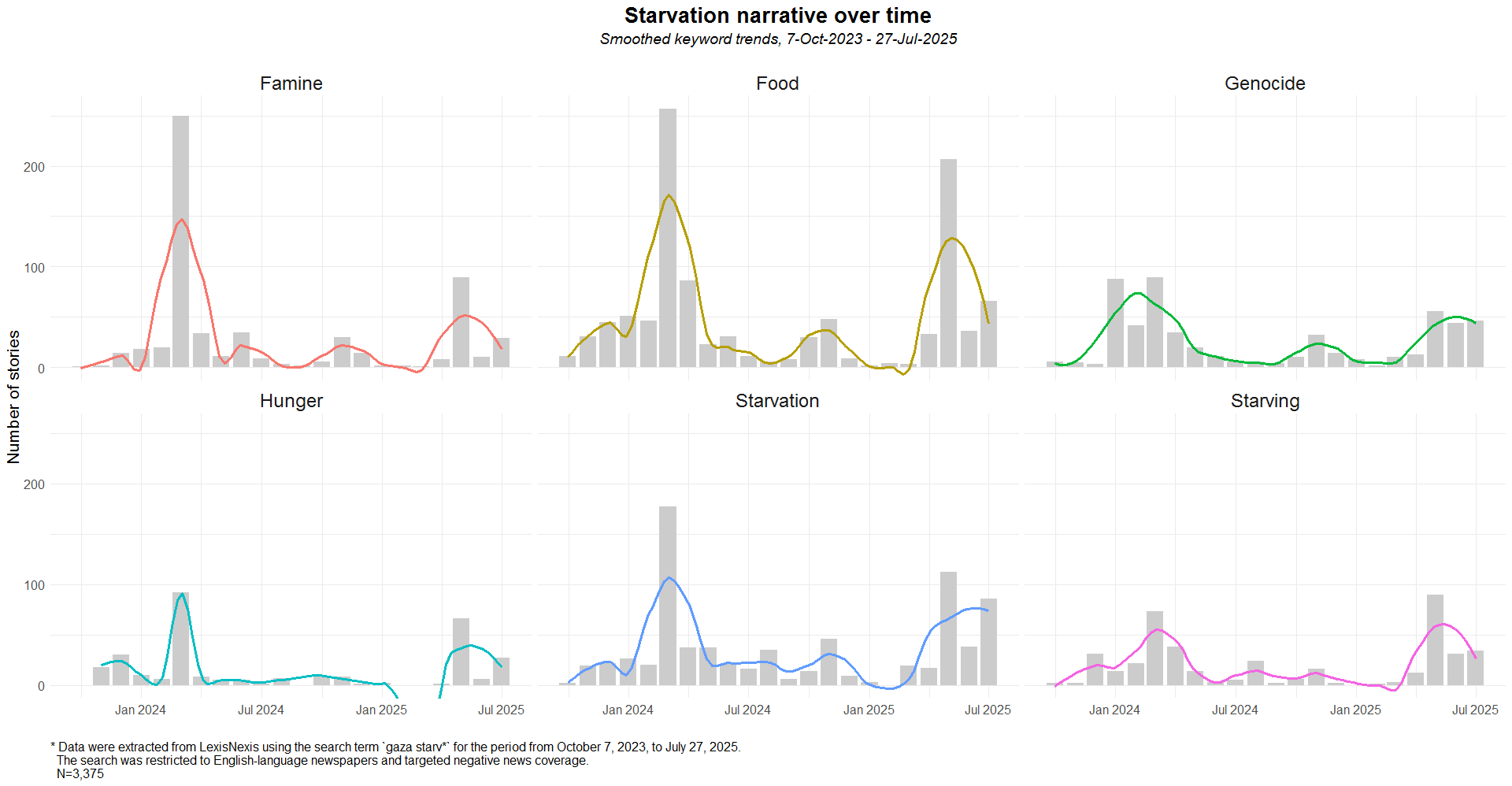
From this dataset, the temporal frequency of five famine-related keywords – “hunger,” “food,” “starvation,” “starving,” and “famine,” alongside the term “genocide” – was examined. The resulting smoothed trend graphs, shown below, visualize how often these terms appeared in news coverage over time, pinpointing distinct narrative peaks that align with key phases of the war. This visualization offers a clear view of how the hunger narrative evolved throughout the conflict, highlighting when and how famine-related rhetoric emerged in global media.
Starvation narrative over time
The graph doesn’t just chart a humanitarian crisis. It shows how the crisis itself and the way it was portrayed interacted over time. Each spike in famine language reflects both conditions on the ground and the choices by Hamas, advocacy groups, and newsrooms about what to emphasize and when.
The first major peak (January-March 2024) followed Israel’s tightening of border restrictions in late 2023 and chaotic aid deliveries. But the famine narrative went beyond the facts. Although the UN warned of “imminent famine,” international criteria for famine were not met. Much of the suffering was caused by Hamas itself, through looting warehouses, hoarding flour and fuel, and selling supplies on the black market to maintain control over the population..
The second surge (October-November 2024) took on a sharper diplomatic edge. This period saw intensified Israeli operations targeting Hamas command centers, heavy urban fighting, and reports of Yahya Sinwar being targeted and subsequently killed. But the famine frame wasn’t just about Sinwar. Human rights groups blanketed social media with hunger imagery; UN agencies renewed their alarm bells; major outlets ran famine-labeled coverage, often recycling the same photos of breadlines and empty pots. The famine story became a bargaining chip in ceasefire talks, invoked in editorials and op-eds as leverage, amplifying Hamas’s own messaging at a crucial moment in negotiations.
The third and steepest spike (May-July 2025) was even more deliberate. This peak is still ongoing, so the situation continues to evolve. What’s unique about this phase is the shift in coverage from general hardship to the more visceral, headline-grabbing term “starving.” Hamas intensified its famine optics, pushing images of gaunt children and their helpless mothers. Behind the scenes, they blocked independent food deliveries and fired on Gazans attempting to reach alternative distribution points managed by the Gaza Humanitarian Fund. This wasn’t mere narrative opportunism. It was calculated narrative engineering, creating imagery so raw it bypassed scrutiny and sparked immediate outrage. Crucially, this strategy also reflects Hamas’s broader aim to regain control over food distribution in Gaza, positioning itself as the essential provider and gatekeeper of aid. By controlling the narrative and the flow of resources, Hamas consolidates power internally while using the famine story to increase international pressure on Israel.
These peaks were not merely reflections of events; they were shaped by intentional choices in framing that molded global perception, often overshadowing the facts themselves.
Why is the narrative weaponized?
This strategy does more than exploit a humanitarian crisis; it creates a perverse incentive to prolong it. Each viral image of misery translates into diplomatic capital. Hamas understands this. The more the world perceives Gaza as on the brink of famine, the greater the pressure on Israel for ceasefires, easing of blockades, and restoration of Hamas’s role as an intermediary in aid delivery.
The result is catastrophic for civilians. Hamas has no interest in resolving Gaza’s food insecurity because it thrives on sustaining it. Credible reports document how Hamas diverts aid, blocks alternative delivery mechanisms, and militarizes humanitarian operations, ensuring the suffering persists, while its leadership shelters in fortified tunnels with ample supplies.
This weaponization depends on language as a force multiplier. Terms like “famine” and “genocide” carry immense moral weight, although, based on Hamas’s own data, the thresholds required for famine under international standards are not met. Visual manipulation compounds this effect: widely circulated images are often recycled, AI-generated, taken from unrelated conflicts like Syria and Yemen, or falsely portray children suffering from severe illnesses as victims of starvation. Together, these tactics reinforce a misleading narrative of total collapse.
Seeing through the smoke
The food crisis in Gaza is real. But its presentation, timing, amplification, and framing are engineered. Hamas’s exploitation of starvation as a political weapon underscores a grim truth: the group prioritizes leverage over lives, optics over outcomes.
Until policymakers and the media understand this strategy and develop responses that ease suffering without incentivizing it, the world risks reinforcing a deadly playbook, where famine becomes not just a tragedy, but a deliberate weapon of war.