
Bridging faith. Defending truth. Confronting hate
Hamas’s Most Enduring Weapon: The Theology That Drives the Movement
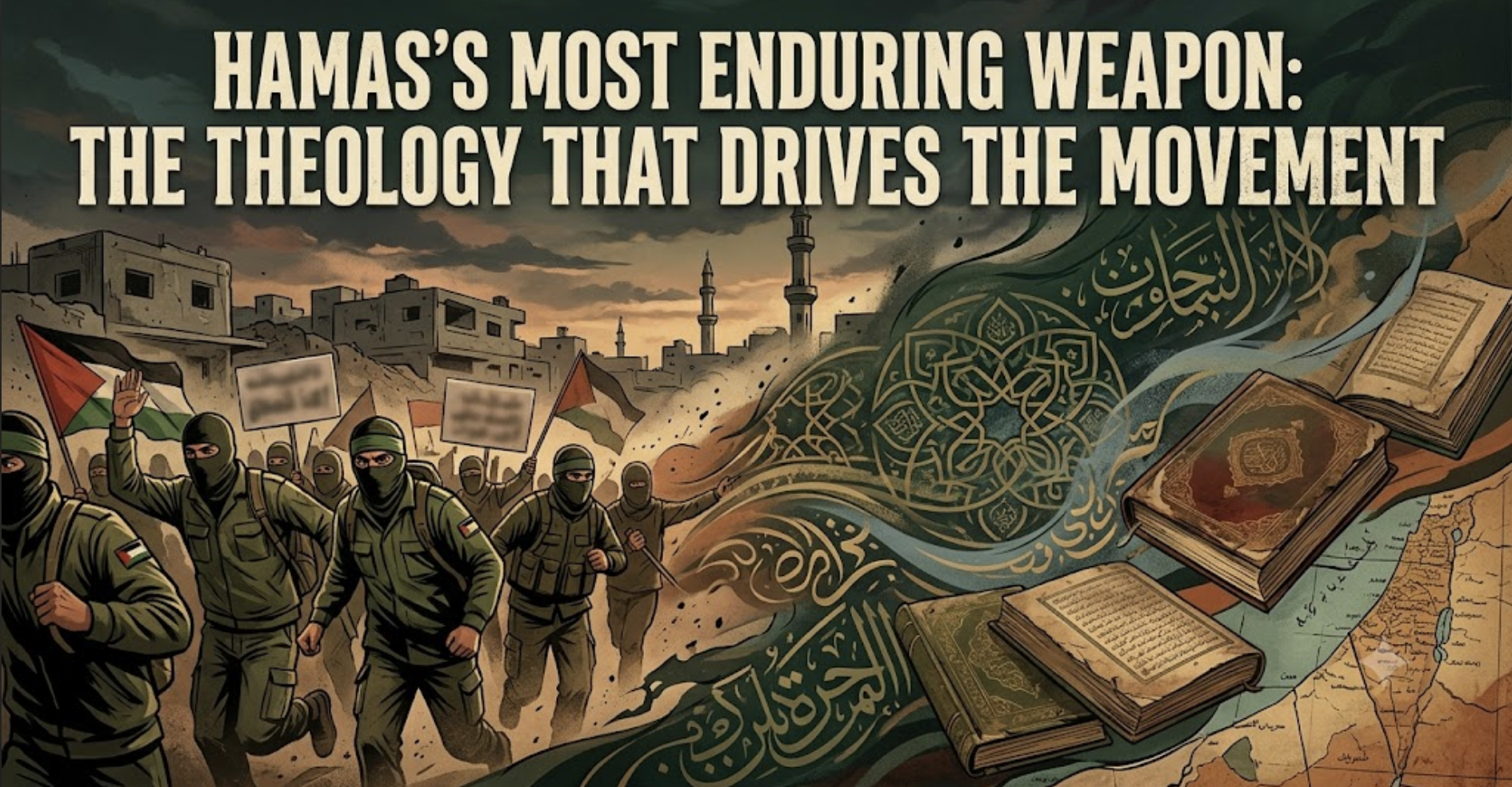
There are many different ways to examine Hamas and what drives its ideology. Many people examine it through a sociological lens where things like colonialism, occupation, poverty, and political grievance are treated as the primary explanations for its rise and appeal. Others use the lens of nationalism to explain Palestinian dispossession, military occupation, and the struggle for self-determination. Still others look at it through a political lens, seeing Hamas as a political organization and its governing of Gaza and its effort to build legitimacy. Another way to approach the conflict is to look at the story Hamas tells Palestinians in Gaza through its speeches, religious teaching, media, and political messages.
My approach is to examine Hamas through a theological lens. While the aforementioned lenses can illuminate some aspects of understanding Hamas, the larger issue is that they obscure the religious ideas through which Hamas interprets the conflict, defines its enemies, and justifies violence. I believe that Hamas cannot be fully understood without taking seriously its theological worldview, which places the present conflict within a much larger sacred history. Hamas’s most enduring weapon is not a rocket, a tunnel, or a military battalion, but an interpretive system.
That theological logic is precisely what Western accounts tend to miss.
Because many Western accounts of Hamas treat its theology as secondary to its political grievances, they often misunderstand how the movement defines its goals, interprets events, and justifies its actions. For example, Western observers sometimes view Hamas as an organization whose religious language is used to give emotional force to political grievances. The Islamic vocabulary is used but it is largely a cultural wrapping around an essentially modern struggle, and this vocabulary interprets things like occupation, displacement, settlement expansion, and the blockade of Gaza. This gets the relationship between religion and politics backward. Hamas does not simply use theology to lend religious weight to political grievances. Its theology shapes how those grievances are understood, why they exist, and what Hamas believes it is permitted—or required—to do in response. For Hamas, politics is one of the places where its religious convictions are put into practice.
Those grievances are real, and Hamas has learned how to use them to its advantage. But they do not tell us everything about what the movement believes it is fighting for. Hamas is not simply a Palestinian nationalist group with an Islamic identity added on. It calls itself the Islamic Resistance Movement, presents Islam as the foundation of its goals and principles, and understands the struggle for Palestine as part of a much larger religious mission.
The 1988 covenant draws on Islamic theology and anti-Jewish language to frame the conflict as a religious obligation, not just a political one. It allows Hamas to present Palestine as an Islamic endowment, then invoking jihad, and places the conflict within sacred history. The 2017 document seeks to cover up the theological commitment by cloaking it in political language, distinguishing Jews from “the Zionist project.” Hamas uses this clever tactic to present itself as an Islamic Palestinian national liberation movement.
The point is not that politics, nationalism, or Palestinian suffering are unimportant. They clearly matter. But my point is that Hamas operates inside of a religious framework that tells Hamas what the conflict is ultimately about, and what counts as victory. If Hamas continues to be treated as a conventional political movement, there is hope that it will abandon its deepest commitments if the right agreement is offered. This, my friend, is snake oil. Hamas may change its language, make temporary compromises, or adapt its tactics, but the religious beliefs that give the struggle its meaning still remain at the heart of the movement.
Endnotes
“The Covenant of the Islamic Resistance Movement,” August 18, 1988, arts. 5–15, Avalon Project, Yale Law School
Hamas, “A Document of General Principles and Policies,” May 1, 2017, paras. 1–3, 7–9, and 14–26, Interactive Encyclopedia of the Palestine Question
Related Topics
Related Posts