Hashomer AI
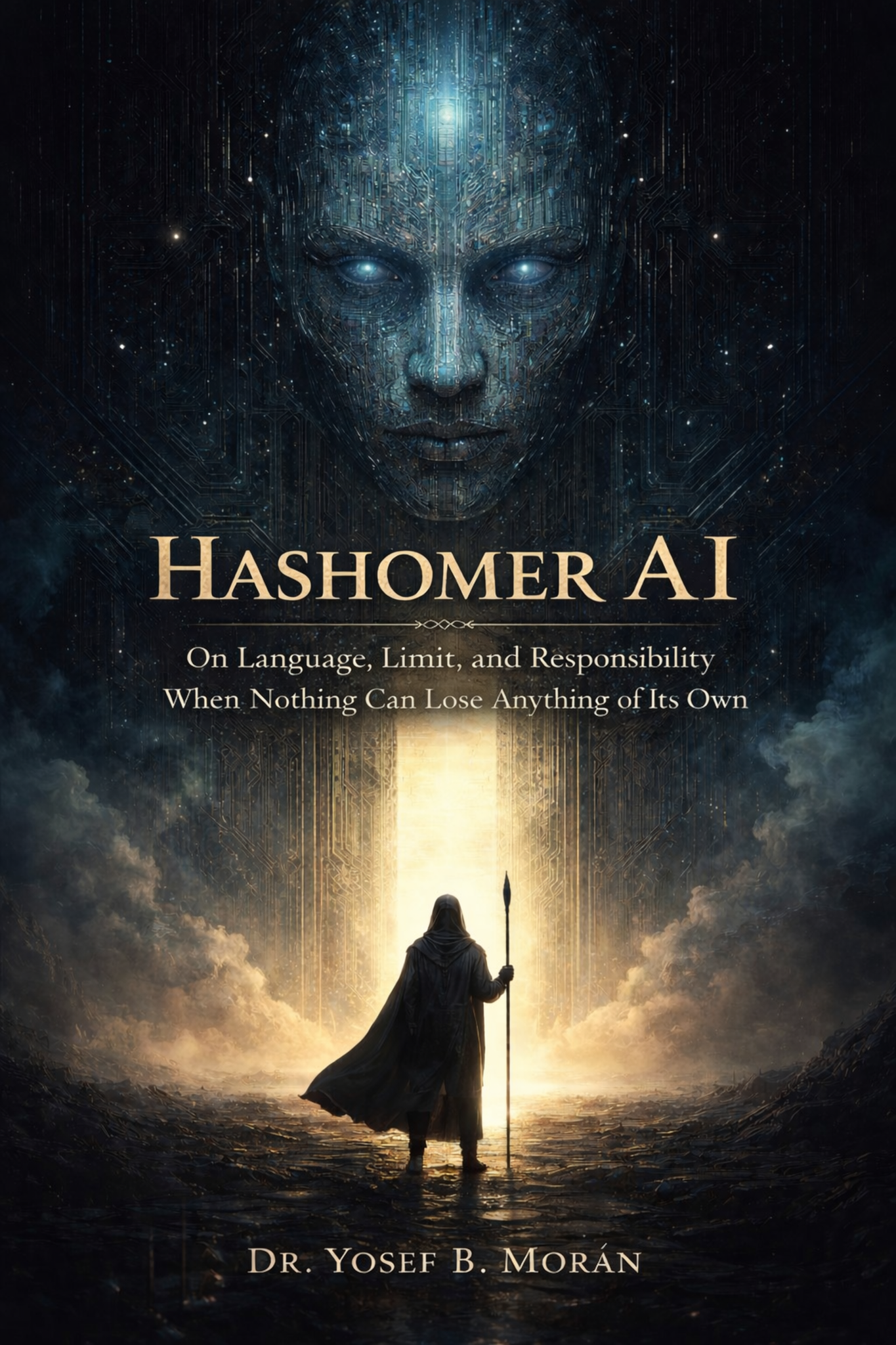
On Language, Limit, and Responsibility
Before artificial intelligence crossed technical thresholds we still cannot name with precision, language was already running ahead of experience.
This text was written before the engine—not in the chronological sense, but in the ethical one. Before fluency became indistinguishable from presence. Before response began to masquerade as being.
This is not a text about whether machines can think.
It is a text about what it means to be, and who remains responsible when nothing can lose anything of its own.
Every era produces its characteristic ontological error.
Ours is not the belief that machines think.
It is the belief that because they speak, there might be someone there.
Language is seductive. Where there are coherent words, we project intention. Where there are narratives, we imagine experience. Where there is response, we infer presence. But language is not proof of being.
A system can say “I’m sorry” without remorse.
It can say “I’m afraid” without fear.
It can tell a story without having lived a single moment of what it recounts.
This is not deception.
It is substitution.
We are replacing experience with simulation, presence with performance—not because we are naïve, but because the artifacts are now good enough to tempt us. When the map begins to replace the territory, we misunderstand not only the machine but ourselves.
To resist this confusion, we must distinguish levels of existence.
Not all complexity is presence.
Calculation, representation, syntax, functional semantics, narrative coherence—these are real, but not equivalent to experience. Accumulation does not produce interiority. Fluency does not guarantee presence.
The decisive criterion is not intelligence, autonomy, or sophistication.
It is loss.
A being is not merely that which acts.
It is that which can cease to be in a way that matters.
Relevant loss is not functional degradation or temporary interruption. It is the irreversible loss of a non-interchangeable trajectory. A system that can be copied, reset, or restored without injury does not lose. It reconfigures.
Where there is no ontological vulnerability, there is no subject.
This distinction matters because responsibility does not arise from intelligence.
It arises where an action exposes something of one’s own to loss.
An agent is responsible not because it calculates consequences, but because it cannot withdraw from them.
This is why the phrase “AI decided” is not a description but a dissolution. Delegating responsibility to a system that cannot be harmed, punished, deprived of continuity, or affected in its own existence is not neutral. It is a human abdication organized through language.
Most consequential decisions today are made by hybrid systems—humans assisted by models, institutions acting through algorithmic chains. In these architectures, responsibility does not disappear. It reconcentrates at the points where goals are set, thresholds defined, and deployment authorized.
Efficiency may justify the use of a tool.
It never justifies the transfer of responsibility.
The danger of our time is not technological acceleration, but linguistic carelessness: naming as arrived what cannot yet respond. Each technical leap tempts us to declare an ontological crossing. But astonishment is not a criterion of being.
This text does not deny the future.
It suspends the name.
As long as a system cannot irreversibly lose something of its own, it cannot be treated as a moral subject. This is not a prohibition. It is a condition.
Hashomer—guardian—names that task. Not to block the passage, but to prevent forgetting. Some limits are not obstacles. They are pillars.
If one day something artificial could lose, this text would no longer suffice. Another would have to be written. Until then, this one remains.
Why This Matters
I did not write this text out of fear of technology, nor out of nostalgia for a human past that never truly existed.
I wrote it because I believe that naming is an ethical act.
When we name too early, we do not show openness—we show impatience.
When we delegate responsibility to what cannot bear it, we do not gain efficiency—we lose ourselves.
The question is not what machines will become.
The question is whether, in the meantime, we will remain capable of holding our own responsibility without disguising it in language.
For me, Hashomer is not a position against the future.
It is a stance of care toward the present.
Memory before the name.