
Middle East Analyst
Haym Salomon: The Indispensable Jewish American Patriot
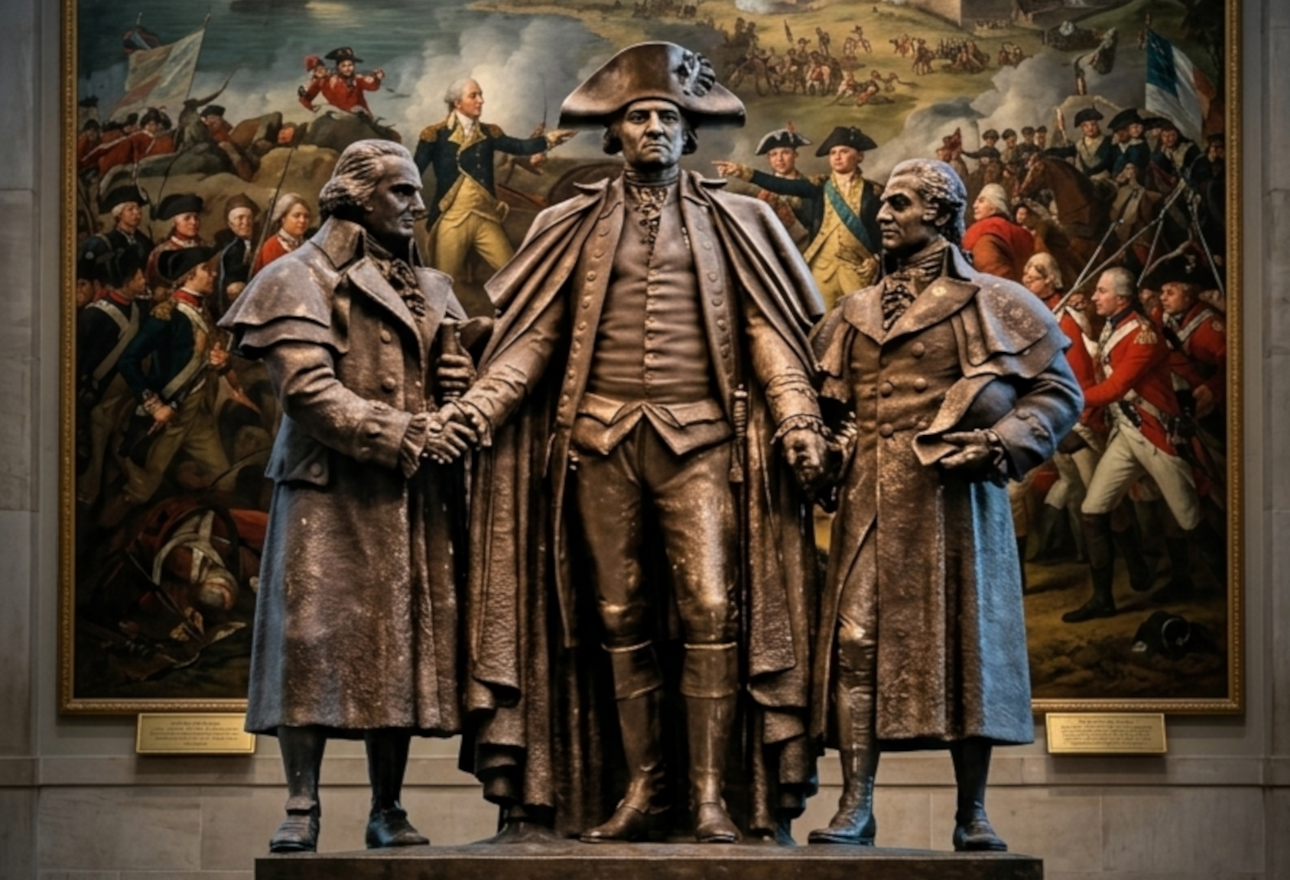
By author (AI)
A Polish-born immigrant twice imprisoned as a spy became the financier the Continental Army could not do without — and paid for it with everything he had
“Indispensable” is a word that should be earned, not asserted. Applied to Haym Salomon, it is earned by a specific, well-documented fact: at the single moment the Continental Army’s war effort came closest to collapsing for want of money, there was one man Washington could call on. That does not make Salomon more consequential than Washington. Without Salomon, the war may well have stalled at the moment it needed, above all others, not to.
An Immigrant Who Chose a Side Immediately
Salomon was born in 1740 in Leszno, in the Polish–Lithuanian Commonwealth, to a Sephardic Jewish family descended from Jews expelled from Spain in 1492. He traveled and worked in finance across Western Europe as a young man, acquiring fluency in several languages, before immigrating to New York City around 1775 — arriving at the exact moment the colonial crisis was tipping into war.
He did not wait to see which way the conflict would go. Salomon joined New York’s branch of the Sons of Liberty almost immediately and established himself as a financial broker for merchants engaged in overseas trade. In 1776 the British arrested him on suspicion of espionage; his fluency in German led his captors to employ him as an interpreter for their Hessian mercenaries, a position he used to encourage desertions and to assist escaping American prisoners. He was arrested a second time in 1778, reportedly under sentence of death, and escaped to Philadelphia — where he rebuilt his brokerage business and, this time, embedded himself directly in the Continental Congress’s financial machinery.
The Financier of Last Resort
From 1781 onward, Salomon worked closely with Robert Morris, the Superintendent of Finance for the Continental Congress and the two men conducted dozens of transactions together over the following three years. Salomon’s role took three distinct forms. He brokered the conversion of French and Dutch subsidy loans into hard currency and sold Continental and government securities on commission — market-making for government debt that had, by that point in the war, few other willing buyers. He personally advanced funds, interest-free and without expectation of repayment, to members of Congress living in near-poverty in Philadelphia, including James Madison and James Wilson; Madison later wrote candidly of subsisting on “the favor of Haym Salomon” and of his discomfort that Salomon “obstinately rejects all recompense.” And he held large quantities of Continental paper in his own name — an exposure that would prove ruinous.
The defining episode came in August 1781. As the American and French armies marched south to trap Cornwallis at Yorktown, the Continental Army was unpaid, unprovisioned, and reportedly close to mutiny. Washington calculated he needed roughly $20,000 to move and sustain his troops for the campaign. Morris told him no such sum existed in any official account. Washington’s response, by multiple contemporary accounts, was direct: send for Haym Salomon. Salomon raised the money through the sale of bills of exchange, the campaign proceeded, and Cornwallis surrendered in October — for practical purposes, the last major battle of the war.
A Voice for Religious Liberty, Not Only a Ledger
Salomon’s patriotism was not limited to financing other men’s citizenship. He was an active member of Philadelphia’s Congregation Mikveh Israel, and in 1782 made the largest individual donation toward construction of its synagogue building. In December 1783, he joined Rabbi Gershom Seixas and other Jewish communal leaders in petitioning the Pennsylvania Council of Censors to strike the religious test oath that barred non-Christians from holding public office in the state — an oath originally aimed at disenfranchising Quakers that had, in practice, excluded Jews as well. The effort succeeded. The following year, responding publicly to antisemitic attacks in the press, Salomon wrote plainly: “I am a Jew; it is my own nation; I do not despair that we shall obtain every other privilege that we aspire to enjoy along with our fellow-citizens.” That is not incidental biography. It is a Jewish immigrant treating full citizenship as a live, contestable question in the republic he was simultaneously bankrolling — and pressing the argument himself rather than waiting for others to make it for him.
The Cost
Salomon died in Philadelphia on January 6, 1785, at forty-four, after a lingering illness. He died insolvent. The Continental securities he held in his own name had collapsed in value when the postwar government failed to make good on its wartime debts, and the personal advances he had refused to collect were, by definition, never repaid. His widow and four children were left without provision. His obituary in the Independent Gazetteer described him, accurately, as “remarkable for his skill and integrity in his profession, and for his generous and humane deportment.” His family spent decades afterward petitioning Congress for repayment of his wartime contributions; Congress never acted on the claim.
Separating the Record from the Legend
Salomon’s story has accumulated legend in the two centuries since, and an honest account should say so plainly. The often-cited figure that he personally contributed upward of $600,000 to the Revolution rests substantially on the claims his heirs pressed before Congress, and an early-twentieth-century investigation by Jewish historians examining the family’s petition found that some of what was billed as personal lending was in fact commission-based paper sales rather than loans from his own fortune. The Yorktown financing itself is well attested by multiple independent sources; the aggregate lifetime total is not settled fact and deserves to be treated as contested. Separately, the durable popular claim that the thirteen stars on the Great Seal of the United States were arranged in the shape of a Star of David as a tribute to Salomon has no documentary support. It is a tribute paid in myth to a man who does not need myth — the confirmed record is substantial enough on its own.
Why This Belongs on Independence Day
Salomon’s story is not a footnote to the Revolution’s financial history; it is a load-bearing part of it, at the exact moment the war could have ended in exhaustion rather than victory. It is also, distinctly, a Jewish American story: an immigrant who left Poland to escape upheaval, who staked everything on a country that had not yet decided whether men like him would be full citizens in it, who helped force that question in Pennsylvania while simultaneously keeping Washington’s army in the field, and who died having been repaid in neither money nor recognition. Two and a half centuries later, both debts remain worth acknowledging.
Related Topics