The views expressed herein are solely mine.
Hezbollah Is Plotting to Kill Lebanon’s Leaders
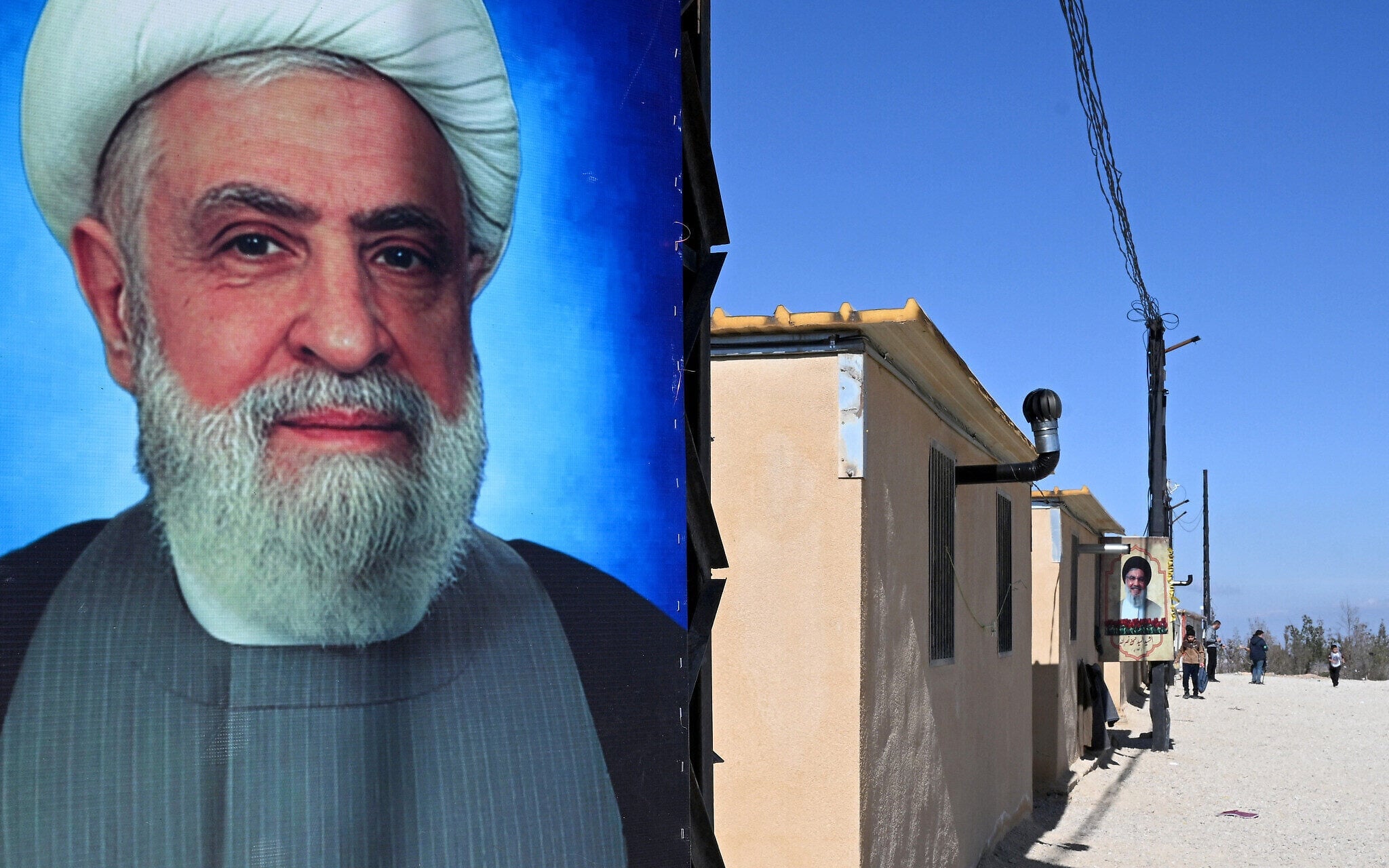
A poster of Hezbollah chief Naim Qassem outside shelters at the Imam Ali Housing Compound, near the city of Hermel in Lebanon's northeastern Bekaa valley on February 4, 2026. (Joseph EID / AFP).
Lebanese President Joseph Aoun and Prime Minister Nawaf Salam have done what too many of their predecessors refused to do: openly accuse Hezbollah of dragging Lebanon into repeated wars and holding the state’s sovereignty hostage. Their demand is direct and non-negotiable: the Lebanese state must establish a monopoly on weapons. Hezbollah’s response has been equally direct — threats, venom, and the unmistakable signal that political assassination remains an available instrument of coercion.
This is not ordinary political friction. It is a confrontation with an Iranian-backed terrorist organization that, for decades, has treated Lebanon less as a sovereign homeland than as a forward operating platform for foreign strategic interests.
The escalation did not emerge in a vacuum. Hostilities reignited on March 2, 2026, when Hezbollah opened fire in support of Iran only days after the start of the joint American-Israeli military offensive against the Iranian regime. Israel responded by expanding its buffer zone inside Lebanese territory and striking more than 45 Hezbollah infrastructure sites, including weapons depots, military positions, and rocket launchers. Roughly 350 Hezbollah operatives were eliminated, while more than 1,100 affiliated targets were destroyed. Israeli operations have since expanded, with forces pushing deeper into the south and reaching areas roughly 20 kilometers from Beirut.
A U.S.-backed ceasefire has reduced large-scale exchanges, and the third round of direct Lebanese-Israeli talks took place in Washington on May 15. Beirut’s position has remained consistent: de-escalation must precede any broader settlement, and any transition toward full state control over arms is conditional on credible U.S. guarantees. By any serious standard, it is the most assertive sovereign posture Lebanon has taken in years.
Hezbollah has responded with open contempt. Senior official Nawaf al-Musawi called President Aoun “one of the worst presidents to ever lead Lebanon,” effectively condemning him for refusing to subordinate the state to Hezbollah’s agenda and choosing the Western civilization model. He described engagement with Israeli leadership as “a disgrace” and dismissed negotiations as “an illusion.” Hezbollah leader Naim Qassem went further, insisting that no external actor has any role in the weapons file, declaring Hezbollah will “not surrender,” and threatening to “turn it into hell for Israel.”
These are not the statements of a political party operating within a constitutional system. They are the declarations of an armed, Iran-aligned terrorist movement that still performs Nazi-style salutes and remains fully committed to rejecting the authority of the state in which it operates. Therefore, the most immediate danger is not necessarily renewed conventional war with Israel — though that risk remains elevated. It is internal destabilization.
Israeli intelligence assessments, alongside reporting from the Meir Amit Intelligence and Terrorism Information Center, have warned of the possible activation of Hezbollah’s covert Unit 121 against Lebanese political and security figures advocating disarmament. The unit has a documented history of targeted assassinations, including the 2005 killing of former Prime Minister Rafik Hariri and other political figures over the past two decades. As Hezbollah faces mounting military pressure and diminishing political leverage, covert violence and internal disruption are becoming increasingly central tools of deterrence.
At the same time, Hezbollah is repositioning forces across southern Lebanon and the Beqaa Valley while demanding a national referendum — a mechanism widely viewed as an attempt to convert its armed constituency into a permanent veto over state policy. The organization continues to insist that its arsenal is an “internal matter,” even as it maintains an independent military structure and operates in direct coordination with Iran’s regional strategy.
The Lebanese government’s position is, in effect, a test of sovereignty itself. No state can credibly claim full authority while an autonomous, foreign-backed armed actor maintains its own chain of command, foreign-policy alignment, and coercive enforcement apparatus. The current diplomatic window — supported by genuine U.S. engagement — represents Lebanon’s clearest opportunity in years to reassert state control.
Hezbollah understands this perfectly well. That is why its rhetoric is escalating and why intelligence warnings are increasingly focused on assassination risks and internal sabotage. The organization has never accepted disarmament through a political process. Its method has always been coercion: rockets against external adversaries and targeted violence against domestic challengers.
Washington and its partners now face a simple test of seriousness. If Lebanon’s political leadership is left exposed while Hezbollah retains its independent military capacity, the disarmament process will collapse, the ceasefire will erode, and Lebanon will remain what it has effectively become for years: a fragmented state functioning as a forward operating platform for Iranian regional strategy.
In practical terms, this requires urgent U.S.-Israeli coordination with Lebanese authorities to ensure direct protective security for President Aoun and Prime Minister Salam, alongside a calibrated, progressive withdrawal of Israeli forces from selected Lebanese areas. Such a phased repositioning would demonstrate in real time that diplomacy under the Aoun government produces tangible sovereignty gains, while Hezbollah’s militarized posture delivers only isolation, destruction, and strategic decline.
The trajectory is becoming unmistakably clear. Either the Lebanese state secures a monopoly on force and neutralizes the threat of internal armed coercion, or Hezbollah reimposes dominance through intimidation and selective violence. The middle ground is disappearing rapidly.
Related Topics