They didn’t wake me. My hands aren’t clean.
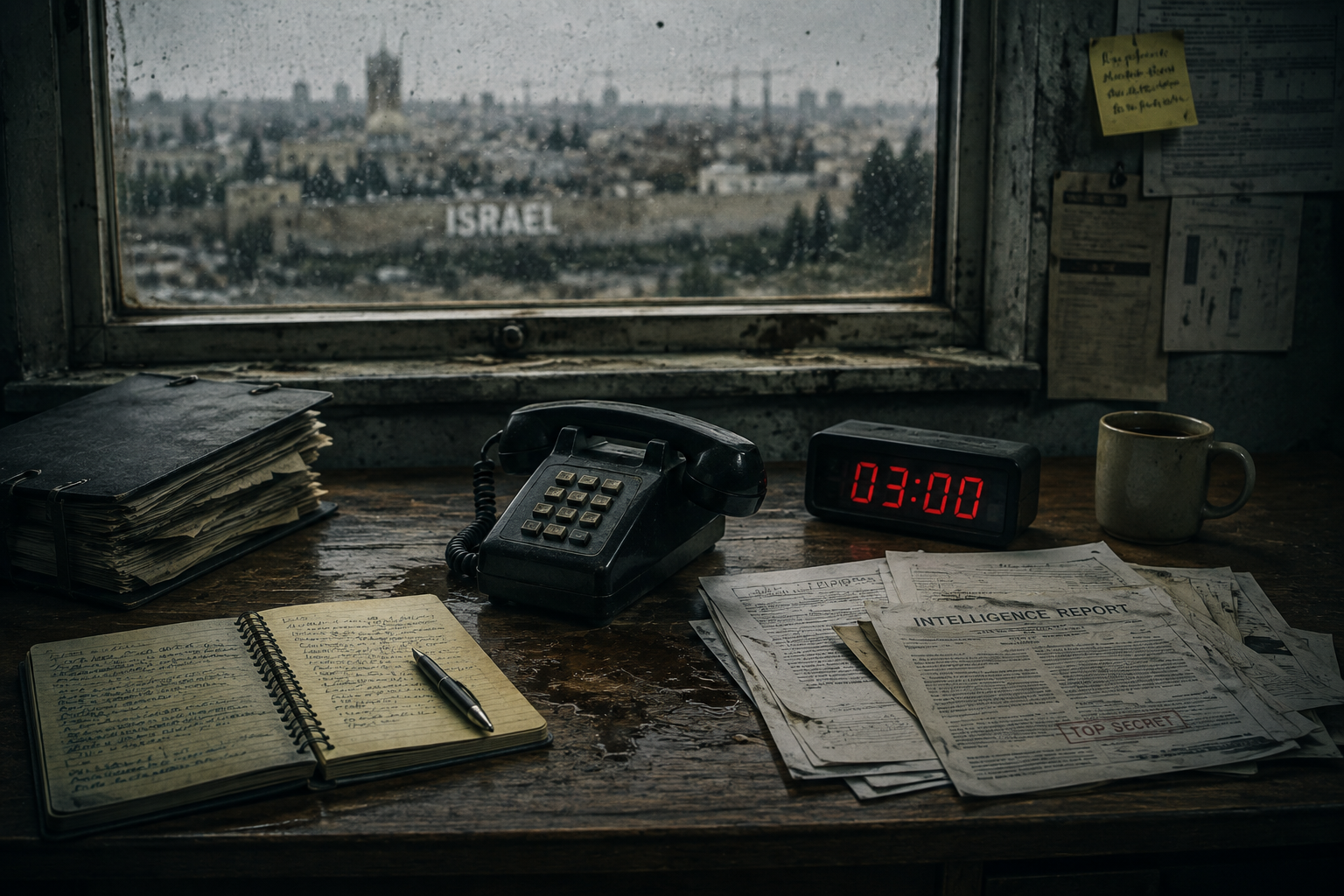
“They didn’t wake me.” And my hands cannot be washed clean
There are phrases that set out to explain a catastrophe and end up revealing something rather deeper.
“They didn’t wake me” is one of them.
Benjamin Netanyahu now maintains that, in the hours before the Hamas attack of 7 October 2023, Israel’s security chiefs detected troubling signs and deliberately decided not to wake him. In his account, they feared that the Prime Minister would order an immediate mobilisation, put the air force on alert and instruct the military to strike anyone approaching the border. That, they believed, might trigger precisely the escalation they were trying to avoid.
Netanyahu goes further. He says that, had they woken him, the invasion would not have happened.
Perhaps one day the full records will allow us to know precisely what happened during those hours. Perhaps they will reveal grave failures by military and intelligence commanders. Perhaps they will establish that someone should have called the Prime Minister and did not.
All of that matters.
But there is something that explanation does not resolve.
A prime minister does not begin to bear responsibility when the telephone rings at three in the morning.
Responsibility did not begin that night
For years, Israel operated on a strategic assumption that Hamas could be contained, managed, deterred. Under Netanyahu’s governments, the transfer of Qatari funds into Gaza was permitted and defended. The logic was familiar: preserve a measure of economic stability, avert a humanitarian catastrophe and buy, directly or indirectly, periods of quiet.
Even a few days before 7 October, according to information published afterwards, the priority remained to preserve calm and avoid escalation.
Now another reconstruction of the past appears: Netanyahu as precisely the man who never underestimated Hamas and who, had he only been woken that night, would immediately have grasped the scale of the danger and taken the decisions capable of preventing the catastrophe.
The two images collide.
It is not enough to reply that others also believed Hamas had been deterred. Precisely because that assumption was shared, the failure was systemic. And someone who for so many years occupied the political summit of that system cannot retrospectively place himself outside it.
“They didn’t wake me”
The phrase does something extraordinary: it compresses years of responsibility into a handful of hours.
Suddenly, what recedes from view is the policy pursued towards Gaza, the strategic assumptions that were accepted, the signals that were misread, where the priorities lay, how military resources were allocated, or how the State of Israel came to find itself in that position.
The question contracts into another:
Why didn’t they wake Netanyahu?
And that contraction has a politically convenient consequence. If the decisive problem was that others had the information and failed to wake the Prime Minister, Netanyahu ceases to appear as a central part of the system that failed. He almost becomes a victim of that same system.
But the responsibility of a head of government is not confined to the orders he can personally give in the final hours before a catastrophe. It also extends to the political, strategic and institutional architecture within which that catastrophe became possible.
There can be military responsibility.
There can be responsibility within Shin Bet.
There can be responsibility within the intelligence services.
There can be officers who made unforgivable mistakes.
And, at the same time, there can still be political responsibility.
The strongest objection
There is a reasonable objection, and it deserves to be taken seriously.
A prime minister does not personally control every intelligence assessment, every tactical warning or every operational decision. In a modern democracy, responsibility is distributed among the political leadership, the military, the intelligence services and multiple levels of command. It would be simplistic, in retrospect, to place every decision made by such a complex system on the shoulders of one person.
True.
But absolution does not follow from that.
What follows is exactly the opposite: different responsibilities can exist simultaneously, even overlap.
An intelligence failure does not eliminate political responsibility. A flawed military assessment does not erase a strategic decision. The fact that someone else failed does not prove that you did not.
Complexity distributes responsibility.
It does not make it disappear.
You cannot wash your hands by distributing the blame
That is the heart of the problem.
Netanyahu may prove tomorrow that a general got it wrong, and his hands will still not be clean.
He may prove that Shin Bet misread a signal, and his hands will still not be clean.
He may prove that someone received a document and decided it was not urgent enough to wake him. His hands will still not be clean.
Because responsibility is not a fixed quantity to be divided among several people until, as one person’s share grows, another’s diminishes or disappears.
A single catastrophe can have many people responsible for it, at different levels and for different reasons.
“They didn’t wake me” might explain why Netanyahu did not make a particular decision in the early hours of that morning. It might even become an important element in establishing the responsibility of others.
What it cannot do, by itself, is absolve everything that led to that morning.
And then there are the dead
Here the battle over the narrative reaches a limit.
Because there is something Netanyahu, his family, his opponents, the generals, the intelligence services and any future commission of inquiry can no longer alter:
what happened, happened.
Israel suffered deaths, injuries, hostages taken, communities devastated and families destroyed.
Then came the war.
And with it came an enormous number of Palestinian deaths, civilians caught in a devastating war, families destroyed, mass displacement and cities reduced to ruins.
Suffering does not become less real because it happened on the other side of a border.
We may argue for decades over who knew a particular piece of information at two in the morning, who received a report at three, who telephoned, who did not, and what Netanyahu would have ordered had someone opened his bedroom door.
It must be investigated.
But the dead remain dead.
The hostages who died do not return.
Destroyed families do not go back to the moment before.
A rebuilt house does not make the moment of its destruction cease to have happened.
That is the brutality of reality: once something has happened, no subsequent narrative can return it to the realm of possibility.
Before the fact there is choice; afterwards there is responsibility
Perhaps this is the deepest dimension of 7 October.
Before an event, there is an interval.
Between information and a decision.
Between a warning and a response.
Between a policy and its consequences.
While that interval remains open, another direction can still be chosen. Not always. Not completely. But there is still something that has not yet happened.
Then it closes.
Possibility becomes fact, and then we can investigate the past, interpret it, argue over it, justify it, distort it, even lie about it.
The one thing we can no longer do is undo it.
And that is where the true weight of responsibility begins.
Not because a human being has complete control over events. No one does. But because for a time there is a margin — sometimes large, sometimes miserably small — within which our decisions take part in shaping the reality that will ultimately exist.
On 7 October, that interval closed.
Then something else began: the struggle to establish what happened and who must answer for it.
Fifty-five-page documents can be written.
Records can be selectively presented.
There can be interviews, accusations, counter-accusations and new reconstructions of those early hours.
The reality left behind does not move a millimetre.
The question that will remain
Netanyahu may yet win an argument about the hours immediately preceding the attack.
He may even succeed in demonstrating that, had he received certain information, he would have acted differently.
But that will probably not be the question that remains.
The historical question will be far more uncomfortable:
How did Israel, after so many years under his leadership, arrive at that night?
“They didn’t wake me” can explain a few hours.
It does not explain the years before them.
And it cannot erase what came afterwards.
Responsibilities can be shared.
Consequences cannot.
And no one who was in command can simply wash his hands of them.