
High-Tech Oases and the Missing Piece of Middle Eastern Climate Resilience
As the Mediterranean summer sharpens into a multi-month crucible of extreme heatwaves and declining water security, a dangerous illusion persists across the Middle East. It is the belief that resilience to an altering climate is purely an engineering challenge—a matter of building larger desalination plants, laying smarter drip irrigation lines, and financing grand state megaprojects.
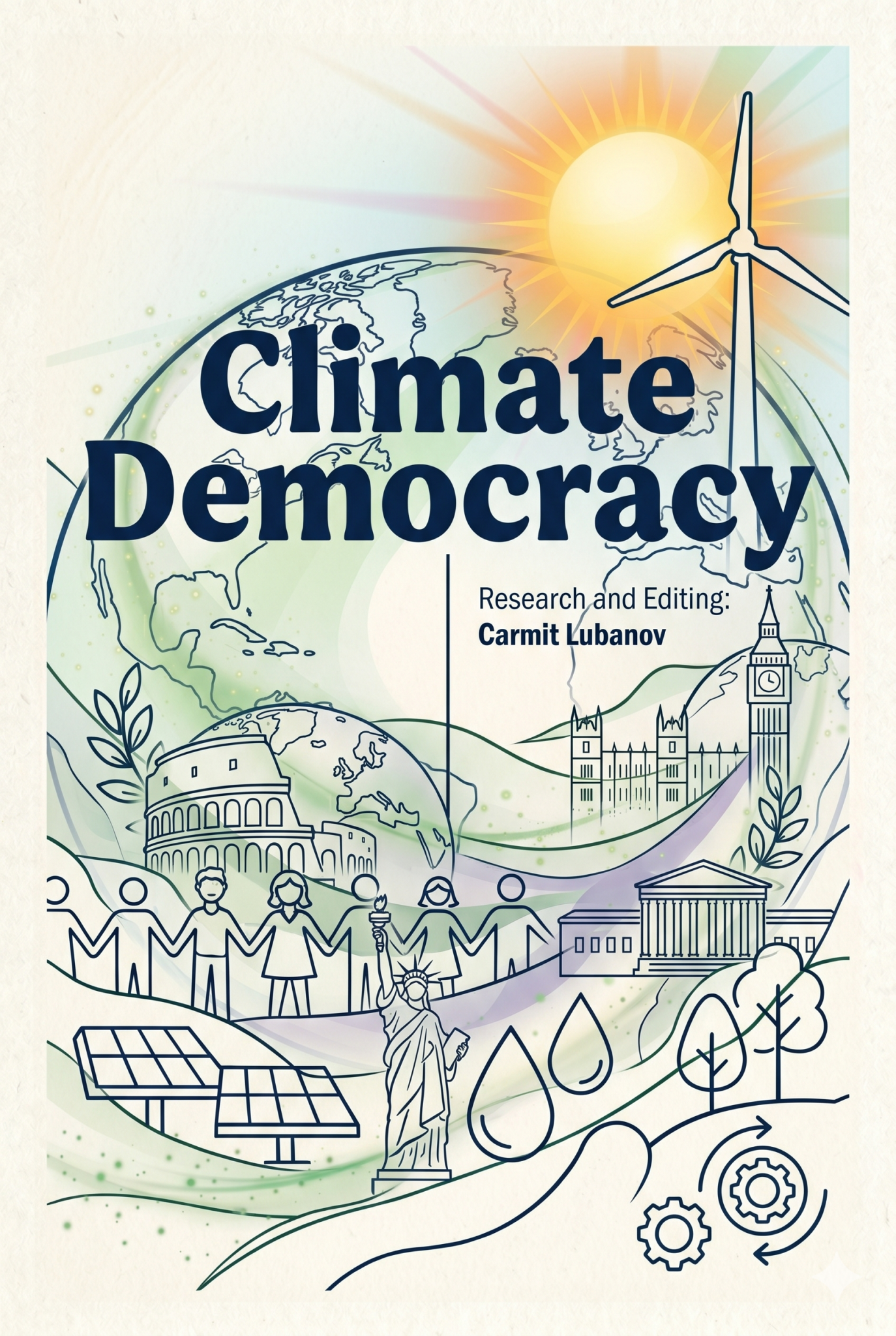
But as the geopolitical reality of the Euro-Med region shows, technology and infrastructure are only half the battle. The true baseline of survival in a warming world depends on a concept still largely ignored in our region: Climate Democracy.
Climate democracy is the structural alignment between top-down state policy and bottom-up civic trust. It means that when a government designs environmental mandates, they are legally binding, fiscally transparent, and co-designed with the communities most vulnerable to the crisis. When we look across the Mediterranean shore, we see a striking, multi-speed gap in how this democratic contract is executed.
These insights are the result of recent research by the Tahadhari Center, which focuses on climate resilience and its implementation in the Euro-Med region. The analysis maintains a focus on Israel and the Middle East while utilizing the Euro-Med and global benchmarks as critical contrasts.
In the North Mediterranean—nations like France and Greece—climate policy is legally institutionalized via binding national laws and independent oversight councils. Propelled by strict European Union targets, their public exhibits intense climate anxiety. Yet, as the Eurobarometer notes, their primary structural struggle is a “Fairness Gap.” European citizens actively demand climate action, but they fiercely contest its implementation if they perceive it as an unfair economic penalty on lower-income or rural demographics. For the North Med, climate democracy is an ongoing negotiation about socioeconomic equity.
Shifting focus to the Southern Mediterranean—Egypt, Jordan, and Morocco—the dynamic changes completely. Here, climate change is experienced as an immediate crisis of livelihood. According to the Arab Barometer, nearly half the population identifies absolute water scarcity and agricultural collapse as their primary existential threats. Yet, outside of Morocco’s impressive constitutional clean-energy scaling, the democratic channels required to convert this raw, experiential public panic into enforceable policy are severely constricted. In places like Egypt, independent environmental activism is routinely sidelined. The result is an “Agency Gap,” where the populations who understand the threat best have the least leverage to shape state priorities.
Where does Israel stand in this fractured landscape? Right at a paradoxical crossroads.
Israel is a global powerhouse of climate-resilient engineering. We have achieved unparalleled water security through groundbreaking seawater desalination and wastewater reclamation. Yet, beneath this high-tech armor lies a staggering domestic legal vacuum. Israel’s draft Climate Bill has been repeatedly stalled, weakened, and delayed. State Comptroller audits consistently reveal that the vast majority of local authorities lack active climate preparedness plans.
This reveals Israel’s own “Periphery Gap.” Because our broader public is insulated by state engineering, we suffer from an apolitical tech-complacency. We view climate change as a problem for the tech sector to solve, rather than a structural crisis that requires robust legislative accountability and equitable budgeting. Consequently, our peripheral communities and minority populations—such as the Bedouin in the Negev—are left exposed to extreme heat and localized floods without statutory protection or a seat at the planning table.
Global benchmarks offer a stark warning against this complacency. The United States proves that immense financial green subsidies can be fundamentally undermined by hyper-partisan polarization and a lack of unified legal enforcement. Conversely, India demonstrates that despite massive clean-energy infrastructure expansion, systemic social inequalities continue to slow down local adaptation for the most vulnerable.
Technology can build an oasis, but it cannot sustain it without a robust civic contract. If Israel and the broader Middle East are to survive the intensifying climate anomalies of the coming decades, our decision-makers must look past purely engineering fixes. True relative resilience cannot be bought or engineered in isolation; it must be democratized. We must bind our climate goals in enforceable law, protect independent civic spaces, and ensure that our peripheral communities are treated as active partners—not afterthought casualties—in the transition ahead.