
Singapore-based entrepreneur, exploring Jewish life in Asia
The Stability Premium: France’s Unrest and the Value of Normality
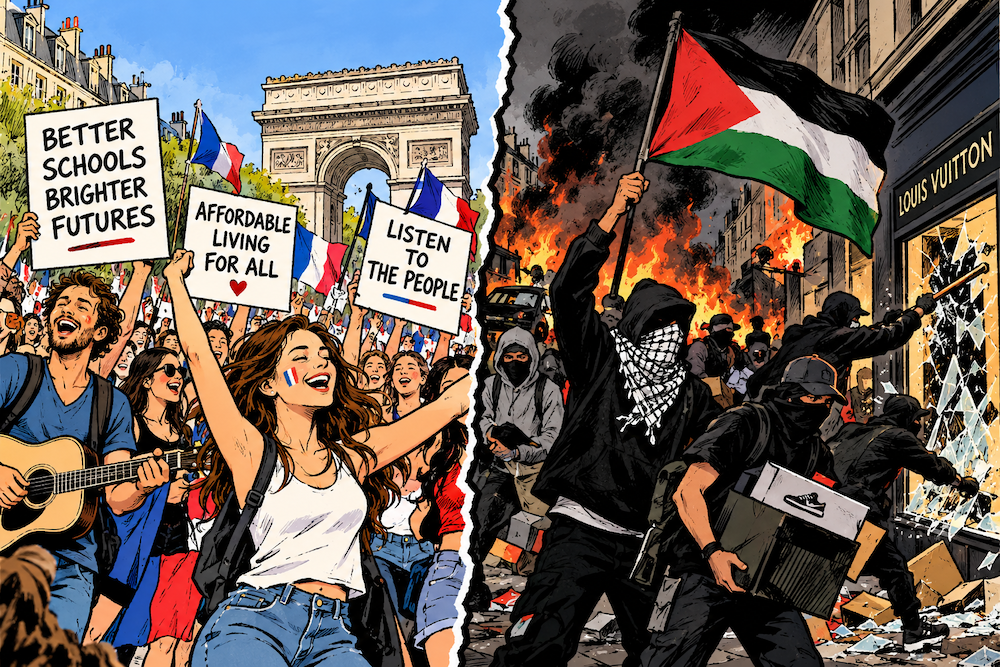
Two Sides of the French Riots (AI-generated)
Depending on which media outlets you follow, you could be forgiven for thinking you’re watching two entirely different events unfold over the past week in France.
On one side, thousands of people peacefully protesting legitimate grievances: the cost of living, deteriorating public services and an education system that many feel is failing their children. I’ve watched firsthand footage of demonstrators singing, dancing and marching together. No issues here.
But then there is the other side…
Masked young men smashing windows, looting shops, setting vehicles alight and attacking public buildings. Ordinary shopkeepers desperately trying to protect their businesses as their livelihoods being destroyed by criminals. Scenes that are difficult to reconcile with calls for better schools and affordable groceries.
And predictably, two narratives have emerged.
One argues that the violence is a symptom of a population pushed to breaking point by economic hardship and political neglect.
The other points to failures of immigrant integration, criminality and a breakdown of law and order, warning that France has allowed problems to develop that it is increasingly struggling to control. Many say that this problem is only getting worse and is rapidly spreading across most of Western Europe.
Like most situations in life, these two perspectives are not necessarily mutually exclusive.
A society can have entirely legitimate economic grievances while simultaneously facing serious problems with crime, integration and public order. Acknowledging one doesn’t invalidate the other.
That doesn’t mean we should automatically attribute these particular riots to immigration. French authorities have pointed towards radical-left groups and opportunistic criminals. However it hard not to make that connection when we can see on countless videos the faces (useless hidden under masks or keffiyahs), dress code, and demographic and age profile of what seems like the majority of perpetrators.
But equally, we shouldn’t dismiss legitimate concerns about integration and social cohesion simply because they’re politically uncomfortable.
Something else has struck me. Amid the French flags and banners demanding economic reforms, almost every video or photo I have seen coming out of France has seen a large number of Palestinian flags featured prominently. For some reason, looting clothing or jewelry shops and graffitiing ‘Free Palestine’ are linked.
What exactly does Gaza have to do with the cost of living or the quality of schools in France? Not a clue.
People are of course entitled to express solidarity with Palestinians. But I find myself wondering whether these demonstrations have become an outlet for a much broader collection of political grievances, some connected, others considerably less so.
Perhaps for some protesters these causes are all part of a wider frustration with government and the political establishment. Fair enough. But when everything becomes part of the same protest, the original message risks getting lost. And frankly, the imagery of keffiyeh-wearing, Palestinian-flag-wielding groups vandalising, smashing windows, rioting and stealing does nothing to promote sympathy.
Prime Minister Netanyahu has already indicated this correlation, blaming the civil unrest on extremist Islam.
There have also been troubling reports of Jewish-owned businesses being damaged during the unrest in Marseille. Subsequent statements from local Jewish community representatives and police have clarified that many businesses were attacked across religious lines, with little established evidence that Jewish shopkeepers were deliberately singled out.
However, for France’s Jewish communities who already have legitimate security concerns and have been expatriating in record numbers, these persistent acts of criminality are yet more cause to consider their futures in the land of cheese and wine.
Anyway, all of this has led me to think about something I call the stability premium.
Here in Singapore, we pay a considerable premium for almost everything. Housing, cars, schooling, you name it. Anyone who lives here, whether a Singaporean or a foreigner, will complain about the cost of living. Including me.
But there’s another kind of premium that’s much harder to quantify.
The ability to wake up in the morning, take your children to school, open your business, walk down the street and reasonably expect that the institutions and infrastructure around you will continue functioning as intended.
That’s the kind of stability premium I’m talking about.
There is a similar premium when it comes to Israel. No doubt that economic conditions and cost of living have become increasingly a worrying factor in the land of milk and honey. No doubt there is existential angst about when the next flareup will occur with Iran, or the Houthis, or Hamas, or Hezbollah or whatever comes next. There is angst about sirens going off in the middle of the night.
And yet… I’m reminded of Elie Weisel’s famous quote:
“As a Jew, I need Israel. More precisely: I can live as a Jew outside Israel but not without Israel.”
Jews cannot live without Israel, and Israel cannot exist without Jews. The bond is sacred. There is something to be said about a nation that intrinsically values your protection. A nation made of people with shared goal and identity, however fractured sometimes.
Having lived across three continents, I’ve come to appreciate that social cohesion is not something that simply happens because people of different backgrounds live alongside one another. It takes both top-down legislation as well as grass-roots cultural integration and understanding.
It requires effort. Effective institutions. A degree of mutual respect. And perhaps most importantly, a shared understanding that everyone is expected to play by the same rules.
Stability doesn’t mean the absence of disagreement. Nor should it mean suppressing legitimate grievances. It means having the institutions, social trust and political maturity to manage disagreement without allowing it to descend into widespread disorder and chaos, as we’ve seen on the streets of France and elsewhere.
The people demanding better schools and more affordable living costs deserve to be heard. The shopkeeper whose business has been destroyed deserves to be protected. Both matter.
If governments fail to address economic grievances, resentment will only grow. If they fail to maintain public order, confidence in the state erodes. Neither failure is conducive to a cohesive society.
And when people lose faith in both their economic prospects and the ability of their institutions to protect them, it creates fertile ground for political polarisation.
We can already see how easily the events in France lend themselves to competing political narratives, each highlighting the evidence that supports its position while conveniently ignoring the rest.
The tragedy is that ordinary people, including those who simply want better schools, affordable groceries and safe streets, are the ones left paying the price.
The question is – can the governments, institutions, and ordinary citizens come together to promote and build a brighter future together? Or is it too late?
Related Topics