Holocaust Survivors Are Afraid — Not for Themselves, But for Their Grandchildren
Holocaust survivors have endured everything: ghettos, camps, starvation, flight, hiding, torture, and the loss of entire families. They survived the full force of human evil — and lived and rebuilt their lives, raised families and contributed to society, and believed, or at least hoped, that antisemitic hatred belonged to the past.
On October 7, that belief cracked. The atrocities committed that day – families fleeing burning homes, entire households murdered, civilians brutally massacred – hurled survivors back more than 80 years.
But it was not only the atrocities committed against innocent civilians that broke something within them, but also what came afterward: a global wave of antisemitism, brazen and unapologetic.. The justification of the massacre. The glorification of Hamas. Open calls for violence against Jews voiced openly on university campuses, in city streets, and across social media. Jewish cemeteries defaced, Swastikas defacing Jewish cemeteries. Mezuzahs torn from the doorposts of Jewish homes. Antisemitism has reached monstrous proportions, and it has not receded.
In the past year alone, 20 Jews were murdered in antisemitic attacks in Colorado, Washington DC, Manchester, and Bondi Beach, Australia. Each of the victims was a world unto themselves. Each attack is a reminder that ancient Jew-hatred never disappears – it adapts.
Ahead of International Holocaust Remembrance Day, the International March of the Living spoke with Holocaust survivors in the United States, Canada, Australia, and the United Kingdom. We asked how they feel and what message they wish to convey. Despite the geographic distance, they all said remarkably similar things.
They are angry. They are heartbroken. And they are afraid.
Not for themselves. They have already faced the worst imaginable. They are afraid for their grandchildren. Those who witnessed how words turn into violence, how incitement becomes murder, recognize the patterns. They hear the language. They see the silencing. They feel the fear returning — not to them, but to the next generation.
That fear shapes daily life. Survivors describe being cautious even when ordering an Uber. As Prof. Mark Spigelman from Sydney explains: “I no longer enter the Jewish Museum as my destination, but put in a nearby building instead.” Jacques Weiser from the UK also says he is careful when moving through public spaces.
And yet, despite everything – and perhaps because of it – they are strong. Proud of their Jewish identity. They do not retreat from public life. They refuse to withdraw. They do not surrender to silencing, incitement, or threats.
Eva Kuper from Canada shared that she has not stopped attending synagogue or Jewish events. “I have done so with greater frequency and persistence”, she said.
“We will not hide,” says Rosette Goldstein from Florida. “We will not give up who we are out of fear.”
Mark Spigelman continues to teach at a university in Sydney despite the hostile environment, and continues to wear the yellow pin calling for the return of the hostages.
Some survivors admit, painfully, that they are no longer certain antisemitism can be eradicated. It is ancient, adaptive, and persistent. Yet despite these difficult times, they have not lost hope.
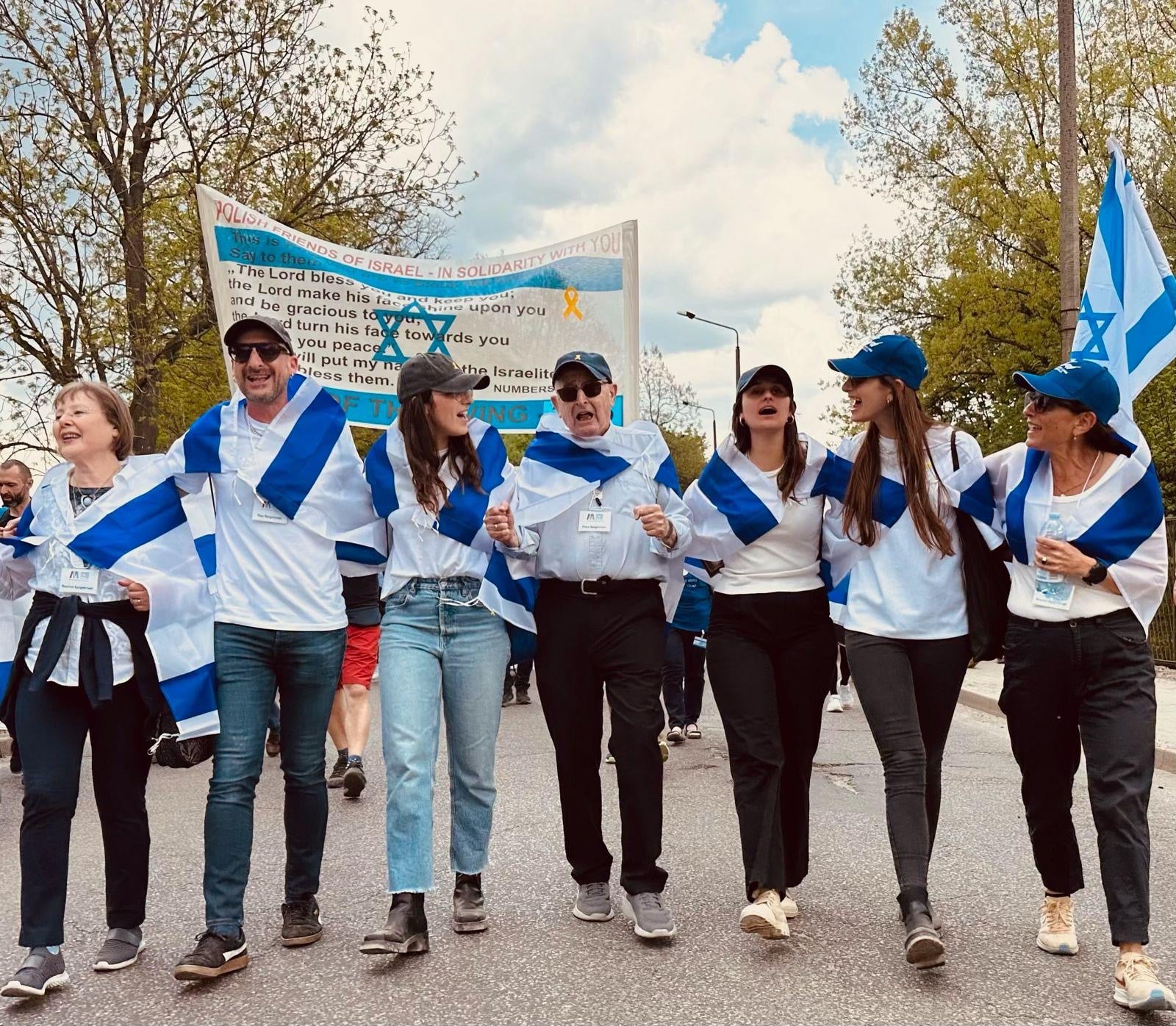
Their hope lies in young people who choose to listen — and to walk alongside them.
The young people who choose to listen, to ask questions, to march alongside them in the March of the Living are where that hope lives.
“Education, education, education,” they repeat — not as a slogan, but as an answer. “We will defeat hatred and ignorance only when we help people see t the other as a human being, not as an enemy,” says Eva Kuper.
Despite leadership that has failed to eradicate antisemitism, Holocaust survivors have not lost hope. And they have not lost faith. They still believe in humanity. They believe in compassion.
“In the face of hatred, we must cling to our humanity and stand against extremism, intolerance, and hatred,” says Jacques Weisser . They search for today’s Righteous Among the Nations — those who do not stand by as antisemitism surges. They exist, and their actions matter.
Ahmed al-Ahmed, who stopped the massacre at Bondi Beach, gave them hope.
New Yorkers who came to buy from a Jewish bakery after its employees called to sever ties with Israel gave them hope.
The State of Israel gives them hope. A state that did not exist when their world was destroyed. Israel gives the Jewish people a voice, strength, and protection. An anchor of security and hope, even as the world falters.
In the final years of their lives, they ask us a searing question: What will we promise them — and what will we actually uphold?
Today we are promising them that their voices will be heard.
That the Holocaust will not be forgotten.
That its lessons will be acted upon.
The responsibility now – is squarely ours.