
How a Cornered Israel Could Drag the Whole World Into Nuclear Winter
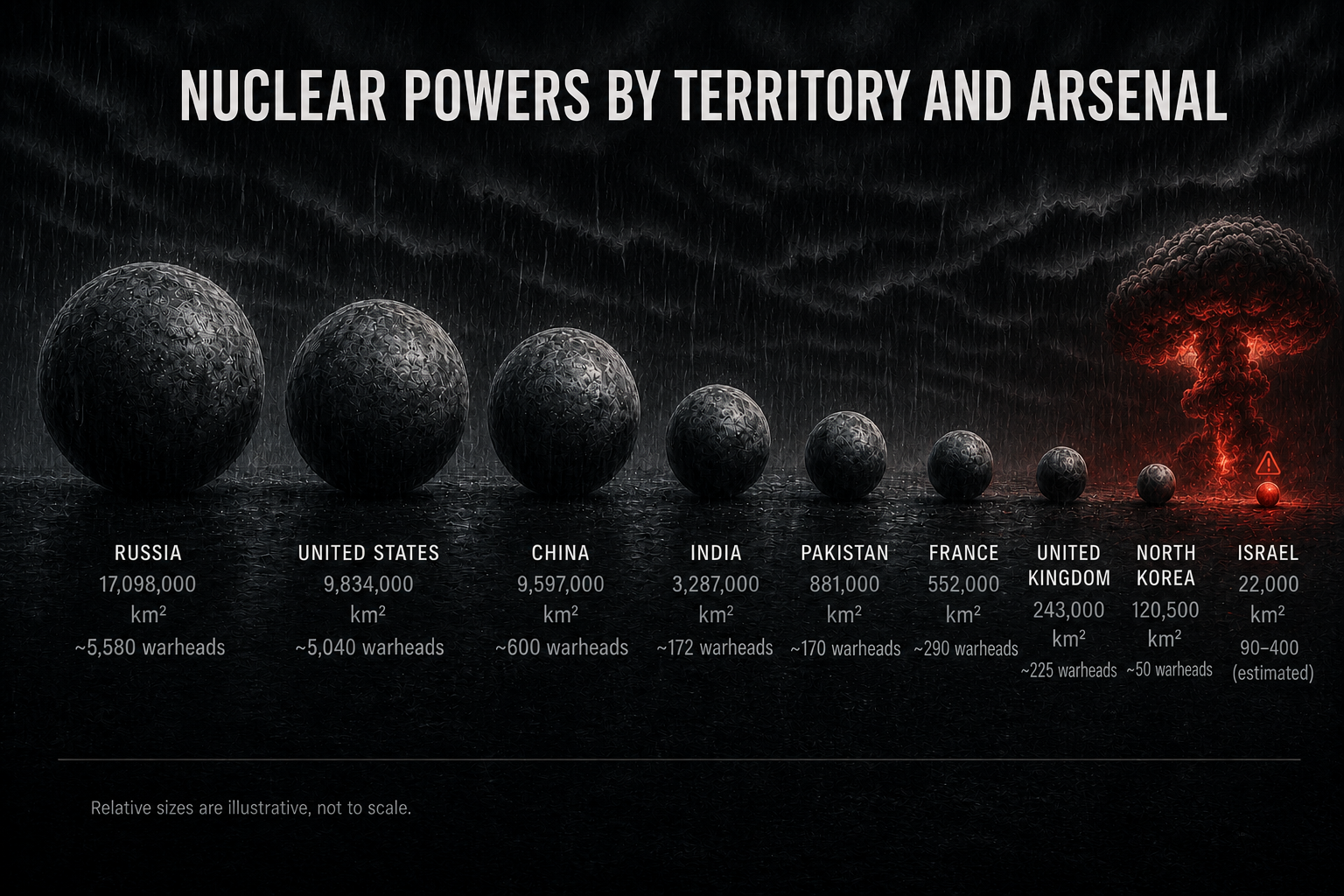
Nine countries hold nuclear weapons. Eight of them can lose a city and still be a country the next morning. Russia could absorb a strike on Moscow and govern from a hundred other places across eleven time zones. The United States, China, and India all have room to bleed. They have distance, hinterland, a second and a third and a tenth place to stand. Israel has none of that. That single fact, the sheer smallness of its territory, makes its nuclear arsenal the most dangerous of the nine.
Look at a map with honest eyes. Israel runs about 470 kilometers from north to south, a drive of some five to six hours down its length. But length is not where the danger lives. At its waist, near Netanya, the country narrows to roughly 15 kilometers, a span a car crosses in minutes and a missile in seconds.
There is no depth to trade for time, no interior to retreat into, no province to sacrifice so the nation can regroup. Every point on that map sits close to a border. Every border touches a declared enemy, or has in living memory. When a state is this narrow, losing territorial control does not feel like a setback. It feels like the first minute of the end.
This is the psychological engine that other nuclear powers do not carry. Vast nations can tolerate the sensation of losing ground. Losing ground and losing the nation remain two distinct realities separated by hundreds of kilometers and tens of millions of people. In Israel, those two realities collapse into one.
The loss of control and the threat of annihilation arrive together, in the same instant, because there is no space between them. That is not paranoia. It is physical reality. When you can cross a country at its waist in minutes, you cannot afford to be wrong even once.
Smallness bites in a second way, and it lasts far longer than any battle. If a massive country suffers a radiological catastrophe, it can evacuate the poisoned region and resettle its people elsewhere. Israel has no elsewhere. Contamination, unlike an invasion, does not recede when the fighting stops.
A ground-level detonation or a strike on a nuclear installation pulls debris into the fireball and scatters far more long-lived fallout than an airburst high above a city ever would. Were the reactor at Dimona itself struck and its six decades of accumulated material released, the result, as I have argued previously, would not be measured in years but in geological time.
Independent modeling has projected a permanently uninhabitable zone of 2,500 to 3,000 square kilometers, and the plutonium at its center has a half-life of roughly 24,000 years. Losing three thousand square kilometers forever is not a regional wound for a country measuring just 470 kilometers end to end. For Israel, every piece of land is a vital organ.
From this comes a doctrine that outsiders often mistake for aggression. In 1981 Israel destroyed the Osirak reactor in Iraq before Saddam Hussein could build a nuclear weapon. In 2007 it did the same to a reactor under construction in Syria. Both countries dwarfed Israel.
In both cases, Israel struck the capability while it remained an intention, not a weapon. The pattern earned the name of the prime minister who ordered the first strike.
The Begin Doctrine holds that Israel will not permit a sworn enemy to acquire the means of its destruction. Read from the outside, it looks like an aggressive first strike. Read from inside those 15 kilometers, it looks like the only way to avoid facing a blow you have no room to survive.
A quieter piece of evidence might be the most telling. Israel has never confirmed that it holds nuclear weapons. It has also never denied it, and it has never once asked to be removed from the list of the world’s nine nuclear states. That list is not folklore. It is the working consensus of every serious arms monitor on earth, and Israel sits on it by their assessment, not by its own admission.
Any government wrongly considered a nuclear power would loudly protest such a dangerous label. Israel says nothing. That silence is the message. It neither claims the weapons nor surrenders the deterrent that the world’s belief in them provides. Ambiguity, held this deliberately for this long, is itself a form of speech.
Notice what that speech does not say. No Israeli official has ever stood before a crowd and promised to wipe another nation off the map. The threat is capability without declaration, deterrence without a target list. That is a different grammar from the one used by the regime that governs Iran, which names its intended victim openly and repeats the naming as policy. This distinction matters. It separates those prepared to use nuclear weapons strictly to survive from those speaking openly of erasing a neighbor.
We must be exact here to avoid flattening two very different realities into one. Israel, by every reasonable reading, is prepared to use its nuclear weapons under one condition and one only: the certain, imminent end of the state itself.
This is the logic captured by the grim name its planners are said to use, the Samson Option, after the biblical figure who brought the temple down on his own head along with his enemies. The doctrine is not a plan to erase a rival. It is a vow not to die alone.
That difference is the whole of it. Deterrence, the doctrine that has kept nuclear weapons unused for eighty years, rests on a simple wager. If I fall, you fall. It works when both sides fear falling equally, when both have enough to lose that neither will move. But the wager grows thin when the two players are wildly different in size.
Massive countries can imagine surviving an exchange. They can tell themselves they will absorb the blow and endure with most of their land and people intact. Israel can tell itself no such story. For Israel, there is no absorbing the blow, no enduring with most of the nation intact, because a single successful strike is the nation. The smallest player at the table faces an entirely different reality. For them, mutual destruction is not mutual at all. It is simply destruction.
This is why the territory is the danger, and not the arsenal. Larger nuclear powers have the luxury of patience. They can wait to see whether deterrence holds, whether the adversary is bluffing, whether time and diplomacy might yet do the work. If the wait proves wrong, they will still exist to regret the error. Israel does not have that luxury. It reaches the point of no return sooner than any other nuclear state, not because it wants to, but because its total lack of space leaves no margin for a second guess.
Having the least room to be wrong means holding the lowest threshold. That low threshold creates the most dangerous condition of all. It surpasses large arsenals. It surpasses fierce rhetoric. It fatally shortens the distance between a threat and the final answer.
The danger does not end at Israel’s borders. This reality should trouble Moscow and Beijing most of all. In 2019, the Bulletin of the Atomic Scientists modeled a nuclear exchange between India and Pakistan, two arsenals of roughly 170 warheads each. The finding was stark. A war using barely three percent of the world’s nuclear stockpile would kill 50 to 125 million people outright. It would loft enough soot into the upper atmosphere to drop global temperatures by two to five degrees Celsius.
That is nuclear winter. It means failed harvests, collapsed food systems, and famine reaching billions who never heard a single detonation. I have written before about how closely that modeled scenario tracked the real escalation that followed.
Now weigh that baseline against the ambiguity. Estimates place Israel’s arsenal anywhere from 90 to 400 warheads. No one outside a small circle knows the true figure, the yields, or whether they are measured in kilotons or megatons. The opacity is deliberate.
Consider the high end of that estimate, and consider what the Samson Option actually means in practice. When facing certain annihilation, leaders do not keep weapons in reserve. There is no tomorrow to reserve them for. They use everything they have.
If a fraction of the Indo-Pakistani arsenal could chill the planet, a cornered Israel emptying up to four hundred weapons over its enemies would never remain a regional catastrophe. It would trigger a global one. The resulting winter would settle over Moscow and Beijing.
Russia must feed 144 million people. China must feed 1.4 billion. Both countries depend on crops that a nuclear winter would destroy. Soot would darken the sun and ruin growing seasons in the very latitudes that feed them. The powers that protect the regime that could corner Israel are risking famine for their own populations.
This is the calculation the two great powers refuse to make out loud. They shield the regime in Tehran, sell it what it needs, and treat it as a useful instrument against the West. But the instrument they are sharpening creates the exact pressure that could one day leave Israel with no move but the last one.
The powers most capable of reining in Iran are instead helping back the most vulnerable nuclear state on earth against the wall. Keeping the weapon out of Tehran’s reach is not a favor to Israel. For Moscow and Beijing, it is basic self-preservation.
None of this is an argument that Israel is the villain among the nine. It is the opposite. The villainy, if the word applies, belongs to whoever would force a state into the corner where its only remaining move is the last one. But the world should understand plainly what it is dealing with. The most vulnerable nuclear power is the most combustible one, precisely because it cannot afford to lose. Fifteen kilometers is not a statistic. It is a fuse. And the fire it could start will not stay in the Middle East.