I write what I see
How a Local Raid Became a Rorschach Test for Antisemitism
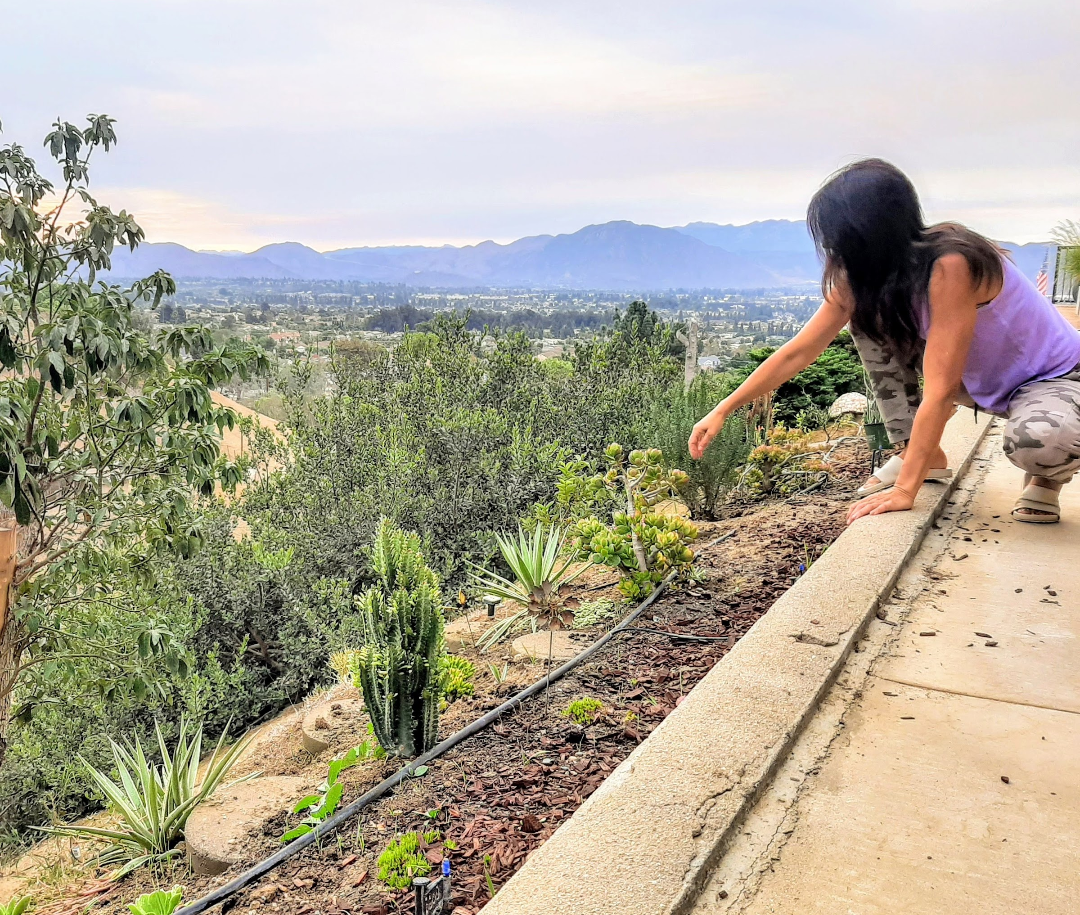
A quiet yard in a picture-perfect town—where the grass is green and the hate runs just beneath it (courtesy Levinsky)
You’d think that in a sleepy town like Camarillo, where the hottest debates—usually in the local Facebook mom group—revolve around whether local farmers should be growing hemp plants, which fast-food chain they’re hoping will open next, or if we really need yet another Starbucks, things would stay, well, local.
But not anymore. Not in 2025—when even a post about an ICE raid at Glasshouse Farms targeting undocumented workers turns into a battleground over Israel, Zionism, and whether Jews are allowed to speak.
According to reports, protestors showed up in response to the enforcement action. Tensions escalated. One protester allegedly fired shots at federal agents. The Ventura County Sheriff’s Office was called in to assist with crowd control.
A local city council member with deep ties to the farmworker community urged people to protest peacefully and clear the area for everyone’s safety. She didn’t defend ICE and she didn’t attack the protestors. Her message was balanced, compassionate, and responsible. Yet despite that clarity, the condemnation of her message was swift and unrelenting, as if asking for peace was somehow a betrayal.
I publicly supported her. I commended her courage for striking a tone of reason in a moment of chaos.
That was my first mistake.
Within minutes, the very first response to my comment claimed that police have never been and will never be safe for people of color, and that the council member should have known that. She was accused of betraying her community and supporting oppression.
I knew this was a risky thing to weigh in on, but I refused to stay silent. I’ve followed enough posts in the local Camarillo mom group to know that whatever I say is usually turned upside down. I’m often the odd one out. They want to bring in a Chuck E. Cheese, and I suggest maybe something that fits the charm of a beachside hill town—something with character, like Ojai, not another corporate chain. So I already knew that saying anything about police–especially if it didn’t toe the activists’ line–would be dangerous.
It’s not as simple or one-sided as people make it out to be. How on earth can you dismiss all the good that law enforcement does—especially in moments of crisis? You can’t. Blanket statements about police being universally racist or oppressive aren’t just inaccurate—they’re dangerous. They erase nuance, ignore lived realities, and devalue the real, often life-saving work that many officers do every single day.
After nearly losing my home in the recent Camarillo fire, I saw firsthand the dedication of firefighters and officers alike. I was helped by both. I recall thinking, how can anyone, with a straight face, condemn them all? Yes, there are real issues in the system. But reducing every cop to a villain is unfair and dishonest.
I responded that being stopped by police is never pleasant, even when you’ve done nothing wrong. I’ve experienced it myself. But I also understand that for others—especially Black Americans and people of color—these encounters can be far more charged. Sometimes they’re targeted unfairly, and the stakes of those encounters can be much higher. That’s a reality we can’t ignore. Still, acknowledging that doesn’t mean I’ll stay silent or vilify every officer.
Also, painting all cops as inherently and irredeemably racist, especially when so many of them are themselves brown or dark-skinned, is lazy thinking. We can hold space for that truth while still rejecting sweeping, reductive accusations. We can’t ignore nuance, facts, and lived experience, including mine.
And unlike many of the people doing the shouting, I actually know what goes on behind the scenes. I’ve served in national security. I was a soldier in the IDF. I worked airport security in Israel. I’ve made the hard choices, not from a keyboard but in real-time situations. So I wasn’t speaking from theory, I was actually speaking from experience.
That was my second mistake.
The moment I mentioned the IDF, the thread stopped being about public safety in Ventura County—and became about me. About Israel. About Jews.
I can already see the eye rolls: Why on earth would you mention the IDF? I’m hearing this sort of solution much too often . . . The simple answer is that I refuse to hide my identity. I mentioned that I was a soldier, not to provoke or to posture. But because it was relevant. And yes, it was in another context entirely. But the moment the word “IDF” appeared, the conversation stopped being about the issue—and started being about me.
Someone responded dismissively to my service, mockingly writing “Grllll IDF bye” with an image that was removed, while another said that “grieving Mexican women are not actively committing or contributing to genocide.” Then a political cartoon was shared equating ICE officers with IDF soldiers, as if enforcing U.S. immigration law and defending Israel from terror attacks are the same thing. There was that inevitable—“It’s always y’all’s go-to . . . ,” which was followed by the same predictable slang. It’s never just casual slang. It’s the mask slipping and a very loud tell. It reveals the speaker’s need to group, to other, to reduce Jews to a monolith, and then dismiss us entirely.
Oh and then came the self-appointed educators—non-Jews explaining to me what “Semitic” really means, as if I hadn’t read a book in my life. Others reached even further, dragging Holocaust resistance into the conversation to “teach” me about morality, as though invoking the Warsaw Ghetto Uprising was a valid retort in a debate about protest safety in California.
Someone even went so far as to compare ICE to the Gestapo, claiming Ventura County was beginning to resemble Nazi-occupied Poland. And although the Warsaw Ghetto Uprising was an act of desperate Jewish resistance against extermination—these comparisons weren’t just ignorant—they were obscene. They didn’t serve to honor Jewish suffering, but they did hijack it.
No one is being shoved into cattle cars, tattooed with numbers, or gassed in extermination camps for being undocumented. To compare ICE enforcement—flawed as it may be—to the Gestapo is a moral travesty. It’s also a case of historical appropriation while standing on the backs of murdered Jews to make a political point. You can fight for immigrant rights without hijacking our trauma. The fact that I even have to say this out loud is staggering.
The people arguing with me didn’t think twice about taking some of the darkest chapters in our history and using them as rhetorical props to shame a Jew for speaking. I was not about to let it go–because this is our current fight, and the warning signs aren’t subtle anymore.
Yes, the trauma experienced by farming families—adults and children alike—is real. I don’t minimize it. Not for a second. But it is not the same as what Jewish families endured. Undocumented farmworkers who are detained may face court hearings, potential deportation, or time in immigration detention—but they are not being sent to extermination camps. Many are released with monitoring, and while the system is undeniably harsh, it does not mirror the industrialized machinery of genocide. Children are often reunited with their parents and in the case of children left to fend for themselves, the community has stepped in immediately until they’re reunited. This matters. To conflate these realities feels more like historical erasure.
And the irony here? These same people will accuse Jews of “weaponizing trauma” the moment we call it out.
What struck me most wasn’t the cruelty—it was the speed. One moment, I’m speaking on behalf of calm and community. The next, I’m being treated like an oppressor for having worn an IDF uniform. They weren’t just angry—I was vilified for who I am. My words were no longer being read in good faith, they were being mined for a reason to exile me from the conversation.
When that chant—“Death to the IDF”—started echoing a few weeks ago, people rushed to defend it. “Free speech,” they said or “How is that worse than what the IDF is actually doing to Palestinians?” But those of us who know—who’ve seen how hatred spreads—we are now feeling it in every fiber of our body. We’ve seen this before and we’re seeing it unfold before our very eyes. We knew exactly what it meant. Bobby Vylan wasn’t interested in promoting peace—his chant was all about provocation, wrapped in art, and weaponized for applause. For us it was a warning, and it’s only the beginning.
People forget that in Germany, it all started with words. With slogans like “Die Juden sind unser Unglück” (“The Jews are our misfortune”), printed on the cover of “Der Stürmer.” With “Kauf nicht bei Juden!” (“Don’t buy from Jews”), painted across shop windows. With “Juden raus!” (“Jews out”) shouted in the streets. With “Der Jude ist schuld!” (“The Jew is to blame”) repeated until it sounded like fact. These phrases were the very words that softened the public for what came next.
The slogans we hear today—“Death to the IDF,” “Zionists Out,” “Go back to Europe,” “From the River to the Sea, “Globalize the Intifada,”—aren’t some bold new resistance. They’re recycled hate with a modern font. And history has already shown us exactly where they lead.
People mock us for bringing up the past—a past that never really left us, because we’re constantly reminded that we are still “the other.”
My friends are usually the first ones to say, “It’s just Facebook/Instagram/TikTok.” And this surprises me to no end because it’s not just social media. These moments, or micro-flashpoints are the new public square. And what this reveals is chilling: antisemitism is continuing to spread like wildfire. It’s no longer the occasional stain. It’s woven into the fabric of any sort of activism–whether online or in the streets. All the while, this activism is dressed up as justice, disguised as allyship, and camouflaged in causes that have nothing to do with Jews or Israel. And yet the rage and hate somehow end up directed towards us, regardless.
This latest incident makes something I’ve tried to suppress bubble to the surface: the overwhelming urge to leave. To pack up, walk away from the gaslighting, and resettle in Israel for good. If only it were that simple—if only there were jobs waiting for my husband and me. The truth is, I don’t know how much longer I can survive in a country where this kind of hostility towards Jews has become a daily feature and not a bug.
Or maybe it’s human nature that suppresses the truth. You keep telling yourself—it’s never really going to happen. Not here. Not with these people. They’re just being ignorant. They don’t really hate me, do they? But deep down, you know better. You just don’t want to admit it.
Still, I refuse to disappear. I will never hide my identity, my service, and my support for Israel.
Related Topics
Related Posts