
Middle East Forum Fellow/North Africa Risk Consultant
How Algeria Smothers Opposition Parties Before the Campaign Begins
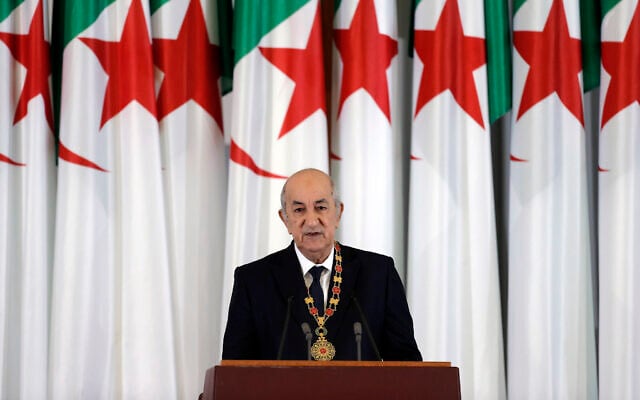
File: Algerian President Abdelmadjid Tebboune delivers a speech during an inauguration ceremony in the presidential palace, in Algiers, Algeria, on December 19, 2019. (AP Photo/Toufik Doudou)
Algeria’s parliamentary elections, scheduled for July 2, are still weeks away, and the Algerian regime has already ensured that the outcome will disappoint no one in power. The mechanism is not crude ballot-stuffing or outright candidate bans, though those tools remain available. It is something more refined: administrative suffocation, deployed with deniability and enforced through bureaucratic inertia. The opposition is not being suppressed. It is simply being buried in paperwork.
Under Algeria’s amended electoral law, parties that lack a sufficient number of elected local officials must compensate by collecting voter signatures, known as tazkiyat, to qualify their candidate lists. The threshold is not unreasonable on paper. In practice, it has become an instrument of exclusion. Parties including Jil Jadid (New Generation), the Union of Democratic Forces, Vanguards of Liberties, the Workers’ Party, the Socialist Forces Front, and the Rally for Culture and Democracy have all reported severe difficulties collecting and certifying the required signatures before the May 18 deadline. The complaints are consistent: municipal employees refused for days to authenticate the collection forms, citing the absence of official instructions from higher authorities. By the time those instructions arrived, or were grudgingly acknowledged, opposition parties had lost irreplaceable days in a process with no margin for error.
The obstacles did not stop there. Representatives of several opposition parties described overcrowding at municipal offices, deliberate slowness in processing files, and a measurable reluctance among ordinary citizens to sign, a reluctance that in authoritarian contexts is rarely spontaneous. The Rally for Culture and Democracy, which draws its base from the Kabyle region east of Algiers, went further than most, publicly accusing administrative officials of operating with a partisan logic that violates the formal principle of equality between political formations. The party described what it called a pattern of disguised refusal and discriminatory treatment during the filing process, particularly in Algiers. That is a direct accusation that civil servants are acting as political operatives, and in Algeria, it is almost certainly accurate.
When opposition delegations brought their grievances to the acting head of Algeria’s nominally independent electoral authority, Karim Khalfan, his response was instructive. He acknowledged the problem, expressed sympathy, and then explained that extending the signature deadline fell outside his legal competence. He promised to refer the matter to the presidency of the republic. This is how managed democracies work. Authority is always located one level above wherever you happen to be standing. The body with the power to fix the problem declines to act, while the body without the power to act expresses concern.
The contrast with the ruling presidential majority parties could not be sharper. Those parties have reported no difficulties whatsoever with the signature process and are instead focused on the next challenge: persuading voters to turn out in large numbers. The secretary general of the National Democratic Rally, one of the regime’s institutional pillars, is reportedly touring the country in a ground campaign designed to maximize participation. The infrastructure of the state is available to those who serve it.
This is the architecture of Algerian electoral politics under President Abdelmadjid Tebboune. Elections are held on schedule. Multiple parties compete. International observers are invited. And the results reflect, with remarkable consistency, the preferences of the security establishment and the presidency. The July 2 vote is for the lower house of parliament, a body with limited legislative independence but significant symbolic value. A legislature populated predominantly by ruling coalition loyalists will be presented as democratic legitimacy. That is the product being manufactured right now through expired signature deadlines and unresponsive municipal clerks.
Washington has largely accepted this framing. Algeria is treated as a security partner in a volatile region, a supplier of natural gas to European markets eager to reduce their dependence on Russia, and a stabilizing presence along the Sahel frontier. That strategic calculus is not without logic. But it carries costs. The Algerian regime’s domestic legitimacy rests on a foundation of managed consensus that requires the periodic elimination of credible opposition voices. When that consensus cracks, and it eventually will, the United States will find itself allied to an institution without a legitimate political counterpart to negotiate with or build upon.
The opposition parties currently scrambling to collect signatures before Monday’s deadline are not revolutionary movements. They are reformist, secular, legally registered political formations that are trying to participate in a process the regime has nominally opened to them. Their treatment reveals something important: the Algerian military-political establishment does not want an opposition it can tolerate. It wants one it can control. The difference between those two things is the difference between a managed democracy and a real one. Algeria is not the former. It is the latter wearing borrowed clothes.
Related Topics
Related Posts