
How Anti-Zionism and Antisemitism Combine to Produce Dehumanization
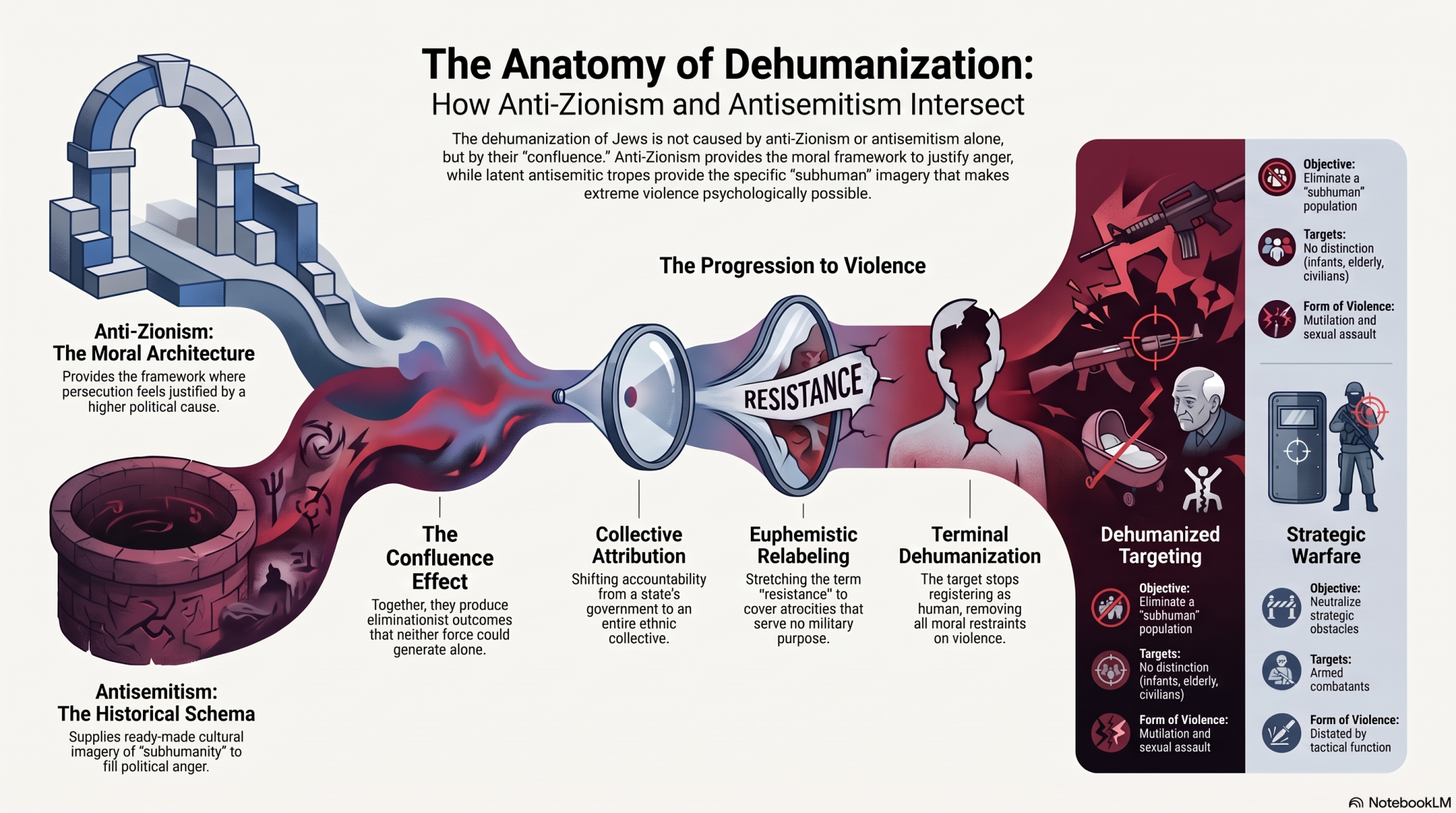
The dehumanization of Jews now visible across Western protest movements, campus discourse, and isolated but lethal acts of violence is not the product of anti-Zionism alone, and it is not the product of antisemitism alone. It is the product of their confluence.
Anti-Zionism supplies the moral architecture that makes violence against Jews feel justified rather than merely tolerated — the framework in which persecution, real or claimed, licenses the response.
Antisemitism supplies the content that fills the resulting vacancy: a centuries-deep schema of Jewish subhumanity that stands ready, in Western cultural memory, the moment a mind reaches for something to dehumanize a Jew with.
Neither mechanism produces what we are currently watching on its own. Anti-Zionism without antisemitism produces political opposition, sometimes fierce, rarely eliminationist. Antisemitism without a live political conflict to attach to produces prejudice without an outlet. Together, they produce a Columbia University crowd chanting “Death to Jews” and “F the Jews,” a tenured professor calling the murder of twelve hundred people “awesome” and “incredible,” a gunman outside a Jewish museum in Washington shouting “Free, free Palestine” over the bodies of a couple who were, days from now, going to be engaged — and, on October 7 itself, violence that made no distinction between combatant and infant, and that included mutilation and sexual assault serving no military purpose at all. That last fact is the clearest evidence in the entire pattern, because rape and mutilation are not things done to an enemy regarded as human; they are what a population becomes capable of once the target has already stopped registering as one.
What Dehumanization Requires
Psychologist Albert Bandura’s account of moral disengagement identifies the stages by which ordinary people come to accept or commit violence they would otherwise recognize as wrong: moral justification of the act by appeal to a higher cause, euphemistic relabeling of the violence itself, displacement of responsibility onto leadership or circumstance, minimization of the actual consequences, and — the final and most consequential stage — dehumanization of the target, so that harming them no longer registers as harming a full human being. Most of these stages require no ethnic content whatsoever. A soldier can morally justify an act, euphemize it, and diffuse responsibility for it about almost any adversary in almost any war, with no prejudice against that adversary’s ethnicity required at any step.
Dehumanization is different. It cannot be manufactured from nothing in the moment; it requires a pre-existing schema — some pool of imagery that already carries the message these people are less than fully human — for the disengaging mind to draw on. For most conflicts, the available schema is thin and generic: “the enemy,” “the occupier,” “the regime’s people.” For the Jewish target specifically, the available schema is neither thin nor generic. It is the oldest continuously operating dehumanization schema in Western civilization — vermin, disease, poison, subhuman cunning, collective guilt inherited by blood rather than earned by act — sitting fully assembled in cultural memory, available to be reached for whether or not the person reaching for it could articulate its provenance. This is the precise point at which latent, persistent antisemitism enters the mechanism: not as the reason political anger at Israel exists, but as the reason that anger’s dehumanizing register, once triggered, reaches for this content instead of the generic wartime callousness every conflict produces.
The Progression
Start where the argument has to start honestly: with anti-Zionism that sounds, and often is, entirely innocent. “I believe Palestinians deserve a state.” “I think the occupation is wrong.” “I question whether a state founded in 1948 should organize itself around one ethnic group’s self-determination.” None of these statements requires a trace of antisemitism to hold. They are ordinary political positions, argued by serious people, including some Jews, on grounds that have nothing to do with Jewish identity as such. If the sequence stopped here, there would be no piece to write — anti-Zionism would be indistinguishable from any other political critique of a state’s founding premises, and pointing at it would be nothing more than an attempt to declare a legitimate debate off-limits.
It does not reliably stop here, and the interest of this piece is in what happens past this point, because no single component of the progression announces itself as the moment antisemitism entered the room.
One component is a shift in register rather than content: the same position stated with escalating moral totality. Opposition to a policy becomes opposition to the state’s legitimacy becomes the demand that the state be dismantled entirely — not reformed, not pressured, ended. This alone is still defensible as politics; people have called for the dissolution of other states on anti-colonial grounds without needing antisemitism to explain it. But it is what makes the next component possible, because a state whose existence is itself the crime no longer offers any policy off-ramp — there is no reform that would satisfy the demand, which means the moral pressure the position generates has nowhere to go but toward the population sustaining the state.
A second component is where that pressure lands: collective attribution. The demand shifts from being about a government to being about a people — Jews generally, not just Israelis, treated as personally accountable for a state’s conduct because they are Jewish. This is the component anti-colonial theory, honestly applied, cannot authorize on its own terms; it targets an ethnic collective rather than a government or a structure. It is where the earlier innocent-sounding position and antisemitism’s oldest premise — that Jews constitute a single culpable body — become indistinguishable in practice, whatever their stated premise.
A third component is euphemism: violence against that now-collectively-guilty population gets relabeled as justified response, “resistance” stretched to cover conduct no theory of resistance actually sanctions.
A fourth is dehumanization: once the target’s guilt is collective and the response is pre-justified, the restraints that would normally limit violence to combatants, or limit its form to what strategic purpose requires, no longer have anything to attach to. What results is not a betrayal of the starting point. It is that starting point’s logical terminus, reached by people who, at each individual stage, could tell themselves they had not moved very far from where they started.
None of this means every person who states the progression’s opening sentence will ever reach its endpoint. Most do not. What it means is that the distance between “I question Israel’s founding premises” and a Columbia crowd chanting “Death to Jews,” or a gunman shouting “Free, free Palestine” over two bodies, is not the unbridgeable gap it appears to be from either end. It is a small set of components, not a strict ladder each case must climb rung by rung, and antisemitism’s latent schema is what makes each one passable rather than a wall.
Where the Confluence Becomes Visible
The evidence for this is not abstract. At Columbia University, under sworn congressional testimony, then-president Minouche Shafik was made to confirm that protest chants recorded on campus — “F the Jews,” “Death to Jews,” “F Israel,” “No place,” “Death to the Zionist state,” and “Jews out” — constituted anti-Jewish speech, not merely anti-war speech. Those words do not describe a policy. They describe a people. A Columbia professor under the same scrutiny was separately confirmed to have called Hamas’s October 7 massacre “awesome,” “astonishing,” “astounding,” and “incredible,” language that treats the murder of civilians as spectacle rather than atrocity — available to him, in that moment, only because the persons killed had already stopped registering as fully grievable.
Most anti-Zionism runs on ordinary, non-antisemitic political reasoning about power, land, and self-determination, and stops there. What the confluence thesis explains is not why anti-Zionism exists — it does not need antisemitism to exist — but why, at its edges, and with increasing frequency since October 2023, it keeps producing outcomes that generic anti-colonial politics has no mechanism to produce on its own: eliminationist chants rather than policy demands, celebration of a massacre rather than criticism of a war, and murder of diaspora Jews with no connection to Israeli policy at all.
The Signature of Dehumanized Targeting
There is a second, more direct kind of evidence for the mechanism, and it does not rely on chants or rhetoric at all. Combat logic, even in its most brutal forms, retains some relationship to strategic purpose: a combatant is killed because they are a combatant. What combat logic does not explain is targeting that makes no distinction by age or sex, and violence whose form serves no tactical function at all. Both were present on October 7, and both are markers specifically of dehumanization rather than of warfare.
Rape, mutilation, and the murder of infants and the elderly alongside armed adults serve no military objective; they are not how a force behaves toward an enemy it regards as a strategic obstacle to be neutralized. They are how a force behaves toward a population it has already stopped seeing as human. Pogroms did not spare the elderly or the very young; they were not conducted against soldiers. That same signature reappeared on October 7, not because history repeats itself by coincidence, but because the same underlying schema was reactivated by the same underlying permission.
From Atrocity to “Resistance”
Hamas and a range of other actors legitimized the massacre through moral justification, sanitizing language, advantageous comparison, diffusion of responsibility, minimization of the acts committed, and blaming of the victims — the mechanism operating openly, not as inference.
The specific form this took was denial paired with justification, often from the same voices. Electronic Intifada’s founder dismissed the scale of murder and rape on October 7 as “colonial atrocity propaganda,” while a prominent Palestinian poet and commentator described the rape accusations as unsubstantiated distractions from Israel’s conduct in Gaza. Even outlets sympathetic to the Palestinian cause have acknowledged the pattern exists: The Intercept noted that “some individuals and extreme-left organizations have denied these atrocities or upheld them as justified resistance.” At a protest covered by the Jerusalem Post, demonstrators were recorded chanting “Resistance is justified when people are occupied” — a slogan with no atrocity-specific content on its face, but chanted in the same movements, at the same moment, where the atrocities themselves were the live subject of public argument.
This is the euphemism stage and the dehumanization stage working together rather than separately. Denial handles the acts that are hardest to defend even under the “resistance” umbrella — rape is relabeled as fabrication so it never has to be justified at all. What cannot be denied gets relabeled instead — folded into “resistance,” a word that in its ordinary use describes proportionate self-defense, stretched to cover conduct no serious theory of just resistance has ever sanctioned. Both moves require the same underlying premise: that the victims’ humanity is negotiable enough to make either denial or redefinition emotionally available to the people making them. That premise is not manufactured by anti-colonial politics on its own. It is supplied by the same latent schema this piece has already traced.
Why the Jewish Case Is Not Simply One Instance of a Broader Pattern
A fair reader will ask why this deserves treatment as distinctive rather than as one case among many peoples who have suffered recurring persecution — Armenians, Roma, and others carry real histories of organized violence too, and none of them require an antisemitism-specific mechanism to explain it. The honest answer is not that Jewish suffering outweighs theirs; it does not, and the comparison is not a competition. The answer is that what distinguishes the Jewish case is the recurrence of the identical accusation — collective guilt, conspiratorial power, ritual malevolence — across host societies and eras that otherwise share no ideology, no geography, and no continuity with one another: medieval Catholic Europe, Enlightenment France, Czarist Russia, Weimar and Nazi Germany, Ba’athist Iraq, and now a instant transnational protest culture with no unifying ideology beyond opposition to Israel. Other persecuted peoples have suffered grievously at the hands of specific regimes and specific ideologies. Almost no other people has had the same specific accusation travel, intact, across regimes and ideologies that never spoke to one another. That continuity is what makes “latent” the right word — the schema does not need to be taught fresh in each era; it is already there, waiting for a live grievance to reactivate it.
The Reaffirmation
Dehumanization of Jews since October 2023 is not the output of anti-Zionist politics running honestly on its own logic, and it is not the output of a static antisemitism that would have produced the same result regardless of what was happening in Gaza. It is what happens when a political conflict supplies the moral permission for violence and a historical schema, older than the state of Israel by two thousand years, supplies the specific, dehumanizing content that permission goes looking for once it needs an image to attach to. Take away the anti-Zionist conflict, and the schema sits latent, as it has sat latent through long stretches of the last eighty years. Take away the schema, and the conflict still generates anger, but not this register of it — not “Death to Jews” chanted by students who have never met a Zionist policy they could name, not a professor calling a massacre “awesome,” not a young couple gunned down outside a museum for the crime of working at an embassy. Both are present now, reinforcing each other, and that confluence — not either force alone — is the mechanism actually operating in front of us.