
How Inviting Outsiders Into Polarized Jewish State Led to the Diaspora
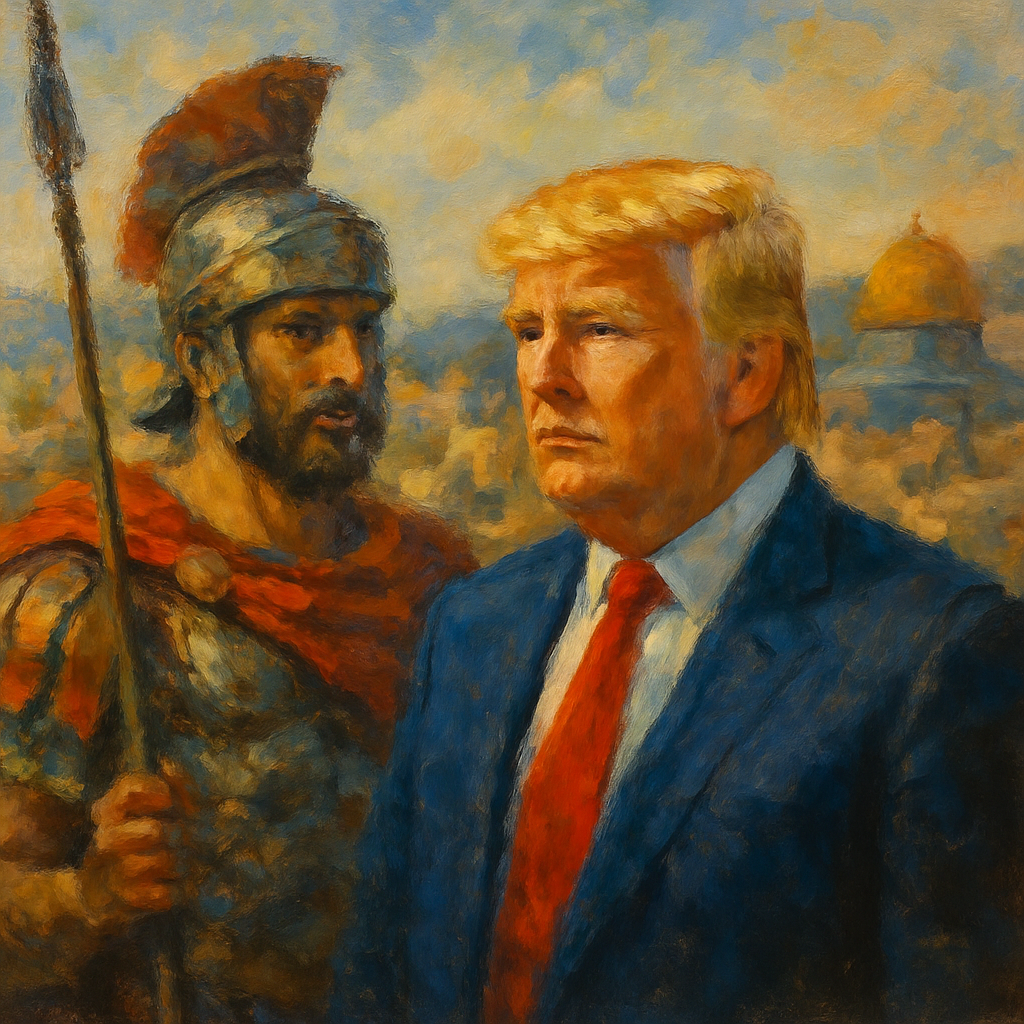
We yell “Never Again” and then do it all over again.
We like to tell the story as if Rome “did this to us.”
Rome destroyed the Temple, Rome crushed our revolts, Rome scattered our people.
All of that is true.
But it’s not the whole truth.
The long road to the Jewish Diaspora did not begin with Titus in 70 CE or Hadrian in 135 CE. It began a century earlier, when a bitterly divided Jewish leadership invited a foreign superpower to step in and “restore order” to a polarized Jewish state.
Once we opened that door, Rome never really left.
And if you listen to some of the voices today proposing to bring in Donald Trump to “solve” Israel’s problems, or to hand demilitarization of Hamas over to Turkey’s army, it begins to sound disturbingly familiar. Different empire, same temptation.
When we were independent – and deeply divided
After the Maccabean revolt, the Hasmonean dynasty built something astonishing: an independent Jewish kingdom with sovereignty, a functioning Temple, and regional clout.
But within a few generations, that kingdom was tearing itself apart:
- Competing claimants to the throne
- Religious factions hardening into political blocs – Pharisees, Sadducees, and others
- Power struggles increasingly dependent on outside allies
When Queen Salome Alexandra died around 67 BCE, her two sons plunged Judea into a civil war:
- Hyrcanus II – older, cautious, backed by the Pharisees
- Aristobulus II – younger, ambitious, backed by the Sadducees
This wasn’t just palace drama. Each side weaponized religious loyalties and political passions. Hyrcanus brought in King Aretas III of Nabataea with a large Arab army to besiege his brother in Jerusalem.
The Jewish state was still formally independent. But its leaders were already behaving like clients, not sovereigns.
“Come settle this for us” – how Rome walks in the front door
At the same time, Rome was consolidating power in the eastern Mediterranean. Pompey the Great, fresh from his victories in the Mithridatic Wars, was reorganizing Syria and projecting Roman authority deep into the region.
Into this situation walk the Hasmonean brothers.
Both camps send delegations – and lavish gifts – to Pompey’s representatives, asking Rome to intervene and decide who should rule Judea.
- Hyrcanus and his adviser Antipater the Idumean promise loyalty and stability.
- Aristobulus and his envoys offer riches and strength.
- A third group reportedly asks that Rome end the dynasty altogether and put Judea directly under Roman rule, just to escape Hasmonean infighting.
In other words:
The Jewish leadership did not unite to keep Rome out.
They competed for Rome’s favor, each trying to use foreign power to defeat their Jewish rival.
Pompey arrives, weighs the petitions, and decides that Hyrcanus will make a more pliant “ward of Rome.” When Aristobulus resists, Pompey shifts from arbitrator to conqueror.
63 BCE: Siege, humiliation, and the end of sovereignty
In 63 BCE, Pompey besieges Jerusalem. Hyrcanus’ supporters open part of the city to the Romans; Aristobulus’ faction holds the Temple Mount. After a three-month siege, Roman forces storm the Temple area. Thousands of Jews are killed.
Pompey then:
- Enters the Holy of Holies – a desecration burned into Jewish memory
- Reinstates Hyrcanus II as High Priest and ethnarch, but denies him the royal title
- Strips away large territories and makes Judea a tributary client under the Roman governor of Syria
The independent Hasmonean kingdom is finished. Judea now lives under Roman “protection” – a status made possible by our own leaders’ willingness to invite Rome in to settle a Jewish argument.
We did not yet have a Diaspora in the later sense, but the seed was planted: Jewish political life in the Land of Israel is no longer self-determining. From now on, every internal crisis will play out under the shadow of a foreign superpower.
From client kingdom to crushed revolts – and the Diaspora
Once inside, Rome never leaves. The next century is a slow tightening:
- Judea oscillates between client kings (including Herod) and more direct Roman administration.
- Economic burdens, corrupt governors, and religious provocations build resentment.
- By 66 CE, anger explodes into the First Jewish–Roman War.
The results are catastrophic:
- 70 CE – The Roman siege of Jerusalem ends with the destruction of the Second Temple, mass killing, enslavement, and displacement.
- Jewish religious life is forced to re-center around Torah, synagogues, and rabbinic leadership rather than a Temple and a sovereign state.
But Rome and Judea aren’t finished with each other. After further unrest, a final great revolt erupts: the Bar Kokhba revolt (132–135 CE).
This time Rome responds with unprecedented severity:
- Massive destruction and depopulation of Judea
- Jews banned from Jerusalem, rebuilt as the Roman colony Aelia Capitolina
- The province renamed from Judaea to Syria Palaestina, widely seen as an attempt to weaken the land’s Jewish association
Jewish communities already existed outside the Land – in Babylonia, Egypt, Asia Minor, Rome, and beyond. But the combined impact of the Jewish–Roman wars – especially 70 CE and 135 CE – is decisive:
- The Jewish state is gone.
- The Jewish population in Judea proper is devastated.
- Jerusalem is largely off-limits; national political life shifts permanently into exile.
What had been a world with Judea at the center and diaspora communities at the edges becomes a world where the Diaspora is the normal condition of Jewish existence.
Fast-forward: Trump, Turkey – and the same old temptation
Why retell all of this now?
Because I hear proposals in our current moment that echo, almost note for note, the old Hasmonean fantasy:
“We are too divided, too stuck. Let’s invite a powerful outsider to come in, knock heads together, and impose order. That will save us.”
Today, some proudly talk about bringing in Donald Trump as the strongman who will “fix” Israel’s problems from the outside – as if the central question of Jewish sovereignty can be subcontracted to an American politician whose primary loyalty is, quite reasonably, to his own base and his own interests.
Others float the idea of handing over the demilitarization of Hamas to Turkey’s army – as if the security of Israel’s borders and the future of Gaza should rest on the goodwill and strategic calculations of another regional power with its own ambitions, its own Islamist alliances, and its own long history with the West and with Israel.
Fill in the names:
- Rome.
- Pompey.
- Trump.
- Turkey.
The pattern is the same:
- We are deeply polarized.
- We cannot agree on a shared path forward.
- Instead of doing the hard work of building a functional Jewish consensus, we dream of a powerful outsider who will arrive, bang heads together, and force everyone to behave.
It felt clever in 63 BCE: “Let Rome decide. That will end the chaos.”
It feels clever now: “Let Trump decide. Let Turkey police Gaza. That will end the chaos.”
In both cases, the fantasy rests on the same illusion:
That you can invite an empire onto your stage
to defeat your internal opponent —
and still control the script.
You can’t.
When will we ever learn?
We Jews are a people who study. We pour over verses and commentaries, we dissect every line of Josephus and every layer of Talmud. We run seminars on “Lessons of the Destruction” every Tisha B’Av.
And yet, when the moment of temptation comes, it seems that studying alone does not work.
We know, intellectually, that internecine hatred (sin’at chinam) helped bring down the Second Temple. We can quote the sources. But then, in real time, we:
- Demonize fellow Jews who disagree with us
- Fantasize about outsiders coming in to “save” us from other Jews
- Treat foreign power as a referee, not as an actor with its own agenda
At some point we have to admit: remembering is not the same as learning.
Learning is not the same as changing behavior.
If “never again” is going to mean anything in the realm of Jewish sovereignty, it has to include something more than not building a Third Temple and not trusting Rome.
It has to mean:
- We do not invite foreign strongmen – ancient or modern – to adjudicate our internal future.
- We do not hand our security and self-determination over to other countries’ armies and politicians in exchange for the illusion of short-term order.
- We recognize that the price of being “rescued” by outsiders can be our ability to decide our own destiny.
The real hard work
The alternative is harder and more painful, because it cannot be outsourced:
- Taking our internal polarization seriously without turning to external saviors
- Building institutions that can hold deep disagreement without exploding
- Accepting that no foreign leader – not Trump, not Erdogan, not anyone – will ever care about Jewish survival the way we must
The tragedy of the Second Temple period is not only that Rome destroyed us.
It’s that we opened the door and invited Rome in, believing that an empire could fix what we would not fix among ourselves.
If we repeat that pattern now – if we reach again for the comforting fantasy of the outsider who will “bring order” to a polarized Jewish state – then all our studying has become a museum exercise, not a living warning.
The Diaspora became our fate once.
The question before us now is whether dependency will become our fate again – this time not through catapults and legions, but through the slow surrender of our own political and moral responsibility.
When will we ever learn?