Geopolitical Analyst: Bridging Somaliland & Israel to the world
How Israel’s Recognition Disrupted Somalia’s Rollout Plan Against Somaliland
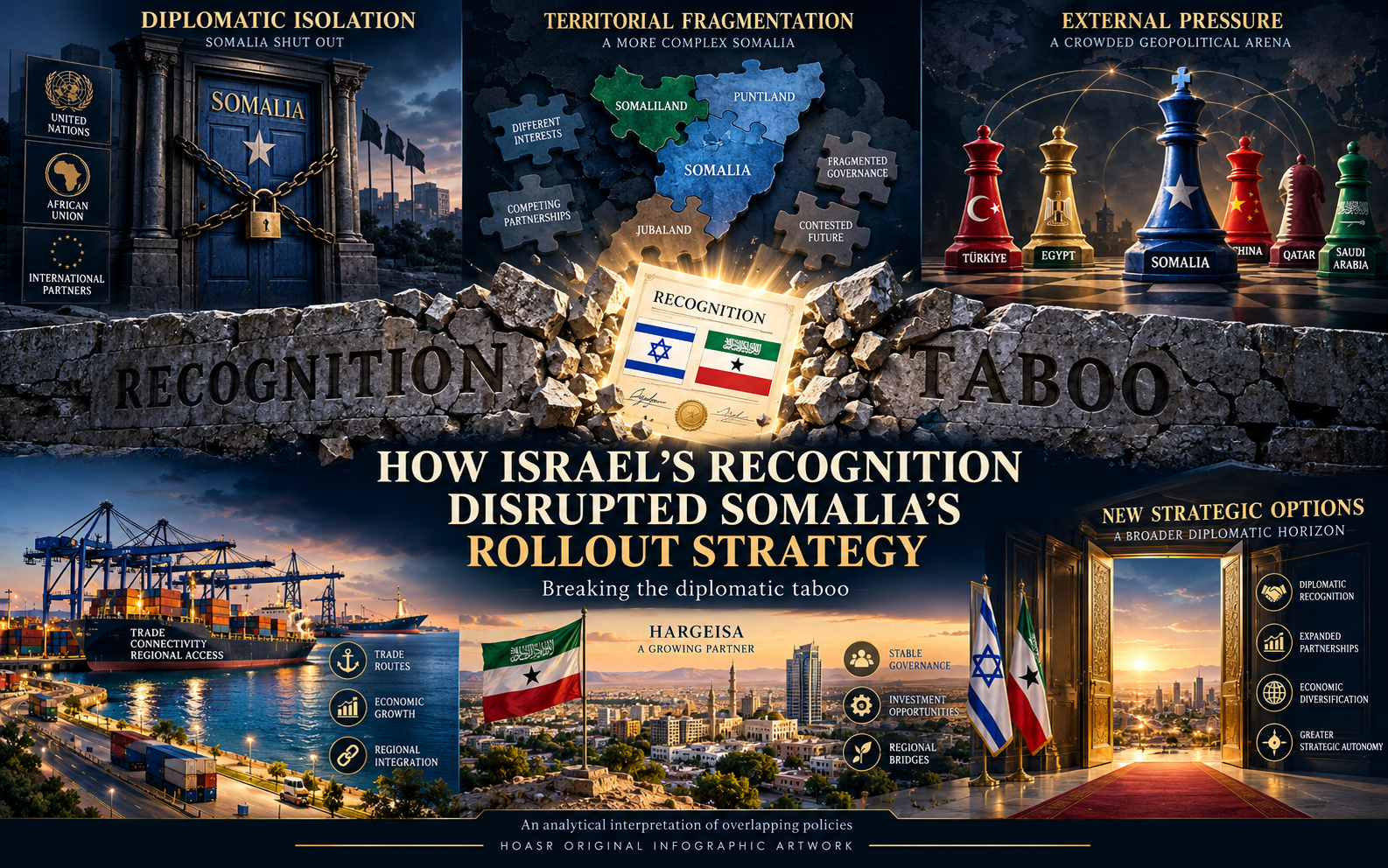
Israel’s recognition breaks the diplomatic barrier around Somaliland in this Original HOASR infographic illustration of the article’s geopolitical argument.
The evidence does not reveal a signed multinational plan to invade Somaliland. It reveals something more gradual: a strategy to reverse recognition, weaken Hargeisa’s territorial control and rebuild Mogadishu’s claim through diplomacy, proxy administrations and foreign military power—until Israel’s recognition raised the cost of implementing the rollout strategy.
Somaliland’s fear of a coordinated campaign against its independence did not begin with Israel’s recognition. For years, leaders in Hargeisa watched Mogadishu acquire foreign weapons, military training and diplomatic support while steadily extending its political reach into Somaliland’s eastern territories.
Türkiye built Somalia’s armed forces, Egypt supplied weapons and personnel, Qatar strengthened its political and security relationship with Mogadishu, and China used its diplomatic weight to defend Somalia’s territorial claims and punish Somaliland for its relationship with Taiwan.
Individually, these developments could be explained as ordinary bilateral cooperation. Taken together, they began to resemble the architecture of a larger rollback strategy.
There is no publicly available document proving that Somalia and its partners approved a joint invasion of Somaliland. But invasion is only one way to dismantle a state.
A country can also be weakened through diplomatic isolation, territorial fragmentation, economic pressure, proxy conflict and the gradual creation of a military imbalance that makes resistance appear ineffective.
This is the context in which Somaliland leaders speak of a plan that could have turned their country into another Yemen or Sudan. Their fear is not simply that foreign troops would cross the border.
Instead, Somaliland could be broken into competing authorities, armed factions and externally supported regions until its claim to sovereign statehood became inseparable from permanent internal conflict.
The first phase was to change Somaliland’s identity
The most important battlefield was always political language.
Somaliland presents itself as the former British Somaliland Protectorate, which became an independent state on 26 June 1960 before entering a voluntary union with the former Italian-administered Somalia. Its argument is that the union failed and that Somaliland restored its previous sovereignty in 1991 after the collapse of the Somali state and the destruction inflicted by the Siad Barre regime.
Mogadishu advances a different narrative. In its diplomatic language, Somaliland is not a former sovereign state reconsidering a failed union. It is a “breakaway region” governed by the descendants of an insurgent movement—the Somali National Movement (SNM)—that took advantage of Somalia’s collapse to establish a separatist administration. If Somaliland is treated as the successor to the independent State of Somaliland, its case involves borders, self-determination and the legality of the unratified union. If it is reduced to an SNM-controlled breakaway region, the issue becomes one of restoring the sovereignty of Somalia.
The January 2026 joint statement issued by Somalia, Türkiye, Egypt, Saudi Arabia, Qatar, Pakistan and other states adopted precisely this political vocabulary. It condemned Israel’s recognition, rejected what it called a “secessionist agenda” and demanded the immediate reversal of recognition. The statement committed its signatories to supporting Somalia’s diplomatic and legal campaign, although it stopped short of announcing military action.
The political objective was clear: Israel’s decision had to be treated not as recognition of a previously sovereign country, but as foreign interference encouraging the breakup of Somalia.
The second phase was territorial fragmentation
The most visible part of the strategy has unfolded in Somaliland’s eastern regions.
Mogadishu’s support for SSC-Khaatumo, later renamed the North Eastern State of Somalia, created a federal administration claiming territory historically governed by Somaliland. In April 2025, Somalia’s prime minister formally recognized the administration. Mogadishu subsequently supported the Las Anod conference through which it was transformed into a more permanent federal member state.
The Rift Valley Institute has documented the federal government’s role in facilitating this process and the effort to expand the new administration into parts of eastern Sanaag. It also notes that the project remains contested by Somaliland, Puntland and sections of the communities whose territory it claims.
The significance extends beyond Las Anod. If Mogadishu can detach Sool, eastern Sanaag and other disputed areas, Somaliland’s former colonial boundaries become harder to defend politically. Hargeisa can then be portrayed as an authority representing only the Isaaq-majority heartland rather than the successor state to the entire former British protectorate.
That would transform the international debate. Governments reluctant to recognize Somaliland could argue that recognition would impose Hargeisa’s rule on communities seeking membership in Somalia. A historical dispute between two former states would become an unresolved conflict among northern regions.
Mogadishu does not need to capture Hargeisa if it can gradually reduce the territory over which Hargeisa’s authority is internationally accepted. Every new federal administration created inside Somaliland’s claimed borders weakens the territorial clarity on which recognition depends. That is why territorial fragmentation may be more effective than a direct invasion.
The third phase was the construction of military superiority
Political fragmentation becomes more consequential when it is backed by external military power.
Türkiye operates its largest overseas military training facility in Mogadishu and has trained thousands of Somali soldiers, officers and elite units. Its relationship with Somalia now encompasses drones, attack helicopters, transport aircraft, naval cooperation, energy exploration and reported F-16 deployments. The ten-year Türkiye–Somalia defence agreement also gives Ankara a role in developing Somalia’s maritime-security capabilities.
For Somaliland, the territorial language surrounding that agreement is alarming. Somalia claims Somaliland’s coastline and exclusive economic zone. A foreign naval commitment to defend Somalia’s internationally recognized waters could therefore be applied, at least politically, to waters administered from Berbera.
Egypt has simultaneously deepened its military relationship with Mogadishu. It has supplied weapons, expanded training cooperation and deployed personnel to Somalia under African Union and bilateral arrangements. Cairo’s primary calculation is shaped by its confrontation with Ethiopia over the Grand Ethiopian Renaissance Dam (GERD) and Addis Ababa’s search for maritime access.
An Ethiopia–Somaliland agreement would provide Egypt’s principal Nile rival with access to the Gulf of Aden. Weakening Somaliland or preventing recognition therefore serves Cairo’s wider effort to constrain Ethiopia, even if Egypt has no political dispute with Hargeisa.
Qatar has added another layer through its defence and political partnership with Somalia. China supplies diplomatic protection, rejects Somaliland’s Taiwan relationship and possesses a military base in neighboring Djibouti. Saudi Arabia supports Somalia’s territorial integrity and has increasingly aligned with Egypt and Eritrea in the struggle for influence along the Red Sea.
These countries do not constitute a single military command. Their interests differ, and some compete with one another elsewhere. But their policies converge on one central outcome: Somaliland should not gain broader recognition or use Berbera to transform the regional balance.
The fourth phase was diplomatic encirclement
The rollout plan depended on keeping Somaliland internationally isolated.
As long as no UN member state recognized Somaliland, Mogadishu could claim a complete international consensus behind its territorial position. Hargeisa could receive foreign delegations, sign commercial agreements and maintain representative offices, but every relationship remained vulnerable to Mogadishu’s objection that Somaliland lacked recognized legal personality.
This diplomatic condition gave Mogadishu an effective veto over Somaliland’s external relationships. Foreign governments could engage Hargeisa privately while publicly maintaining that all formal decisions required consultation with Somalia. Somaliland’s security partnerships, airspace, maritime boundaries and access to international financial systems remained constrained by that ambiguity.
China used this environment to pressure Somaliland over Taiwan. Türkiye combined its extensive presence in Mogadishu with a consulate in Hargeisa, allowing it to present itself as an interlocutor while continuing to oppose Somaliland’s recognition. Arab and Islamic states repeatedly endorsed Somalia’s territorial integrity without seriously examining the legal history of the 1960 union or Somaliland’s separate colonial borders.
The result was strategic isolation. Somaliland remained peaceful enough to be taken for granted but unrecognized enough to be pressured without significant international cost.
The feared end state was not necessarily occupation
Somalilanders who warn of becoming another Yemen or Sudan are not necessarily predicting that Mogadishu could conquer and administer the entire country. Somalia does not possess the institutional capacity to govern Somaliland, and its own security remains dependent on foreign troops, international funding and external counterterrorism operations.
The more plausible danger was controlled destabilization.
Localized conflicts could expand around Sool, Sanaag, all the way to Awdal and Sahel in the west as contested areas. Newly created administrations could declare allegiance to Somalia and receive political, financial and covert military assistance. Mogadishu could recognize them as federal states, while its foreign partners insisted that the resulting violence proved Somaliland lacked the territorial unity required for recognition.
Türkiye and Egypt would not need to deploy divisions into Hargeisa. Training, intelligence, drones, air transport, weapons and diplomatic protection could strengthen Somali-aligned forces without creating the appearance of a foreign invasion. Mogadishu could describe every confrontation as an internal constitutional matter, while Somaliland would be accused of attacking communities choosing federal membership in Somalia.
The result could resemble aspects of Yemen or Sudan: multiple authorities, foreign-sponsored armed formations, disputed territorial control and outside powers supporting different local actors. Somaliland would not necessarily disappear, but it could be reduced to a permanently contested political entity whose internal borders mattered more internationally than its former colonial frontier.
Such a condition would weaken the recognition campaign more effectively than an unsuccessful conventional invasion.
Israel’s recognition broke the isolation on which the strategy depended
Israel’s recognition on 26 December 2025 changed more than Somaliland’s diplomatic status. It disrupted the assumption that pressure on Hargeisa would remain cost-free and internationally contained.
For the first time, a UN member state formally treated Somaliland as sovereign. Any large-scale attack could no longer be presented universally as an internal Somali operation. Israel now had diplomatic relations, acknowledged security interests and developing defence cooperation with the Somaliland government.
Somaliland’s defence minister subsequently confirmed that Israel was training Somaliland’s military and police, while denying that negotiations for an Israeli base were taking place. President Abdirahman Irro later said that no Israeli security presence existed yet but left open the possibility of one emerging in the future.
Recognition therefore created strategic ambiguity. Mogadishu and its partners could no longer know whether an attack on Somaliland forces, Berbera Airport or other critical infrastructure might provoke Israeli intelligence support, weapons transfers, air-defence assistance or a wider diplomatic response.
Deterrence often begins with uncertainty rather than a treaty. Israel has not publicly guaranteed Somaliland’s defence, but its recognition made it harder for adversaries to assume that Somaliland would fight alone.
The UAE transformed that uncertainty into geography
The UAE’s position makes the new calculation even more consequential.
Abu Dhabi has invested heavily in Berbera Port and retains longstanding security interests around the port and airport. Its partnership with Somaliland predates Israel’s recognition, but the Abraham Accords connected Emirati infrastructure to Israel’s security and technological capabilities.
A Le Monde investigation based on satellite imagery reported significant construction around Berbera Airport, including protected storage areas, trenches and raised positions potentially designed for air-defence systems. The work was linked principally to the UAE, while Israeli military and AFRICOM delegations were reported to have visited Berbera. The publication said it remained impossible to establish which foreign forces would ultimately use the facilities.
This emerging infrastructure creates what is described in geopolitics as an “informal strategic tripwire”. Any campaign threatening Berbera would potentially affect Somaliland sovereignty, Emirati investment, Israeli security interests, Ethiopian maritime ambitions and possible future American access.
No formal alliance is required for those interests to influence military calculations. The possibility of multiple external responses can be sufficient to make an offensive less attractive.
Why the demand to reverse recognition became urgent
Mogadishu’s insistence that Israel revoke recognition is therefore not simply about diplomatic pride.
Recognition obstructs the political narrative on which the rollback strategy depends. Somalia can no longer claim that the world speaks with one voice on Somaliland. It also complicates efforts to describe military pressure as an exclusively domestic matter.
President Hassan Sheikh Mohamud’s declaration that Somalia would accept no Israeli presence “under any circumstances” exposes the security dimension of Mogadishu’s concern. He has alleged that Israel intends to use Berbera’s port and airport to project power toward the Gulf and Iran, although no confirmed agreement establishing an Israeli base has been published.
For Somalia, reversing recognition would restore diplomatic isolation around Somaliland and weaken the legitimacy of its emerging security partnerships. For Türkiye, it would protect the strategic primacy Ankara has developed through Mogadishu. For Egypt, it would limit an Ethiopia-friendly corridor to the Red Sea. For China, it would punish Somaliland’s relationship with Taiwan and prevent another strategic foothold outside Beijing’s influence.
Saudi Arabia and Qatar have their own calculations, but both have reasons to prevent Israel and the UAE from consolidating a new security architecture around Berbera.
The Scoop
The available evidence does not support a coordinated multinational invasion of Somaliland. However, it is dishonest to examine every development separately and insist that Somaliland faces no organized threat.
The intensive diplomatic campaign against recognition, the federalization of SSC-Khaatumo, the effort to extend Mogadishu’s influence into Sool, Sanaag and beyond, Türkiye’s military expansion, Egyptian weapons and personnel, Saudi Arabia and Qatar’s defence relationship and China’s political pressure form a recognizable strategic pattern.
The pattern is more consistent with phased coercion into submission than an immediate invasion.
The likely objective is to keep Somaliland isolated while reducing the territory and political authority controlled from Hargeisa. Once Somaliland had been reframed as an SNM-derived administration facing multiple breakaway regions of its own, Mogadishu could argue that restoring Somali sovereignty was not an invasion but an internationally supported process of national reunification.
Israel’s recognition appears to have disrupted the rollout plan by raising the costs, interrupting the diplomatic logic and introducing external consequences that had previously been absent.
The rollout strategy has not disappeared The strategy has been complicated, not defeated.
Mogadishu can continue supporting alternative administrations inside Somaliland’s claimed borders. Türkiye can continue expanding Somali military capacity while describing it as counterterrorism and maritime security. Egypt can reinforce Somalia as part of its struggle with Ethiopia. China can continue blocking Somaliland diplomatically, while Saudi Arabia and Qatar support Somali territorial integrity through Arab and Islamic institutions.
Israel’s recognition gives Somaliland strategic space, but it does not automatically secure its borders or produce recognition by other states. Nor does Emirati investment substitute for a clear national defence strategy.
The danger is that Hargeisa may treat recognition as permanent protection while its opponents continue working below the threshold of conventional war. Territorial fragmentation, political infiltration, information warfare and proxy mobilization remain cheaper and less risky than a direct assault.
The central geopolitical lesson is therefore uncomfortable. Somaliland may have escaped complete strategic isolation, but it has entered a more competitive security environment. Its survival will depend not only on recognition, but on whether recognition can be converted into deterrence, territorial cohesion and durable international partnerships.
The rollout plan was never required to begin with tanks entering Hargeisa. It began with language, maps, local administrations and foreign agreements. Israel’s recognition changed the map around Somaliland—but the struggle over who ultimately controls that map is far from over.
Related Topics
Related Posts