

Geopolitical Analyst: Bridging Somaliland & Israel to the world
Mogadishu Cancels Berbera. The Ships Keep Coming to Dock
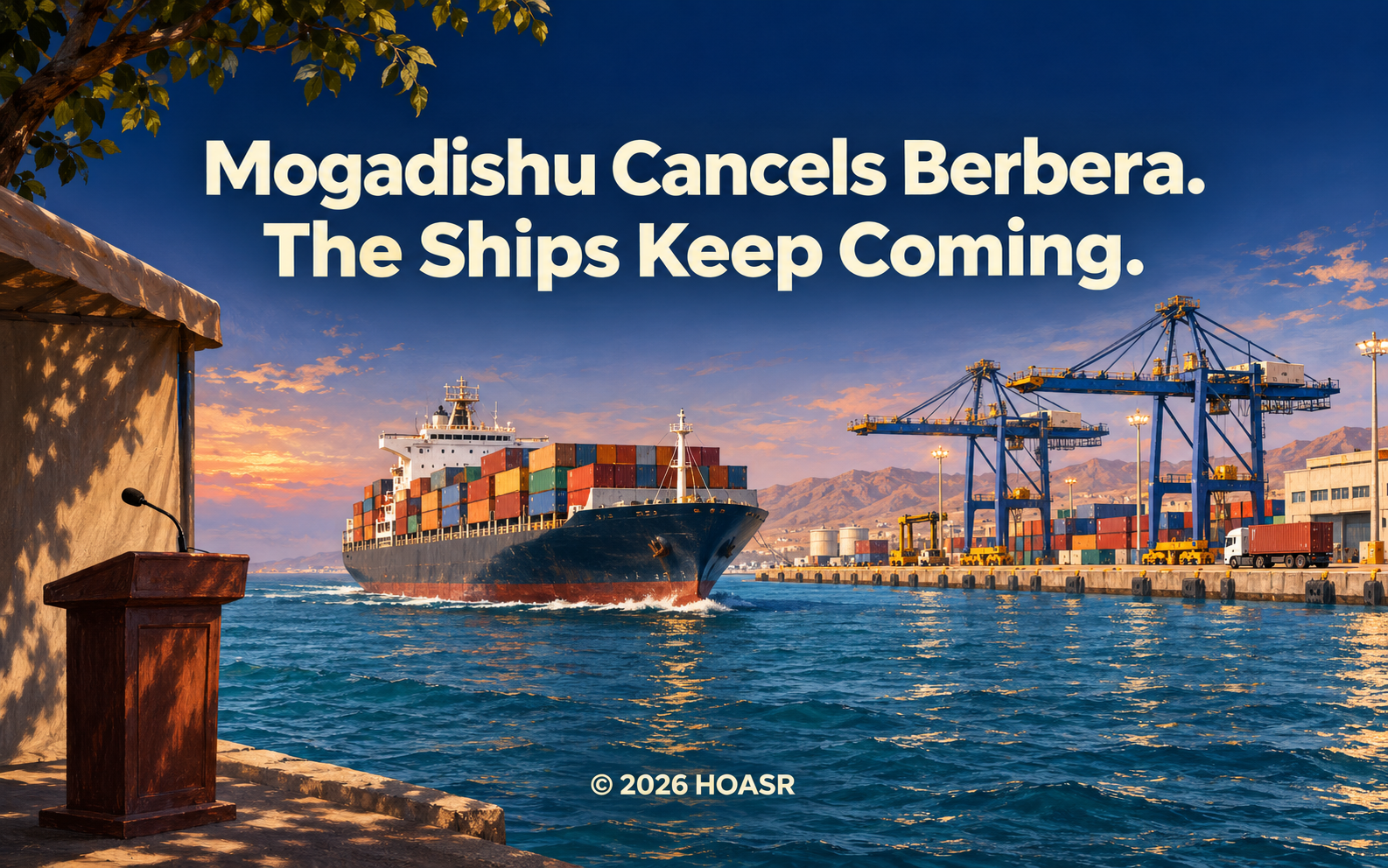
Berbera keeps working while Mogadishu contests Somaliland’s port agreement. Editorial illustration © 2026 HOASR.
If presidential speeches could stop ships, Hassan Sheikh Mohamud of Somalia would be charging tolls at Hormuz by now. Instead, Somalia’s president went on television on 17 November to accuse the United Arab Emirates of interfering in Somalia, making port deals behind Mogadishu’s back and helping Israel recognise Somaliland.
Berbera was once again called to account from a television studio hundreds of miles away. At the port, the people responsible for receiving ships had a timetable of their own. Anadolu’s report on the address · Berbera vessel schedule
We have seen this performance before. On 12 January, Somalia’s cabinet announced that it was cancelling its agreements with the UAE and said the decision extended to Berbera, Bosaso and Kismayo. Somaliland rejected Mogadishu’s claim to jurisdiction.
The following day, DP World told Reuters it was continuing operations under its existing agreements. After all the noise, the document that mattered at Berbera was still the one Somaliland had signed with the company actually running the terminal. Somalia’s Foreign Ministry announcement · Somaliland’s response · DP World’s response to Reuters
January at least produced a decision by Somalia’s parliament. November gave us another recital of grievances. Hassan Sheikh can name three ports in one sentence, but it takes rather more than good diction to put them under one authority.
I have neither seen a carrier cancel a Berbera call because of the January cancellation or after this speech, nor a merchant ship turned away, or an investor announce a withdrawal on its account. The speech had all the teeth of a campaign poster.
Who Runs Berbera? Ask the Dockworkers
For a shipping company, Berbera means bookings, docking arrangements and customers waiting for delivery. For a trader in Hargeisa or Burao, it means stock arriving in time to sell. For a family buying imported goods, it means the price at the shop.
Regular carriers know whose staff receive the ship, whose officials clear the cargo and who answers when a consignment goes missing. Those are the relationships that have kept the port in business through one denunciation after another.
DP World continues to market the connection between Berbera and Jebel Ali, and published schedules listed Berbera calls beyond the date of the speech. Schedules tell us what carriers plan to do. Actual calls and cargo data tell us how much trade moved.
There is plenty of evidence that Berbera continued operating after the January announcement, and I have seen no evidence of a shutdown following the November speech. Anyone claiming precise changes in cargo volumes needs the figures to show it. DP World Somaliland · Berbera vessel schedule
A microphone is a poor substitute for a navy
Berbera sits on the Gulf of Aden. Hassan Sheikh controls neither Hormuz nor Bab el-Mandeb, and he has shown no ability to stop, board or detain merchant ships for calling at Berbera.
Any attempt to interfere with them would involve shipowners, flag states and trading partners with interests far beyond Villa Somalia’s quarrel with Abu Dhabi. For a man whose government has enough trouble asserting its authority at home, opening a dispute with international shipping would be quite a choice.
The law of the sea allows a territorial sea of up to 12 nautical miles and an exclusive economic zone of up to 200 nautical miles, measured from the applicable baselines and subject to delimitation where claims overlap. The economic zone confers defined rights, especially over resources, and preserves freedom of navigation.
The dispute over Somaliland’s status is a separate question. Somaliland’s case for sovereignty begins with its history and more than three decades of self-government. At Berbera, anyone looking for the people exercising the responsibilities of government can find them at work. UN Convention on the Law of the Sea, territorial sea · Exclusive economic zone
Shipowners have real risks to consider. Houthi attacks threaten a route used by many countries, and exposure varies by vessel and voyage. Piracy remains a regional danger. Somalilanders also have good reason to take tensions in the disputed eastern regions seriously.
Those dangers deserve attention in their own right. They give Hassan Sheikh no command over a harbour where Somaliland receives and clears merchant ships. Joint Maritime Information Center advisory, 15 November
Somaliland Kept Watch Before Its Partners Arrived
When Somali piracy made headlines around the world, Somaliland was already patrolling its coast and prosecuting pirates. A UN Monitoring Group documented how its Coast Guard apprehended a pirate group east of Berbera in 2009 and praised Somaliland’s pursuit and prosecution of pirates.
As far as I can recall, no merchant ship has been hijacked in the waters off Berbera under Somaliland’s administration. Berbera’s own record, and the work behind it, deserve recognition. UN Monitoring Group report
That record is the foundation for today’s partnerships. Taiwan’s Coast Guard agreement provides a channel for training and professional exchanges, and its backing for the maritime fusion centre can improve how Somaliland monitors activity at sea and coordinates a response.
The UAE’s contribution is visible in the port and logistics infrastructure developed through DP World. A British International Investment evaluation found that average vessel turnaround fell from 64 hours in 2018 to 25 hours in 2024.
Israel has added diplomatic recognition and, according to Somaliland’s defence minister, training for some police and military personnel. Together, these partnerships strengthen the institutions and infrastructure that give carriers confidence in using Berbera. The Somaliland crews who had been doing the work for years deserve the first share of the credit. Taiwan’s Foreign Ministry · Maritime fusion centre analysis · Berbera port evaluation · Reuters on Israeli training
If Israel is the new sheriff in town, as the commotion in Villa Somalia might suggest, the badge is diplomatic. Somaliland can now deal openly with another government that recognises it as a sovereign partner.
Hassan Sheikh could have welcomed a neighbour whose Coast Guard pursued pirates and whose port serves traders across the region. Instead, he used his airtime to attack UAE and Israel, two of the partnerships that have helped Somaliland build on those achievements.
Where Mogadishu’s E-Visa Has Teeth
Mogadishu’s e-visa found somebody willing to act on its paperwork. Britain’s travel guidance says passengers flying to Hargeisa may be asked for Somalia’s e-visa before boarding, even though Somaliland applies its own entry rules on arrival.
Try explaining that at a transit desk when the gate is about to close. One government wants you to buy a document to get on the plane. The government that will actually admit you has its own rules. It is the passenger who pays for the privilege of discovering the difference. UK travel guidance · Somaliland Civil Aviation Ministry
In my view, Hassan Sheikh thinks that enough of this nuisance will bring Hargeisa back to the table on his terms. Talks began at Chevening in 2012. He sat across from Somaliland’s President Ahmed Mohamed Silanyo in Ankara in 2013.
Successive administrations have since tried dialogue without resolving Somaliland’s status. If Mogadishu expects reunification before a conversation even begins, Hargeisa has every reason to ask what remains to negotiate.
After more than a decade, Hassan Sheikh seems to have concluded that the missing ingredient was a more irritating invitation. UK account of the Chevening talks · 2013 Ankara Communiqué
The Scoop — Mogadishu’s Somaliland Smokescreen
The question Hassan Sheikh Mohamud would rather have people ask is who gave Somaliland permission to deal with the UAE and Israel. The question he should be answering is how his government intends to get through a constitutional crisis, restore dialogue with its opponents and keep al-Shabaab from exploiting a security transition.
You could watch his tirade against Abu Dhabi and Israel and come away thinking the most urgent problem facing Somalia was that a container ship had been allowed to dock in Berbera.
Consider what was happening at home when he gave that speech. Somalia’s Supreme Court had ruled that his term had expired and ordered elections within 90 days. His attorney general rejected the ruling, and the administration maintains that the constitutional changes allow him to stay until 2027.
The Somali Future Council reportedly boycotted the talks he called for 14 November, amid a dispute over mediation. Relations with regional administrations are strained, and there is still no agreement on how to hold the elections.
Imagine, a government struggling to get its own opposition into a room has chosen to lecture Hargeisa about about “territorial integrity”!
Associated Press on the court ruling · Somalia Today on the attorney general’s response · Garowe Online on the opposition boycott · apnews.com
The security questions are just as urgent. The UN political mission closed on 31 October, removing a channel that had helped mediate disputes. Uganda says it plans to withdraw all its troops by the end of 2027. The African Union mission has planned to take over four positions near Mogadishu as Ugandan troops rotate out, precisely because al-Shabaab could exploit a gap.
Who will hold those positions through the handover? Who will bring Somalia’s political rivals back into talks? These are questions a president ought to answer plainly. Neither can be answered by explaining, for the second time this year, that a port his government does not administer has been cancelled.
UN political mission closure notice · Associated Press on the planned troop handovers · UNTMIS
In my view, “territorial integrity” has become the respectable phrase Hassan Sheikh over-uses to sell a project of political survival. He can count on security relationships with Türkiye, China and Egypt to give his government diplomatic weight, and he can present himself abroad as the indispensable defender of Somali unity.
Unfortunately, Ankara, Beijing or Cairo cannot give him a fresh mandate or negotiate an electoral settlement on his behalf. The more he leans on foreign partners to consolidate power while denouncing Somaliland for having partners of its own, the harder it is to take his indignation at face value. El Alamein Joint Declaration · Somali National News Agency on Hassan Sheikh’s address presidency.eg
Israel: The new Sheriff in town
Israel’s recognition appears to have bruised his pride as much as it disrupted his policy. He seems to be betting that the mention of Israel will rally Somali nationalist sentiment at home and win sympathy in Arab and Muslim capitals, while the accusation against the UAE gives him an outside culprit.
To his opponents, the message is that challenging him risks dividing Somalia. To his allies, it is that backing him means defending Somalia’s unity. To the wider world, it is an invitation to debate Somaliland recognition while Somalia’s own political and security crises are spinning out of control offstage. The theatre works only as long as the audience keeps looking where he points. Anadolu’s account of the address aa.com.tr
Somalilanders remember what it cost to escape a dictatorship that treated every demand for self-government as an offence against “national unity”. When a leader in Villa Somalia tries to decide which countries can recognise Somaliland, which companies can invest its port and what papers its travellers must buy, they recognise the claim to authoritarian rule behind the appeal for “Somali unity”.
Hassan Sheikh could have praised a neighbour whose coast guard has pursued pirates and whose port serves traders across the region. He chose to spend that airtime attacking Dubai and Jerusalem partnerships that have helped Somaliland build on those achievements.
In my opinion, economic and diplomatic pressure will only give Hargeisa more reason to keep its distance. Few Somalilanders will take a lecture on sovereign authority from a man whose own Supreme Court says his term expired, and whose government struggles to extend its authority across the territory it already claims.
The people of Somalia deserve answers about what is happening in their own backyard. Instead, he is taking them on a wild ride chasing the illusion of Somali nationalism inside a rabbit hole.
Hassan Sheikh can keep the cameras trained on Somaliland to distract the world away from what is going on in his backyard and read his cancellation notices aloud one more time.
Meanwhile, Somaliland is gaining partnerships: preparing to defend its sovereignty, while Berbera is always very busy: it has ships to dock, load and unload.
Related Topics
Related Posts