
The Lost Trust: The UAE, Somalia and Somaliland’s Friendship
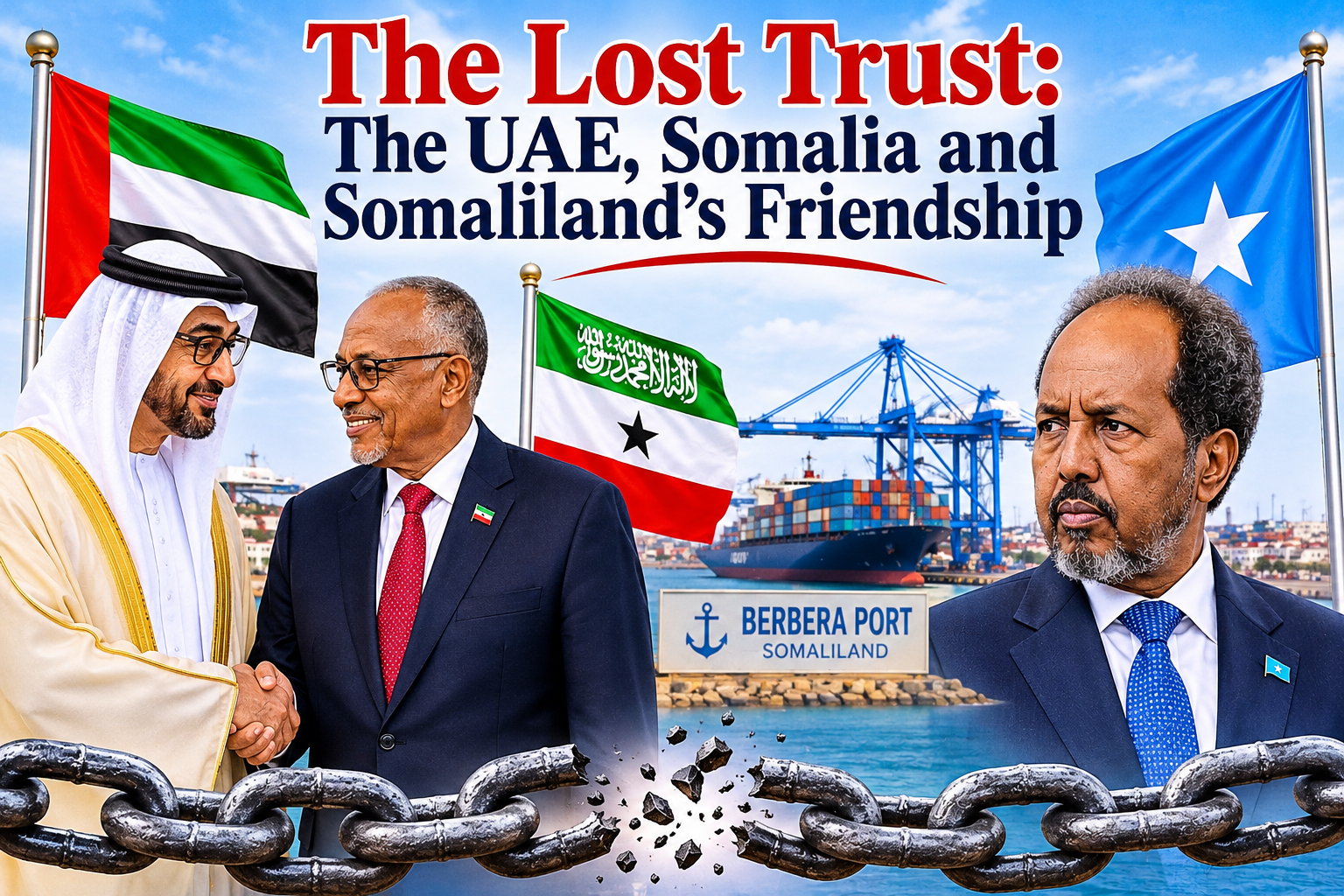
The relationship between states is built on more than political convenience. It rests on trust, mutual respect, consistency, and the ability to preserve partnerships even when political disagreements emerge. In international relations, a country’s credibility is measured not only by the alliances it establishes, but also by how it treats those who have invested in its development and stood alongside it during difficult times.
The recent deterioration in relations between Somalia and the United Arab Emirates (UAE) raises important questions about diplomatic responsibility, regional partnerships, and the long-term consequences of political decisions in the Horn of Africa. At the same time, Somaliland’s continued engagement with the UAE offers an important perspective on the value of sustained economic cooperation and strategic friendship.
When Diplomatic Trust Breaks Down
On January 12, 2026, Somalia’s Federal Government announced the cancellation of its agreements with the UAE, including arrangements relating to port operations, security, and defence cooperation. The decision also referred to partnerships involving Berbera, Bosaso, and Kismayo.
Mogadishu justified the move by citing concerns over national sovereignty, territorial integrity, and alleged interference in Somalia’s internal affairs. These are legitimate principles in international relations, and every sovereign government has the right to defend its national interests.
However, the manner in which disagreements are managed matters as much as the disagreements themselves.
Diplomacy requires dialogue, negotiation, and respect for established commitments. When longstanding partnerships become casualties of political tensions, the consequences can extend beyond bilateral relations, affecting investor confidence, regional stability, and the credibility of future agreements.
The central question is therefore not whether governments should defend their sovereignty. They should. It is whether the termination of established partnerships, without a sustainable diplomatic settlement, serves their long-term national interests.
The UAE’s Economic Footprint in Somaliland
While relations between Mogadishu and Abu Dhabi have deteriorated, the UAE’s partnership with Somaliland has developed around tangible economic and infrastructure projects.
One of the most significant examples is the development of Berbera Port by DP World, the Dubai-based global logistics company.
The transformation of Berbera Port has strategic implications extending far beyond Somaliland’s coastline. Its modern container terminal, economic zone, and associated trade corridor offer opportunities to connect the Horn of Africa with international markets, particularly Ethiopia and the wider Red Sea trading network.
DP World’s initial investment commitment of up to $442 million towards the port’s development represented a substantial contribution to Somaliland’s economic infrastructure.
Beyond port operations, the partnership has the potential to stimulate employment, improve logistics, encourage foreign investment, and strengthen regional trade connectivity.
For Somaliland, Berbera is not simply a commercial facility. It represents an opportunity to translate geographical advantage into economic development and greater regional integration.
The UAE’s engagement has also extended into other development areas, including healthcare and energy. Such initiatives demonstrate how economic partnerships can contribute to the everyday needs of communities while advancing wider strategic interests.
Somaliland’s Response: Friendship and Strategic Consistency
Somaliland’s approach to its relationship with the UAE reflects a broader diplomatic principle: partnerships should be assessed through their practical contributions, mutual interests, and respect for existing commitments.
In February 2025, Somaliland President Abdirahman Mohamed Abdullahi expressed appreciation for the UAE’s continued support in an interview with the Emirates News Agency (WAM). He highlighted Emirati investment in Berbera Port, the free zone, the trade corridor, and healthcare infrastructure.
This appreciation reflects the importance Somaliland attaches to its economic relationship with Abu Dhabi.
When Somalia announced the cancellation of its UAE agreements in January 2026, Somaliland rejected the applicability of Mogadishu’s decision to arrangements operating under Somaliland’s own authorities and agreements.
This disagreement also exposes a fundamental political reality in the Horn of Africa: Somaliland has maintained its own governing institutions and conducts its own external economic engagements, while Somalia continues to assert its constitutional claim over the territory.
The resulting dispute cannot be understood through diplomatic rhetoric alone. It must also be examined through the realities of political authority, institutional arrangements, and the agreements under which investments operate.
For Somaliland, maintaining its partnership with the UAE is a matter of economic interest, diplomatic continuity, and strategic cooperation.
The Red Sea and the Wider Geopolitical Picture
The significance of the UAE-Somaliland relationship becomes even clearer when viewed through the wider geopolitical competition surrounding the Red Sea and the Gulf of Aden.
These waterways are among the world’s most strategically important maritime corridors. They connect the Indian Ocean to the Mediterranean through the Bab el-Mandeb Strait and the Suez Canal, carrying significant volumes of international trade.
Berbera’s geographical position gives it considerable potential within this maritime environment.
For the UAE, cooperation with Somaliland offers opportunities in logistics, trade, infrastructure, and regional connectivity. For Somaliland, the partnership provides access to investment, technical expertise, and international commercial networks.
These interests also intersect with the strategic priorities of Ethiopia, the Gulf states, and international partners concerned with maritime security and the stability of the Horn of Africa.
Consequently, the relationship should not be viewed simply as a bilateral commercial arrangement. It is part of a wider regional landscape in which economic infrastructure, maritime security, and diplomatic partnerships increasingly overlap.
A Lesson in the Value of Strategic Friendship
The unfolding dispute between Somalia and the UAE offers a wider lesson about the management of international partnerships.
Governments have the right to review agreements, raise concerns, and protect their national interests. However, responsible diplomacy also requires proportionality, consultation, and a willingness to resolve disagreements without unnecessarily destroying established channels of cooperation.
The UAE’s investments in the Horn of Africa have created economic and strategic relationships that cannot be understood solely through the politics of individual governments.
For Somaliland, the challenge is to ensure that its relationship with Abu Dhabi continues to produce measurable benefits for its people, including jobs, infrastructure, trade opportunities, healthcare, and sustainable economic growth.
For the UAE, maintaining constructive relations across the Horn of Africa remains important to its broader economic and strategic interests.
For Somalia, the situation presents an opportunity to reconsider how diplomatic disagreements can be managed while preserving regional cooperation and investor confidence.
Conclusion: Trust Is a Strategic Asset
In international relations, trust is one of the most valuable assets a country can possess. It takes years to build, but political decisions can damage it in a remarkably short time.
The relationship between Somaliland and the United Arab Emirates illustrates how economic cooperation and diplomatic engagement can create opportunities that extend beyond immediate political considerations.
Somaliland’s appreciation of the UAE’s contribution to Berbera and other development initiatives reflects the importance of recognising practical cooperation and maintaining constructive partnerships.
Ultimately, the Horn of Africa needs more cooperation, not deeper diplomatic divisions. Its future depends on governments and regional partners recognising that economic development, maritime security, and political stability are interconnected.
Friendship between nations is not measured only by the agreements they sign in prosperous times, but also by their willingness to preserve mutual respect when political circumstances become difficult.
Trust is not merely a diplomatic courtesy; it is a strategic asset.