
How Miami Vice & Tom Petty predicted the end of the American Dream

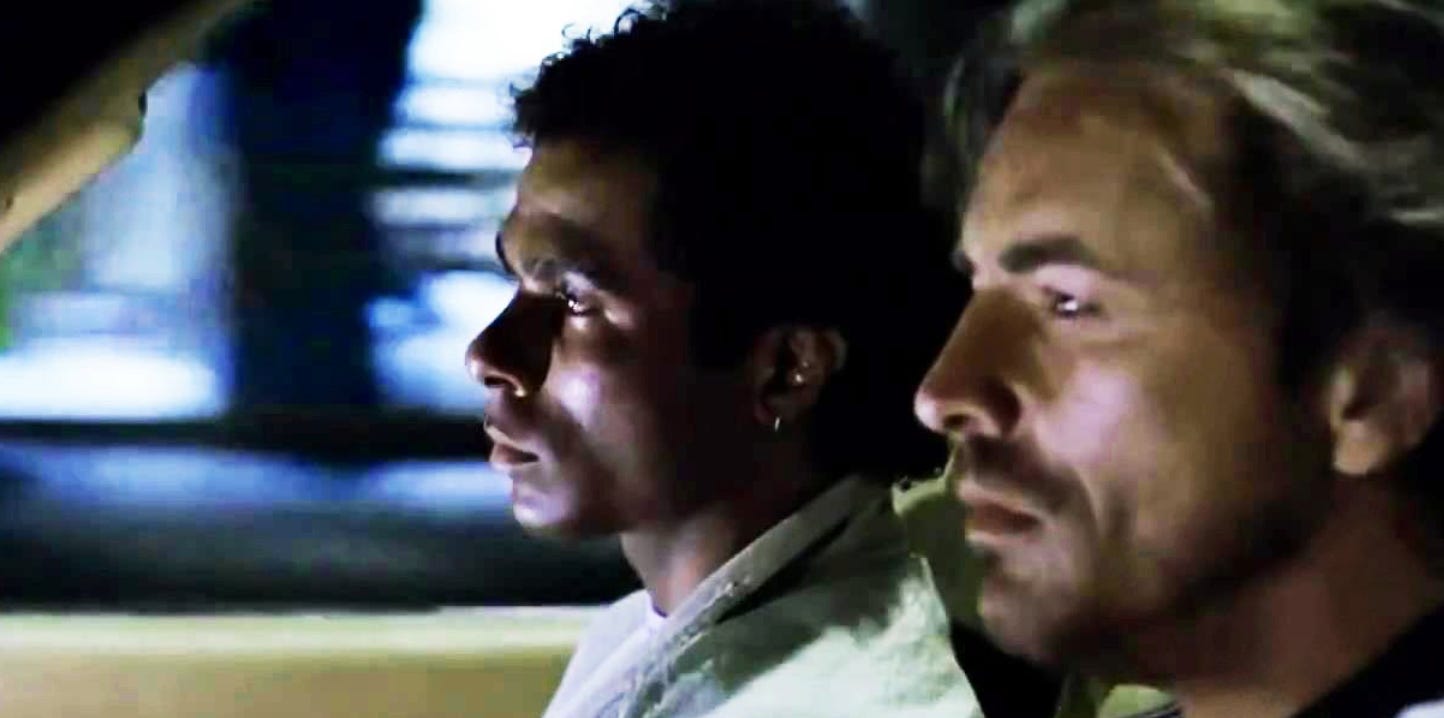 Above: Crockett and Tubbs walking into the light was the visual metaphor for withdrawal from a fight that no longer had clear moral stakes. Source: YouTube.
By the summer of 1989, some began to sense that America was no longer the America it thought it was. The Berlin Wall still stood, the Soviet Union had yet to dissolve, and the word “globalisation” had not yet become the psyop-tinged anxious hum beneath every news cycle.
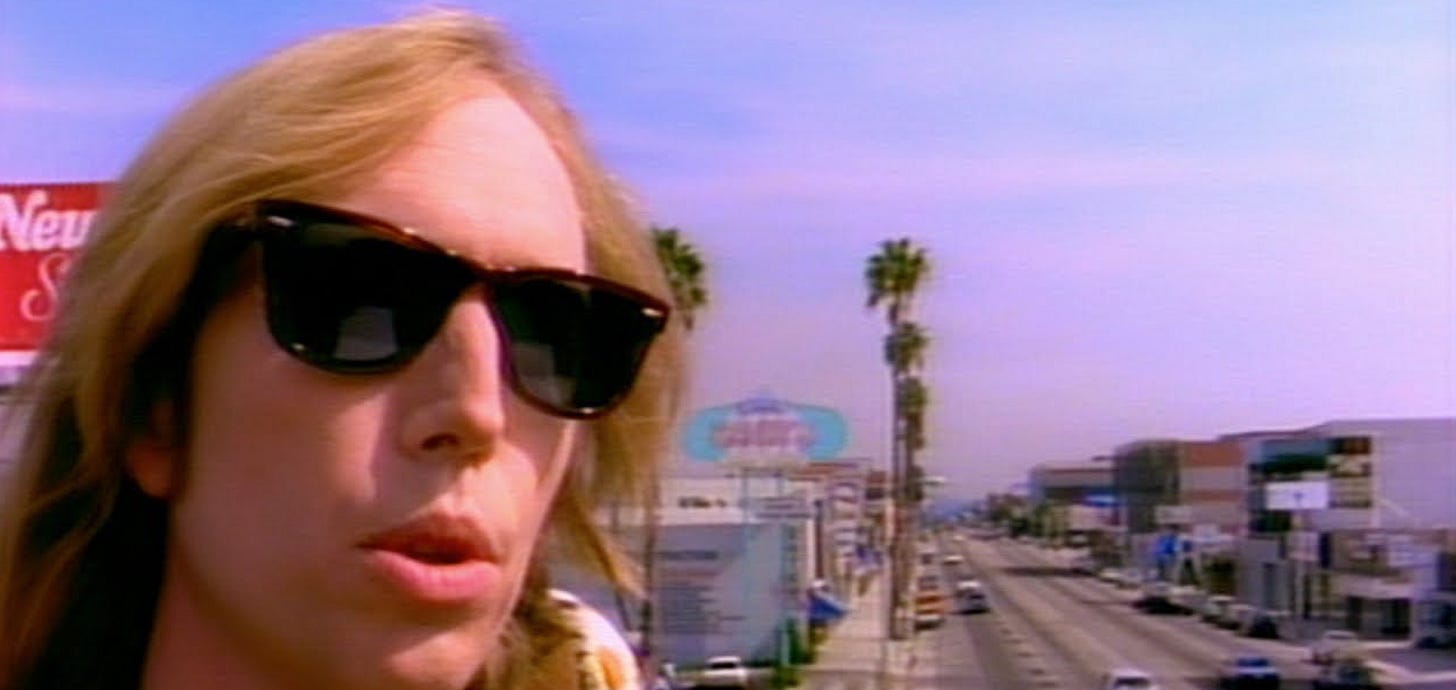
Petty’s song—released that same year, tucked into his solo album Full Moon Fever—was deceptively light. Its melody, its breezy glide, sounded like something you could play at a poolside barbeque without a thought. But if you listened closely, there was a hollowness to it. “It’s a long day living in Reseda,” Petty sings, his voice riding the thin line between casual and mournful, “there’s a freeway running through the yard.”
That freeway—the endless hum of California asphalt—wasn’t just geography. It was a metaphor for what was already slipping away: the local, the rooted, the intimate. The road was always going somewhere else. Change in America, Petty suggested, was already in motion, but change towards what exactly?
Meanwhile, Miami Vice—arguably the most stylised television show of the 1980s (and my all-time favourite cop show)—was ending not with a bang, but with a dissolve.
In its final moments, Detective Sonny Crockett (Don Johnson) and Ricardo Tubbs (Philip Michael Thomas) walk away from their badges, their backs to the camera, fading into the bright Florida light.
But now, the two men were simply walking off the job. It was as if they knew, before we did, that the game was over—that the endless war on vice was a stage set for a larger, unwinnable battle.
Both moments—Petty’s single and Miami Vice’s farewell—were broadcast in a year that should have been a victory lap for the US. The Cold War was ending. The U.S. was poised to stand alone atop the global order. But culturally, the mood had already turned. What these artefacts shared was a sense of departure, of a last cigarette flicked into the wind before a long walk into something darker.
The Early Cracks
To see Free Fallin’ and Miami Vice as harbingers or canaries in the cultural coal mine of imperial decline might feel like overreach—unless you look at what came after. The 1990s were the last decade in which America could plausibly claim innocence in its own myth.
The Gulf War was sold as a just, almost bloodless victory. The internet was marketed as an engine of liberation. Wall Street boomed without consequence—until it did. But beneath the surface, the centrifugal forces pulling the culture apart were strengthening.
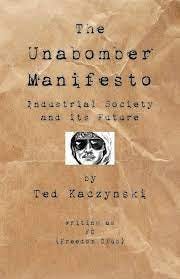
In 1995, Ted Kaczynski’s manifesto—Industrial Society and Its Future—landed with an unsettling thud in the pages of The Washington Post and The New York Times. It was, in many ways, the inversion of Petty’s easy melancholy.
Where Free Fallin’ mourned the drift of American life in a pop song’s gentle lilt, Kaczynski’s text was an outright scream: that technology was hollowing out the human soul, that industrial modernity was an unbreakable cage, and that the freeway running through the yard wasn’t an accident—it was the system.
Most Americans dismissed him as a lunatic, which he undeniably was, but he was also a maths and computer genius, and his 58-page pamphlet had the uncanny effect of feeling truer and truer with each passing year.
If Petty and Crockett and Tubbs were elegiac figures, the Unabomber was the ghost who refused to leave. His diagnosis—that the machinery of American life was fundamentally anti-human—would echo through the decades, eventually reshaping politics itself.
The Dream Unravels
By the time Donald Trump descended his gold-plated escalator in 2015, the Petty–Vice–Kaczynski arc had already played out in the American subconscious. The promises of the American Dream—upward mobility, suburban stability, the righteousness of national power—had corroded.
The financial crisis of 2008 had made sure of that. So had the hollowing-out of American manufacturing, the opioid epidemic, and the endless wars in Iraq and Afghanistan.
The election of Donald Trump as US President wasn’t an aberration; it was a symptom. Or as social commentator Ben Shapiro likes to say, ‘Trump isn’t the murderer [of the American Dream] but the coroner.
Miami Vice was a mirror to Trump’s public persona—pure 1980s excess but stripped of moral resolution. Trump didn’t walk into the light; he doubled down on the shadow. His rise to the country’s top job was proof that the US was ready not for unity or renewal, but for spectacle and grievance.
Where Petty sang of falling, Trump turned the fall into a rally chant of ‘Fight, Fight, Fight.’
Towards Techno Monarchy
Looking forward, these metaphors are hard to miss. The America of Free Fallin’ was still built on a shared cultural soundtrack, a mass media consensus. By the 2020s, that consensus was gone. We live in algorithmic fiefdoms now, each citizen fed a private reality, each voter a data point to be nudged.
The freeway through the yard has become fibre-optic cable through the brain.
If the speculative historians of 2050 look back, they may pinpoint the post-2028 rise of President J.D. Vance as the formalisation of a new techno-world order: a semi-democratic, IT-tech-led autocracy. By then, the lines between political power and technological infrastructure will have blurred beyond recognition.
Social media companies—once platforms for communication—will be de facto ministries of information. Electoral campaigns will be as much about controlling the cloud as winning the vote.
Vance, with his tech-industry alliances and populist rhetoric, will present himself as the champion of the “real” America, even as the machinery of governance becomes indistinguishable from the apparatus of Silicon Valley.
Some form of dissent will still exist—there will be elections, after all—but the bandwidth for opposition will be throttled in ways most citizens barely perceive.
From Freeways to Fibre
In this light, Free Fallin’ and Miami Vice’s finale were not just cultural products; they were early warnings. Petty’s freeway was the physical embodiment of a system optimised for speed, mobility, and rootlessness. Crockett and Tubbs walking into the light was the visual metaphor for withdrawal from a fight that no longer had clear moral stakes. Both moments signalled the exhaustion of a national narrative in which America was the hero of its own story.
The Unabomber’s manifesto took that intuition and stripped it of romance, replacing it with a harsh, unsparing logic. The fall wasn’t just inevitable; it was designed.
So here we are: In a country where the public sphere has been largely privatised, where the dominant architecture is not the freeway but the platform, and where the promise of the Dream is replaced by the gamified hustle of the gig economy. The arc from Petty to Vance is, in its own way, perfectly linear. The empire didn’t collapse in a single event; it sublimated, pixel by pixel, into a different form.
Now it’s being rendered by AI, and soon this new ‘disruptive technology’ will disrupt us all.
The Long Walk Offstage
The last scene of Miami Vice remains one of the most quietly subversive moments on network television. There is no closure, no solved case, and no morality restored. Crockett and Tubbs simply decide not to play anymore.
In a way, they perform the inverse of the American Dream. The Dream says: Stay in the game, keep climbing, work the angles, win. They say, “We’re done.”
Petty’s song does something similar. “I’m free,” he sings, but the freedom is weightless, almost meaningless. Freedom from what? Towards what? It is not the freedom of self-determination but the freedom of falling, unmoored.
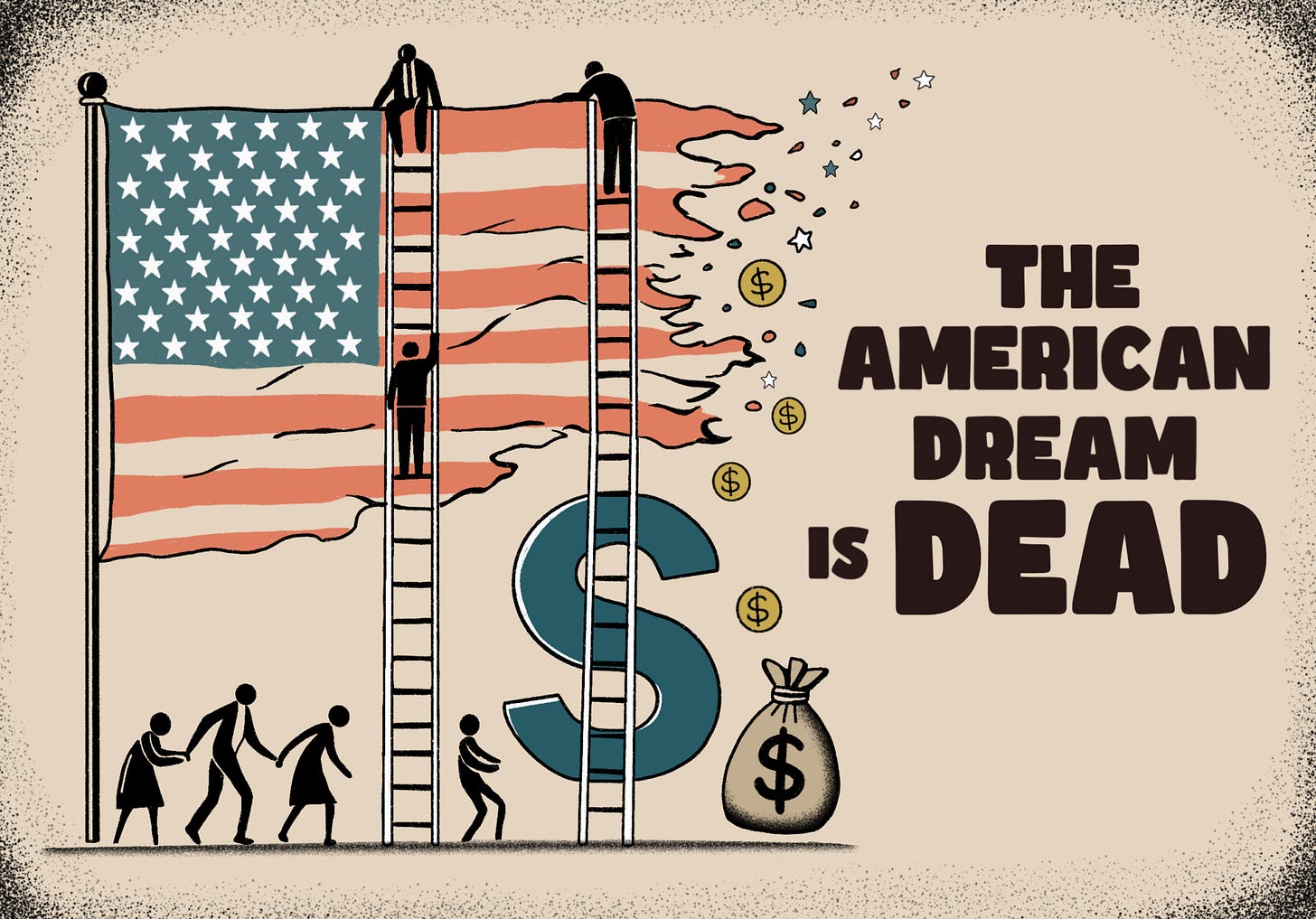
These two moments—one in a song, one in a dissolving frame of television—form a diptych of departure. They are the prelude to a country that will, over the next three decades, exchange the dream of expansion for the reality of contraction.
And yet, there’s a strange comfort in revisiting them now. Maybe because they remind us that the decline didn’t happen overnight. It was chronicled by small, seemingly insignificant gestures—a chord progression, a walk into the light—that told the truth long before the headlines did.