
An Iranian voice in exile
Featured Post
Iran is using Lebanon to win a war that isn’t Lebanon’s
Disarming Hezbollah and reasserting Lebanese sovereignty aren't obstacles to peace, but prerequisites for it. The Islamic Republic won't allow either
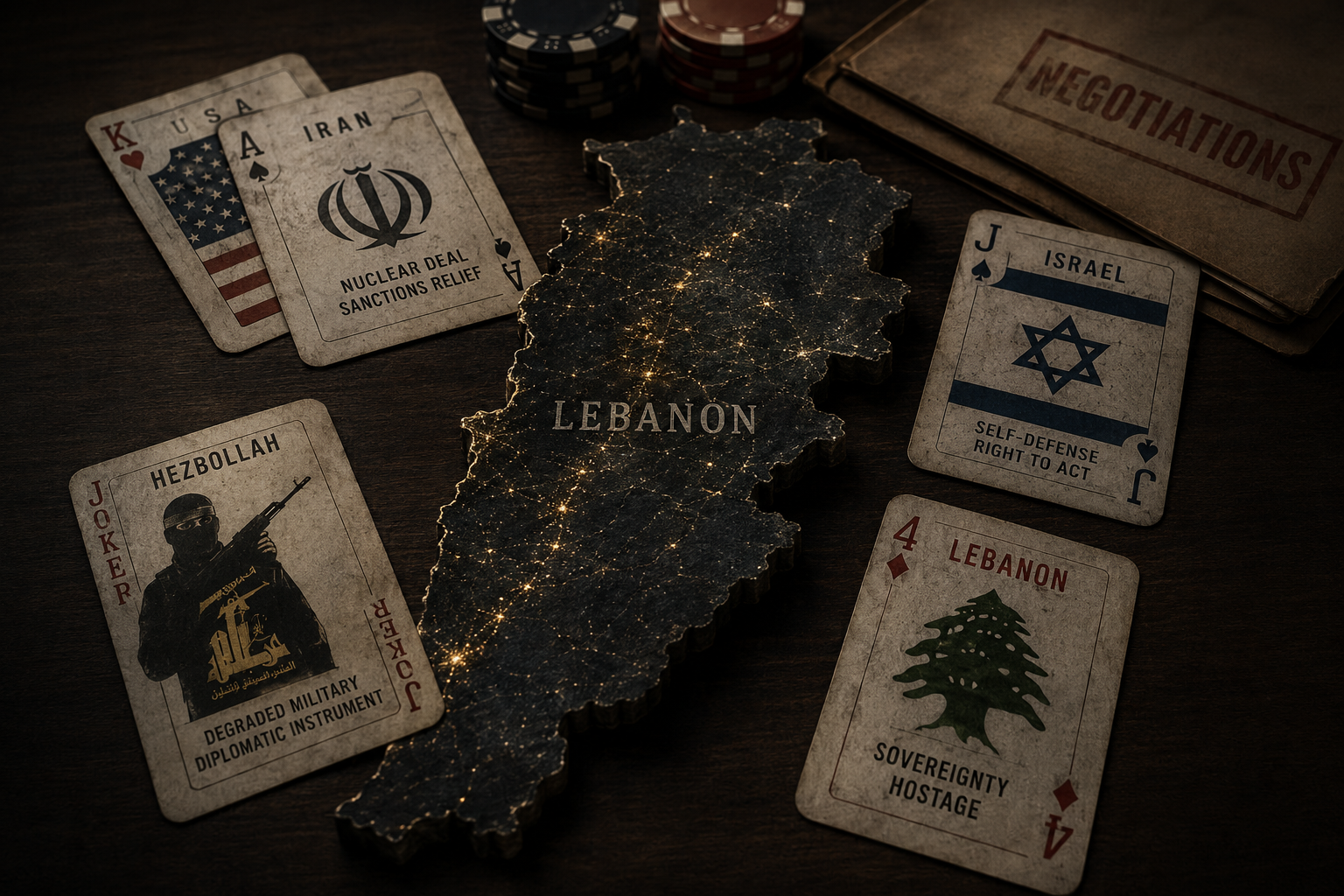
Lebanon holds the four of diamonds in a game it never agreed to play. (AI-generated illustration)
On June 5, 2026, the president of Lebanon said aloud what the structure of the negotiations had already made plain: Joseph Aoun accused the Islamic Republic of Iran of using his country as a bargaining chip in Tehran’s talks with the United States. The accusation was not rhetoric. It was an accurate description of a deliberate strategy — one that subordinates the sovereignty of a state to the survival of a proxy, and the survival of a proxy to the leverage of a regime.
This is how the Islamic Republic fights when its conventional options are exhausted: not by defending its own territory, but by converting other people’s countries into instruments of pressure.
The Demand That Does Not Belong
Iran made the cessation of Israeli operations against Hezbollah in Lebanon a precondition for its own nuclear agreement with Washington. The structure of that demand deserves scrutiny, because it is not logical. It is tactical.
Consider the parties. The negotiation is between Iran (first party) and the United States (second party). Its subject is Iran’s nuclear program and the reopening of the Strait of Hormuz in exchange for sanctions relief. Into this bilateral framework, Tehran inserted a condition concerning the conduct of Israel (third party) against Hezbollah on the soil of Lebanon (fourth party). By what logic does a nuclear agreement between Tehran and Washington require that Israel cease defending itself against an armed group in a different country entirely?
Israel’s confrontation with Hezbollah’s fighters on Lebanese soil is a matter between two states, Israel and Lebanon, and bears no rational connection to the questions actually on the negotiating table.
The Proxy as Diplomatic Instrument
What makes the maneuver transparent is the military reality behind it.
By the assessment of Israel’s Northern Command, Hezbollah has been severely degraded. The Israeli daily Maariv reported on May 29, citing a military source, that operations by Israeli forces in southern Lebanon had gravely weakened the group, that thousands of its operatives had been killed, and that its military infrastructure had been extensively destroyed. Hezbollah, once deemed the second pillar of Iranian deterrence alongside its missile arsenal, is no longer a functioning military force of the kind that it was.
And yet that same degraded group was reported to be pressing Tehran to fold the cessation of Israeli strikes against it into the regime’s negotiations with Washington. The significance is structural: Hezbollah’s value to Tehran is no longer primarily military. It is diplomatic. A proxy that can no longer fight effectively is being repurposed as a bargaining instrument — its protection traded at a table where Lebanon has no seat. The weapon was not laid down. It was converted.
Three Objectives, One Purpose
The weaponization of Lebanon serves three immediate objectives, each feeding a single strategic aim.
First, it allows Tehran to cast Israel as the obstructionist party in the Iran-US negotiations. By demanding that Israel halt operations it has every right to conduct, and framing Israeli refusal as the barrier to peace, the regime shifts the burden of the war’s continuation onto Jerusalem.
Second, it manufactures friction between Washington and Jerusalem. The United States seeks to conclude its agreement; Israel insists on its freedom of action against Hezbollah. By making the latter incompatible with the former, Tehran engineers a wedge between the two allies — a wedge it could never drive by force.
Third, it shifts the focus of the negotiation away from the nuclear file and onto the preservation of the proxy. Every hour spent arguing over Lebanon is an hour not spent on enrichment, stockpiles, and the unaccounted-for nuclear material that is the actual stake.
These three objectives converge on one purpose: to secure the upper hand in negotiation and to exert pressure on the international community. Lebanon is not the goal. Lebanon is the lever.
The Admission From Within
The clearest confirmation of the architecture comes from the proxy’s own leadership.
In a letter to Iranian parliament speaker Mohammad Bagher Ghalibaf, Hezbollah Secretary-General Naim Qassem thanked Tehran for having made “the obligation of Israel to halt military operations on all fronts, including Lebanon, the first clause and the basis of the agreement between Iran and America.” The statement is unambiguous: the insertion of Lebanon into the Iran-US talks was Tehran’s initiative, and Hezbollah understood it precisely as such — not as a defense of Lebanon, but as a clause secured by Iran to serve Iran’s negotiating position.
It is a rare moment of candor. The party being protected has confirmed, in writing, who arranged the protection and why.
The Humiliation of a State
Beneath the strategy lies an act of contempt for Lebanese sovereignty.
The government of Lebanon is itself negotiating directly with Israel. Its president has demanded a state monopoly on arms, telling Iran’s own security chief, Ali Larijani, to his face that Lebanon “rejects any interference in its internal affairs” and that “it is forbidden for anyone to bear arms and to use foreign backing as leverage.” The elected authorities of Lebanon have approved a phased plan to disarm Hezbollah and reclaim the state’s authority — a plan Israel has called a step toward Lebanese sovereignty.
It is Hezbollah — Tehran’s proxy — that rejected the ceasefire its own government accepted. And it is Tehran that insists on binding Lebanon’s fate to a nuclear file in which the Lebanese state has no part. The distinction matters: the Islamic Republic is not acting on behalf of Lebanon. It is acting against the expressed will of Lebanon’s government, overriding a sovereign state in order to preserve an instrument of its own regional projection.
This is the deeper offense. A regime that converts a neighboring country into a chip at its own negotiating table does not merely endanger that country. It denies it the right to govern itself.
The Strategic Conclusion
The case of Lebanon is not an anomaly in the Islamic Republic’s conduct. It is the model in miniature — the same logic the regime applies wherever it has embedded a proxy: the subordination of a host state’s sovereignty to the regime’s strategic needs, and the willingness to sacrifice that state’s stability to prolong its own survival.
As long as Lebanon remains hostage to Tehran’s proxy, neither Lebanese sovereignty nor regional security can be restored. The disarmament of Hezbollah and the reassertion of the Lebanese state are not obstacles to peace; they are its precondition. And the regime’s determination to prevent both — to keep Lebanon bound to its own bargaining position — is one more demonstration that the Islamic Republic’s operational structure cannot be accommodated. It can only be dismantled.
Tehran has told the world, through its own officials, exactly how it fights: with other nations’ territory, other peoples’ lives, and the sovereignty of states it treats as expendable. The international community should take the regime at its word — and recognize that a power which holds a fourth country hostage to win a bilateral negotiation is not a power with which a durable agreement can be reached.
Related Topics
Related Posts