
London based entrepreneur, cybersecurity analyst doing a PhD in AI
How to spot Deepfakes and protect your identity
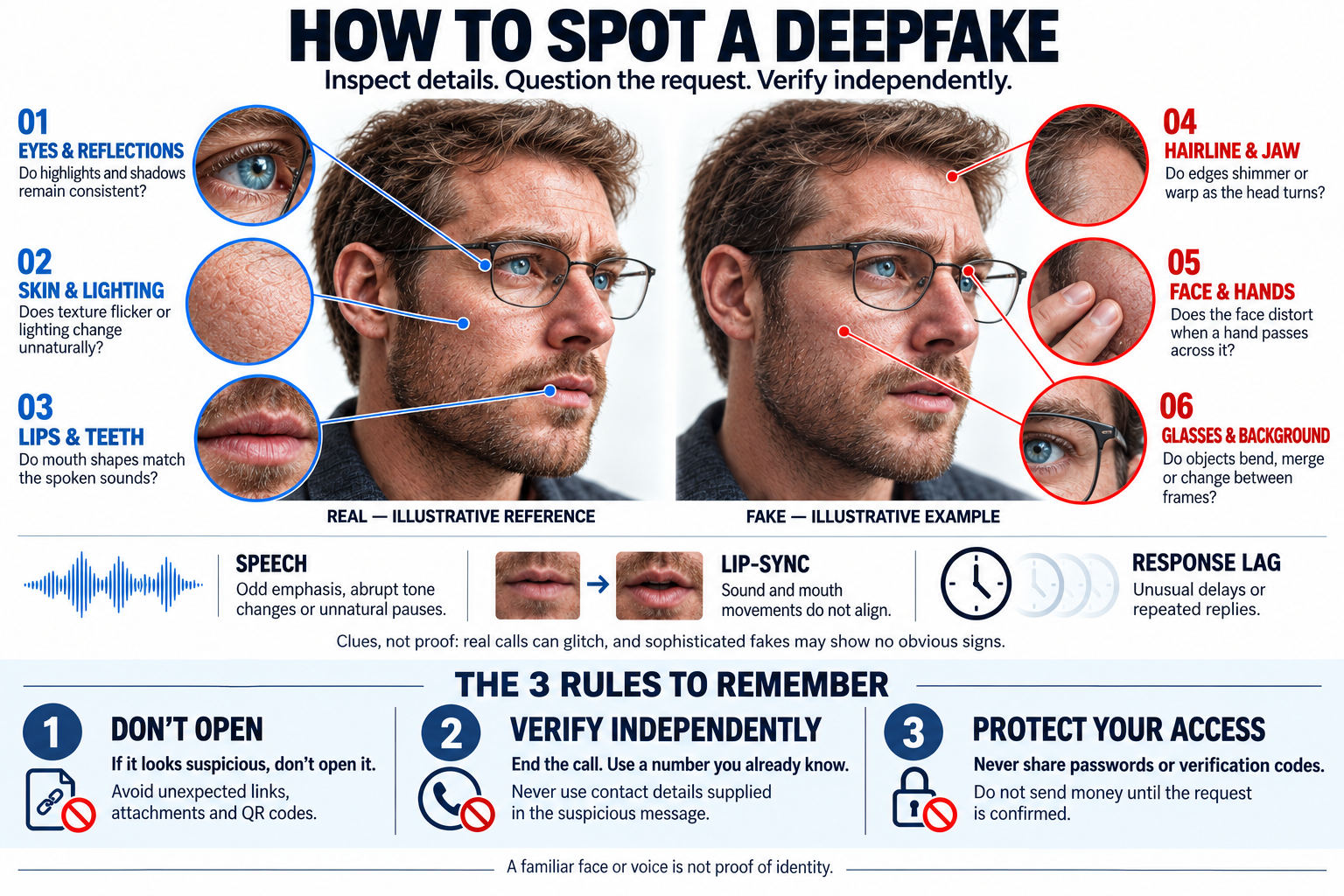
The biggest red flag is financial demand and urgency. One of the two happens and your gut feeling is wrong, hang up. (AI)
How to Spot a Deepfake—and Protect Your Identity in the Age of AI
The telltale signs matter. But the strongest defence is knowing how to verify what your eyes and ears cannot.
In February 2024, the London-headquartered engineering firm Arup lost $25 million after an employee authorized a massive wire transfer. The employee was convinced by a live video call featuring the company’s chief financial officer and several colleagues. Every face and voice on that call—except the victim’s—was an AI-generated deepfake. The trap is always the same: attackers weaponise recognition to gain your permission.
How Deepfakes Work: Fraudsters scrape months of publicly available YouTube videos, podcasts, and social media clips to train generative AI models. These tools map a synthetic face and voice over a live actor in real-time, matching lip movements and tone to create highly convincing digital clones. The AI does not just mimic the person; it allows the attacker to interact dynamically with the victim on a live call.
The Lure: Attackers rely on context and panic to bypass your critical thinking. On X (formerly Twitter), bots monitor user complaints in real-time. Within minutes of a user tweeting about a frozen cryptocurrency wallet, a fake “Support Desk”—often armed with a purchased verified blue checkmark—replies and directs the target to a phishing link or malicious smart contract. In corporate or family scams, attackers manufacture a crisis: a distressed child needing bail money, or an executive demanding a confidential, time-sensitive offshore transfer.
Clear Red Flags
-
Artificial Urgency: The ultimate warning sign is a demand for immediate action. Scammers enforce secrecy, insist you stay on the line, or claim a crypto giveaway is strictly “time-limited”.
-
Visual Glitches: Look for unsynchronised blinking, artefacts around the ears and glasses, or a jawline that shifts when a hand passes across the face. Deepfake algorithms struggle with sharp head rotations and lighting consistency between the face and the background.
-
Audio Inconsistencies: Watch for unnatural lip sync—especially on bilabial consonants like ‘P’, ‘B’, and ‘M’—along with flat intonation or abrupt changes in audio quality.
Your Security Playbook
The biggest takeaway of this article is PAUSE before you act. There is NO RUSH. No Business meeting or deal is “lost” in 2 hours by serious clients, and no “internal email” is that urgent.
-
Break the Connection: If you receive an unexpected request involving money, passwords, or screen access, hang up.
-
Verify Independently: Contact the organization or individual through a known, trusted channel. If a “colleague” requests a payment change, confirm it using your internal corporate directory, not the callback number they just provided.
-
Establish Safe Words: Agree on a private verification phrase with family members. Keep it off social media and out of exposed group chats.
-
Enforce Corporate Procedure: Mandate secondary authorisation workflows for all new payees or altered bank details. A manager’s face on a screen should never be sufficient authority to move funds.

Final Note for safety:-
Even if you made a mistake, your company will appreciate you being cautious rather than laissez-faire. No company meeting or call is so important that 2 hours will move the needle. Nothing in business is “that urgent”. Companies usually have established protocols and nobody would circumvent it. If someone appears to be, you can very safely neglect it.
{Forward this article to your family and friends to keep everyone safe}.
–
Sources
- Federal Trade Commission, Scammers use AI to enhance their family emergency schemes.
- FBI, Senior U.S. Officials Continue To Be Impersonated in Malicious Messaging Campaign.
- Datta, Jia and Lyu, Exposing Lip-syncing Deepfakes from Mouth Inconsistencies.
- Federal Communications Commission, Consumer Alert: Family Emergency Scams.
- NIST, Reducing Risks Posed by Synthetic Content (NIST AI 100-4).
- C2PA, Frequently Asked Questions and Content Credentials Explainer.
- eSafety Commissioner, Sharing school photos and videos in the age of AI.
- CISA, Implementing Phishing-Resistant MFA.
- StopNCII.org, Frequently Asked Questions.
- NCMEC, Take It Down: Frequently Asked Questions.
- eSafety Commissioner, Report image-based abuse.
- CFO Dive, Scammers siphon $25M from engineering firm Arup via AI deepfake ‘CFO’.
- Scam First Aid, Fake Crypto Customer Support Scams.
Related Topics
Related Posts