
Carrie Bradshaw of the Middle East
How to Vet Dates and Politicians
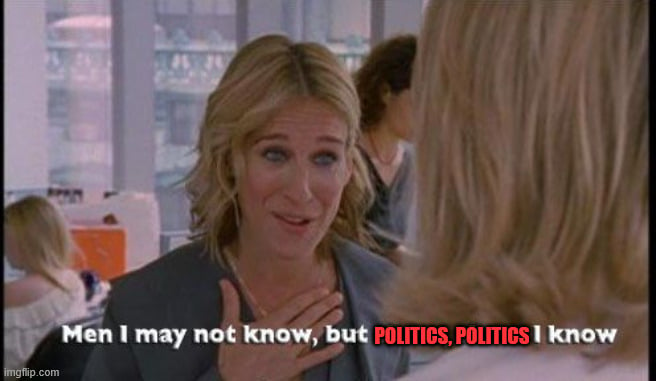
Adapted meme based on a scene from Sex and the City (HBO), included here for cultural commentary.
My friend was going through a break-up. We sat on the grass outside her home as I tried to convince her to hate her ex. I had been seeing New Guy. It’s hard to tell a friend to hate their ex while you’re seeing someone new.
I go on dates pretty often, if you couldn’t tell by the theme of my writing. More often than most of my friends. After one article in particular, one of my closest friends said to me, “I’ve got to hand it to you. You just keep going.” The jury’s still out on whether that was a compliment or a sign of concern. I think I’ve gotten good, after fumbles, married men, and general pendejos, of filtering men out. A kinder way to say that might be that I’ve gotten more discerning about what is and isn’t good for me— and thank goodness I have. My therapist tried her damnedest.
It hasn’t exactly been smooth sailing, and unlike every rom-com ever, I’m not blind to the amount of work it takes to sustain a relationship once you’re already in one. It’s funny how movies portray that decision, committing to one another, as an ending. “And they lived happily ever after”, seems to apply to elections, too. Why wouldn’t it? A politician wanting to honestly put in the work post-election is every voter’s dream.
It’s the work that’s the real issue. How do you choose a partner, choose a candidate, you can grow with? With three of my countries—the US, Israel, and Colombia—facing not-fun elections this year, I can’t help but wonder: What would happen if we chose our candidates how we should choose our partners? To help us set our standards, in dating and at the polls, I’ve narrowed down five things to filter out the fuckbois and the populists:
1. Get their full name before you meet up.
I learned this first, holy grail of rules, the hard way, when I was accidentally plunged into a situationship with Married Guy, who you can read about here. When you meet someone the old fashioned way, you know, in person, it’s harder for them to lie to you (though sometimes they do). I usually volunteer my full name and hope they don’t Google me too heavily or read my column before our first date. If a guy isn’t willing to share that he’s a real person, he’s not for you, and the same goes for politicians hoping to win your vote. A politician’s proposals should be accessible and easy to comprehend. They should also be realistic. Paying rent sucks, but no one can make rent free. The politician that promises to lower you rent might not know how to do that, but the politician that lays out a new economic model and proposes laws to protect tenants probably knows what they’re talking about.
2. Let them order.
—Or at least give them the space to. It’s more about how they lead. Do they usher you into the restaurant, speak to the servers, make decisions and take you into account? I can tell five minutes into a date if a guy is going to bring me in, or if I’m going to have to lead until I finish my beer. The worst date I ever went on was with a guy who didn’t get the door, didn’t make a reservation, and didn’t know how to ask the overwhelmed hostess for a table for two. I asked her to seat us at the bar and listened to him complain about the prices at the restaurant he picked, and how he had lost the shoes he wanted to get married in on his last flight. I asked the bartender for the check in Spanish and begged him to hurry. Leadership isn’t really about making decisions. It’s about inviting other people into them. Anyone who wants your vote should live up to that, too. I don’t want to vote for someone just because they point out how creepy the guy across from us is. I want them to invite me in. A good leader empowers. A bad leader fearmongers.
3. Be honest about what you’re looking for.
For years, I played the cool girl. Maybe it was genuine. The label scared me. I’ve always loved love, but I hated attaching to a person. And of course, you can’t always control attachment. Three months into seeing someone, I’d suddenly open my eyes and realize I had landed myself in another situationship. One time, I dated a Harvard Guy for four months, met his sister, and talked about visiting him in Seattle once he moved for his new job, before I realized my summer fling was becoming my long-term, long-distance, low-commitment, casual boyfriend. I was not a smart twenty-something year old. Now I ask a guy on the first date what he’s looking for and let him know what I want. There’s nothing wrong with telling someone what you want. I don’t know why it can feel so scary. In politics, we’re pressured to vote for whomever our designated party supports. This kind of mental economy, of putting someone else in the driver’s seat, isn’t “cool” behavior. Really, it gives off the same energy as an arranged marriage.
4. Get in the car with them.
It is my personal belief that how a man drives is how he is in every aspect of his life. A few years ago, I was strung along for the better part of a year by a man who lied about his age and his job. He hadn’t even been someone I met on the apps. He was a Political Guy I had a bunch of mutual friends with. When a wiser, older woman told me he had a temper, I figured it was time to conduct my own research. I orchestrated a Damsel in Distress situation and got a ride from him. It took ten minutes in his mid-life crisis sports car to discern that this man, did, in fact, have a temper. He also ran stop signs and didn’t wait for me to go inside before driving off. It pains me to say it would be another couple of months after that before I truly came to my senses. So, watch your candidates debate. Not just the perfectly edited for social media clips of the debate. Watch how they respond to questions, accusations, and interruptions from other candidates.
5. Ask them what their ideal relationship looks like.
This is my signature second date question. You want someone whose values align with yours. Nothing is set in stone, but you should know what your team rules are. I didn’t fully understand that that’s what I wanted to know when I asked that question. I had mostly gotten vague responses, followed by the nervous, “What about you?” Men have always been impressed, and sometimes stunned to hear my response, because after all the men I’ve shrunk for, I know I need someone who wants a big life. I asked New Guy that same question on our second date over my Mezcal Negroni, which he told the bartender he thought I would like. My jaw dropped open as, for the first time in my dating history, I heard my own ideal relationship question answered with my words, “Partnership. Challenge. Support.” Had that been the reason I started asking that question?
It’s not just that those words sound nice together. It’s that they imply that declaring yourselves in a relationship isn’t a goal you’re achieving, but a journey you want to go on together. In relationships, we’re ideally looking for the best person to go on that journey with. Maybe that’s how we should approach politics, too. Your elected officials won’t—and shouldn’t—put their arm around you in a dimly lit restaurant as they push your hair behind your ear, but they should be someone you can work with. Sometimes that means choosing the candidate you know you can hold accountable or even oppose more easily. That doesn’t mean you’re settling. It means you’re being strategic with your vote.
There’s a lot more I could say about New Guy, but I think I’m going to let him write this story. In the meantime, I’ll be enjoying Mezcal Negronis and losing count of how many dates we’ve been on.
Related Topics